A NOTE FROM THE STEWARD
Confused about firewood amounts?
By Daniel Moss · Moss & Sons
You ought to be able to buy firewood without having to become an expert first. But one seller offers a “load,” another offers a “face cord,” and the prices can be far apart. A picture may look generous while telling you very little about the actual amount.
My advice is to slow down and ask a few plain questions. What measured quantity am I getting? Will the pieces fit? Is the wood sound and dry enough for my use? What work is included in the price? A fair purchase starts with an understood agreement.
Plan your storage and rack size · DIY rack bracket system
Start with a measure you can check.
A full cord is 128 cubic feet when the pieces are parallel, touching and compactly stacked. That includes normal spaces between the wood; it does not mean 128 cubic feet of solid timber. One familiar arrangement is 8 feet long, 4 feet high and 4 feet deep.
Georgia’s firewood rule requires bulk fuel wood to be advertised and sold by cords, fractions of a cord, or cubic meters. It prohibits “face cord,” “rack,” “pile,” “truckload” and similar terms as sales measurements. Packaged wood has separate quantity rules. This is a Georgia rule, not a claim that every state has identical requirements. Read Rule 40-15-4-.02(3).
That gives buyers and sellers a common measure. Ask for the cord quantity in writing, rather than relying on a vehicle size or local nickname.
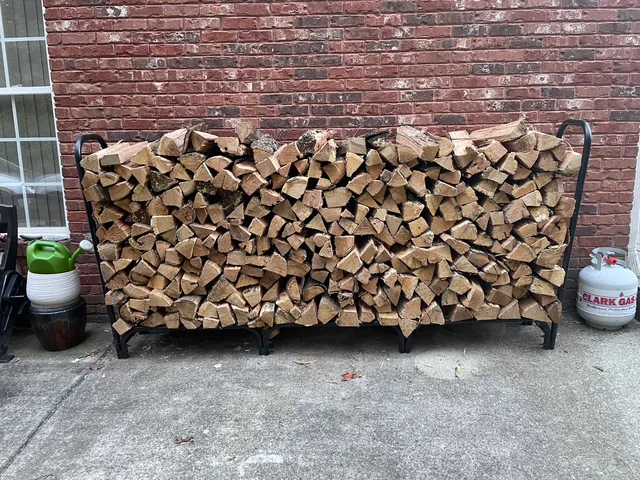
Compare quantities with this photo
| Quantity | Compared with photo |
|---|---|
| ⅙ cord | Half |
| ⅓ cord | Same amount |
| ½ cord | 1½ times |
| ⅔ cord | Twice |
| 1 cord | 3 times |
| 1½ cords | 4½ times |
| 2 cords | 6 times |
| 3 cords | 9 times |
A full cord is 128 cubic feet of compactly stacked wood, including the normal spaces between pieces. Different stack shapes can hold the same quantity. Measure length × height × actual wood depth in feet, then divide by 128.
Shorter logs can mean less wood.
An 8-foot-long, 4-foot-high stack with 16-inch pieces holds ⅓ cord. Keep that same front face but use 12-inch pieces, and it holds only ¼ cord—25% less volume. The depth matters just as much as the height and length.
Short pieces can be useful in a small stove. Mixed lengths are not automatically a bad purchase either. What matters is that the quantity accounts for the actual wood, and that the pieces suit your appliance. Don’t measure to the longest protruding log and assume every piece reaches that far. Ask about typical length, the longest pieces, split size and how irregular lengths are measured.
Seasoned and rotten are different things.
A weathered surface does not tell the whole story. Look at several pieces, including fresh split faces. Ask about soft, spongy or crumbling pieces rather than accepting them as ordinary seasoning. If a delivery includes substantial decay, discuss it before accepting it. EPA’s wood-burning guidance advises against burning rotted or moldy wood.
Dryness is another question. “Seasoned” describes a process, but a moisture meter helps you check the result. EPA recommends wood below 20% moisture for best burning. Use a meter intended for wood and test the newly split interior of several pieces, following its instructions, rather than just the dry-looking outside. This is a buyer’s check, not a claim that every piece we sell has been individually tested.
Set up dry storage before the wood arrives.
Before your West Georgia firewood delivery, choose a firm, level storage spot with room for air around the stack and a manageable walk to the house.
Keep the wood outdoors, raised off the ground, with the top covered and the sides open for drying. Use a sound rack you already own if it fits the load.
Measure the usable stack, not the rack’s product name.
A 4-foot firewood rack with cover may suit a smaller supply. For a longer row, an 8-foot firewood rack with cover (paid link) is one option to compare. Check actual usable dimensions, rated load, leg support and assembly instructions. Confirm that the selected listing includes the cover, and keep it from sealing damp wood inside.
For example, a compact stack measuring 8 feet long × 4 feet high × 16 inches deep is ⅓ cord. At the same height and depth, a 4-foot-long stack is ⅙ cord. Those are stack measurements, not a promise about the capacity of every rack sold under those names. Use the free cord-and-stack calculator for your space.
Build your own rack with a bracket system.
A rack bracket system lets you set the rack length with lumber bought locally. This steel kit includes two end frames and assembly hardware; you supply two 2×4 rails.
Price the complete setup before buying:
- Steel brackets and fasteners. Confirm what the kit includes and follow its assembly directions.
- Two sound 2×4 rails. Check the required lumber size and allowed configuration before cutting. Choose lumber and compatible fasteners suited to outdoor exposure.
- A firm, level base. Allow for any supports required by the instructions. An adjustable length is not an unlimited unsupported span; do not bridge a soft spot or hollow with loaded rails.
- A separate top cover. Keep rain off the upper splits while leaving the sides open to air. The bracket kit does not include a cover.
Add the kit, lumber, supports and cover before comparing the total with a covered steel rack. Reuse sound materials you already have when they meet the kit’s requirements. This kit’s end frames are about 43 inches high, so do not assume a full 4 feet of usable stack height. Follow the manufacturer’s limits and measure the finished stack.
If you’d like the rack assembled and the wood stacked in the same visit, Moss & Sons offers rack setup with firewood delivery. Tell us which rack you have in mind and where it will stand so we can agree on the work and total.
Make the walk to the house manageable.
A canvas log carrier (paid link) gathers a manageable armful for a short trip indoors. Its open ends can still shed bark, so carry it over a clear route and empty loose debris outdoors. Choose a loaded weight you can carry comfortably; make two trips when needed and bring in only the wood you need.
Storage guidance checked October 9, 2026. EPA’s archived Burn Wise guidance supports raised outdoor storage, top covering and airflow. Rack dimensions do not establish whether the wood is dry enough to burn.
Product references: ShelterLogic 90402 covered 8-foot rack; INNO STAGE canvas log carrier. The DIY example uses the ShelterLogic 90459 steel bracket kit; the similar 90460 kit uses plastic brackets. Use the current instructions supplied with the exact kit. These are researched examples, not a claim of hands-on testing by Moss & Sons.
Compare the whole agreement, not just the number.
A low price may be pickup-only, green wood, shorter pieces or a smaller measured quantity. A higher price may include drying, sorting, travel, unloading and careful stacking. Neither number proves the quality by itself.
First compare the same cord quantity, species or mix, condition and piece sizes. Then compare the total at your address, including delivery and placement. Dividing the wood price by the cord fraction helps compare quantity; keep service charges in view too. There is no universal bargain price that tells you all of this.
“What fraction of a cord will I receive, how long are the pieces, is it ready for my intended use, and what is my total with delivery and placement?”
Keep the written quote or delivery ticket. If something looks wrong, take photos and measure the stack, then give the seller a clear opportunity to address it. Georgia’s Department of Agriculture handles weights-and-measures questions.
At Moss & Sons, the brick-wall photo is our consistent ⅓-cord reference. Standard pieces are typically 16 inches long. If you’d like firewood delivered and stacked, tell me your storage space, your fireplace or cooker, and where the wood needs to go. We’ll agree on the quantity, service and total before scheduling. You should understand what you are buying before you decide.
Sources checked September 30, 2026: Georgia firewood method-of-sale rule; EPA wood-burning guidance; EPA moisture-meter instructions. EPA’s Burn Wise material is an archived resource. For measurement concerns, contact Georgia Department of Agriculture Weights and Measures.