HIRAM · EDUCATION & COMMUNITY
The school Hiram helped pay for
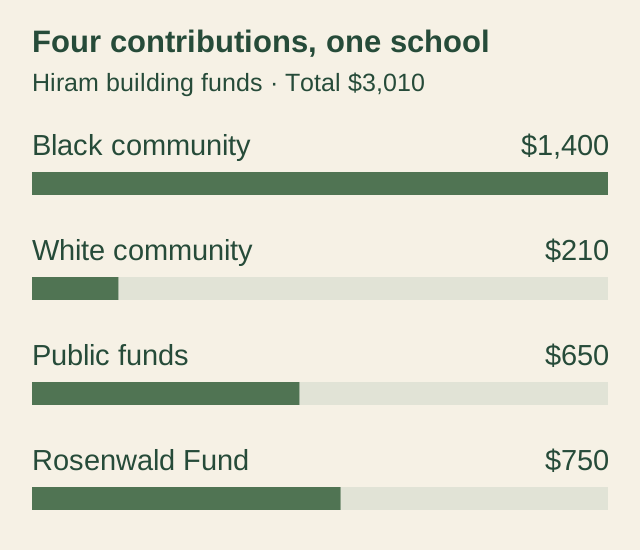
The Black community around Hiram made the largest contribution listed on the Rosenwald school’s surviving building-fund card. [1]
In Hiram, in Paulding County west of Atlanta, that distinction matters. This was a school for children growing up under segregation. Remembering how it came into being means remembering the neighbors who helped make it possible, alongside the organization whose name remains attached to it.
In this story
The people behind the amounts
The card, preserved by Fisk University, records a building cost of $3,010. Black residents contributed $1,400; white residents, $210; public funds supplied $650; and the Rosenwald Fund provided $750. Georgia’s contemporary education report records the same amounts and places Hiram among the school buildings completed during 1930. [1], [2]
The figures establish the size of the contributions. They do not tell us how each family raised its share, whose work went unrecorded, or what someone went without to give. Those are questions for family records and remembered accounts, not scenes we can fill in ourselves.
A school and a library
According to the National Register nomination, the school board approved the funding application on April 4, 1930. At its July 1 meeting, W.J. Arnold reported the building completed and accepted by the state. The nomination draws that account from earlier local records. [3]
The building had two classrooms and a library. A state preservation account names G.R. Newell and Eva I. Harper among its early teachers and describes instruction extending through ninth grade. [4]
The nomination records 80 pupils enrolled in 1937–38. It describes a 130-volume library in the late 1930s, then the only library in the county’s Black schools. By 1941–42, the other remaining Black schools had small libraries too. [3]
After the school years
Hiram’s school closed in 1955 as the county consolidated Black schooling into Matthews Consolidated School. Sweet Home Baptist Church acquired the property that year. The 2001 preservation account describes later uses including dances, movies, church services and community gatherings. [4]
That continued use is part of the story. A building made for children’s education kept providing a place for neighbors to meet.
Today, the Hiram Rosenwald School Museum preserves the school’s history and offers tours and community use. Its own account places preservation alongside teaching: helping another generation understand what this school meant. [5]
The funding card cannot introduce us to every family who helped. It can keep us from overlooking them. Their contribution belongs beside the school’s name whenever its story is told.
Visit the schoolhouse
732 Hiram Douglasville Highway, Hiram, Georgia.
The museum currently advertises a free tour on the first Saturday of each month, 11:30 a.m.–12:30 p.m., with other group visits by arrangement. Check the museum’s current tour information before traveling, or call (678) 250-5992.
Visitor information checked November 17, 2026. This is a museum visit, not permission to enter whenever the building is closed.
Sources and research notes
The original funding card and contemporary state table were visually checked in the November 17 research pass. The later nomination and preservation account are attributed; their underlying board minutes and deeds were not independently inspected. No interview or personal visit is implied.
- Fisk University, Hiram School fund card
Ga 3705, application 19-I, 1929–30 budget. Original card image inspected. The card’s racial categories are paraphrased above; its amounts are unchanged - Georgia Department of Education, Fifty-eighth and fifty-ninth annual reports
printed p. 32 (PDF p. 37), table of buildings completed during 1930. Original scan inspected. Although the volume’s title refers to the biennium ending June 1930, the table explicitly covers calendar 1930 - Hiram Colored School, National Register nomination
2001, particularly printed pp. 8–10. Later research citing school-board records; the underlying board minutes and deeds were not independently inspected. The library qualification follows its dated account - Jacinta Williams, “Saving Georgia’s Rosenwald Schools,” Reflections
August 2001, p. 5. A later institutional account. Its discussion of Hiram must be kept separate from nearby paragraphs about Noble Hill and other schools - Hiram Rosenwald School Museum, history
Museum history and visiting information (hiramrosenwaldschool.org/visit). Used for present-day mission and visiting arrangements. Broad claims about regional uniqueness and the Fund’s founding date are not repeated here
Read another local story
 One mountain, two railroad storiesMoss & Sons · Original explanatory illustration; evidence and sources in the article.
 The Library Came to ThemModern illustration by Moss & Sons; not an archival photograph.
What story should we tell next?
Is there a person, place or piece of local history you’d like to see on Moss & Sons? Perhaps your family has photographs, letters, an old business record—or a memory you’d like to share.
You don’t need to have the whole story. Tell us what you know, and we can start there. Daniel reviews contributions and confirms permission before anything is published.
Know someone who would enjoy this? Pass it along.