Bremen · Music and memory
The songs Hugh McGraw helped carry
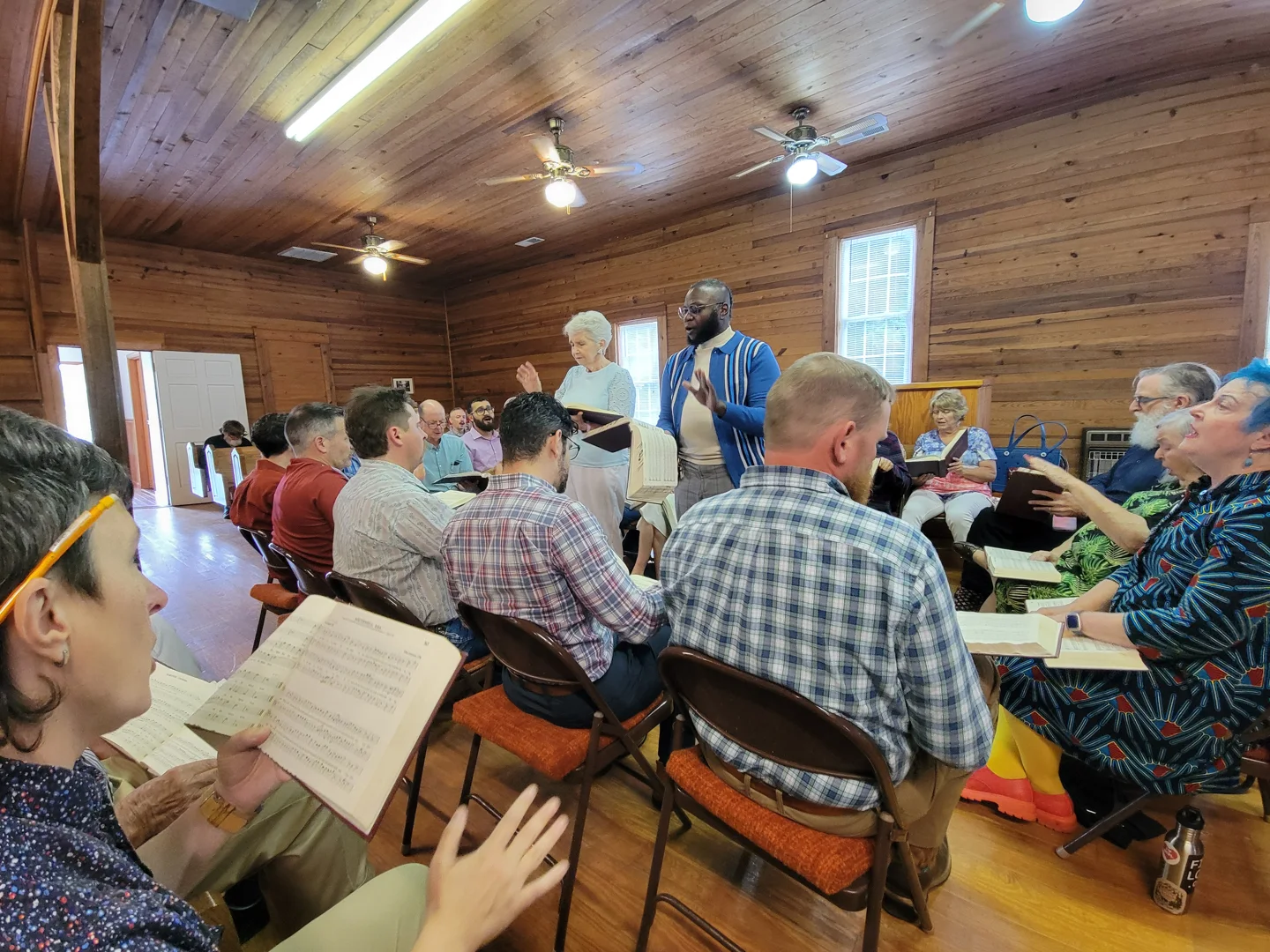
On June 1, 2017, singers gathered at Holly Springs Primitive Baptist Church in Bremen for Hugh McGraw’s funeral. They had come from several American states and the United Kingdom. The minutes record prayers, leaders and song numbers: a community remembering a man in the language he had spent his life helping it learn. [1]
In this story
A working life in Bremen
To understand why they came, begin with work. McGraw managed a Bremen clothing-manufacturing plant. His mother had been a seamstress at Sewell; his father worked for the railroad. Alongside his own employment, Hugh taught singing schools and served the Sacred Harp Publishing Company. His life belonged to the working world around Bremen and to a musical community that extended far beyond it. [2]
A book people learned together
The Sacred Harp, first published in 1844, uses differently shaped notes to help singers learn music. Its history runs through rural singing schools and gatherings where people returned to familiar tunes together. McGraw’s parents introduced him to that tradition. As a child, he preferred playing outside; as an adult, he became one of its energetic teachers and organizers. [2]
Let the singer explain it
McGraw left his own explanation of what he was trying to preserve. In a 1964 address to the Harpeth Valley singers in Tennessee, he told an audience that included scholars and clergy: “You have got to sing it to understand it.” The Sacred Harp Publishing Company published an excerpt in 2013. [6]
He was answering people who heard sameness in the music or treated it as a fading curiosity. His account was full of movement: singers traveling hundreds of miles, young people taking an interest, gatherings in ordinary community spaces. He offered estimates of the tradition’s size, not a formal census. What the talk establishes most clearly is his conviction that participation could give the music a future. [6]
That makes his teaching central to the story. A visitor could hear a performance and leave; a new singer could help sustain the next gathering.
There was practical labor behind that change: teaching people to begin, keeping a book available and bringing singers together. Smithsonian records preserve a July 9, 1976, Washington recording cataloged under the Hugh McGraw Sacred Harp Group. The Library of Congress’s own program lists him with singers from Georgia and Alabama on July 24, 1998. These are specific stops on a journey that carried a local practice onto national stages. [3] [4]
Yet taking a tradition farther also raises a question: how do you change a book without losing what people love about it?

The book that did not take his name
For the 1991 edition, McGraw chaired a committee of Georgia and Alabama singers. They selected music and worked toward a clearer, more usable volume. According to the Encyclopedia of Alabama, committee members proposed calling it the “McGraw Book.” He declined. The familiar Denson name remained in use. [5]
That account offers a fitting way into his story. The work required leadership, but its purpose extended beyond the leader. A songbook succeeds when someone else opens it, learns from it and passes the singing along.
McGraw received a National Heritage Fellowship in 1982. [2] The funeral minutes give us another measure of his reach: people traveling back to Bremen, taking their turns and singing together. [1] For those of us looking closely at this region, his life adds something to the factory buildings and railroad tracks. It asks us to listen for what the people who worked here carried with them.
Sources and further reading
Research notes
The 1964 talk is a published excerpt of McGraw’s own address; his estimates of singing attendance and book sales are not audited counts. The NEA biography’s stated age and year of his adult return to singing conflict, so no exact age is given here. The declined book-name anecdote is attributed to the encyclopedia. Emory’s Raymond Hamrick finding aid identifies Hugh McGraw correspondence, 1965–1999, in MSS 323, box 3, folders 9–13; the letters themselves have not been examined. The Smithsonian recording catalog was consulted, but the audio was not reviewed.
- 2017 Sacred Harp minutes, printed pp. 169–170
Contemporaneous community record of the June 1 funeral; text examined. - National Endowment for the Arts: Hugh McGraw
Family, employment, teaching, notation and fellowship. The stated age and year of his adult return to singing conflict. - Smithsonian recording FP-1976-7RR-0323
July 9, 1976; catalog and permission terms examined. - Library of Congress: 1998 exhibition concert series
Official July 24 program listing. SING LOUD’s retrospective provides a video lead and an edited introduction; video not reviewed in this pass. - Robert and Nancy DuPree: Denson Edition of The Sacred Harp
Editorial process and account of the declined name; secondary scholarship. - Hugh McGraw’s 1964 Harpeth Valley address
Excerpt published December 31, 2013. First-person statement, retrospectively edited; its population and sales estimates are not independently verified totals. - Pitts Theology Library: Raymond Hamrick papers, MSS 323
Finding aid, particularly box 3, folders 9–13. Access and reproduction are distinct; no letters obtained or quoted.
Read another local story
- Bremen hiding in plain sight
- The Songs and Words of Mattie Timmons
- Bud, Jackie and the possum that became a star
Share a photo, memory or landmark
Daniel reviews contributions before anything appears publicly.
Know someone who would enjoy this? Pass it along.