Anniston · A collection’s long journey
The birds that found a home in Anniston
When Anniston opened a new museum building at its Carnegie Library in August 1930, the birds had already outlived their maker. William H. Werner’s mounted collection had traveled from the Atlantic City boardwalk to Pennsylvania and then Alabama. Keeping that work together took another collector, a succession of public audiences and a city willing to make room for it. [1] [2] [3]
In this story
Wonderland on the boardwalk
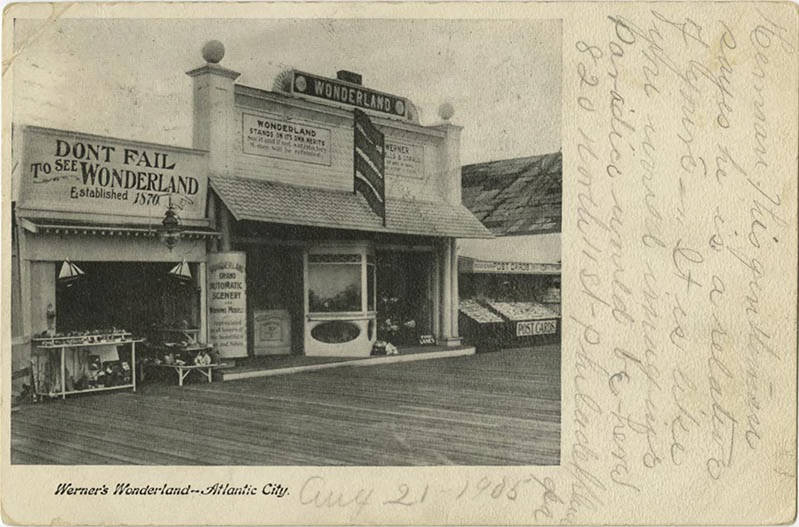
A postcard preserves an earlier setting: Werner’s Wonderland in Atlantic City, with wooden boardwalk planks in front and a small postcard stand beside the entrance. A sign urges passersby to come inside. The natural-history collection belonged to the same seaside world as shops and souvenirs. [4]
Werner’s work also reached well beyond that storefront. The New Jersey State Museum’s report for 1911, published in 1912, lists him as its taxidermist. A memorial records his earlier work preparing exhibits for Lehigh University and his arrangement of birds and mammals for the state museum and major expositions. [3]
The memorial calls Wonderland’s collection his life’s work. It also describes specimens being hunted, killed and prepared: these were preserved animals collected under the practices of that period. Their lifelike appearance was the result of observation and skilled mounting. [3]

The problem of the glass
A likely glimpse of that working life survives among letters to ornithologist William Brewster at Harvard. On December 14, 1890, a correspondent cataloged as W. H. Werner wrote from Jacksonville, Florida. He had seen oval glass used in frames containing birds and wanted help finding its maker. [5]
Could Brewster help him obtain a price list and catalog? He also wanted round glass shaped like a watch crystal, eighteen to twenty-four inches across. The request brings the work down to a practical detail: a bird display needed the right enclosure. Earlier letters describing university work in South Bethlehem help connect this correspondent with the museum taxidermist, although the catalog itself gives only his initials. [5] [3]
A museum for living birdwatchers
After Werner’s death in 1912, H. Severn Regar acquired the collection and continued adding to it. His museum in Norristown, Pennsylvania, gave the preserved birds another public life. [2] [6]
In 1923, the Norristown Audubon Club’s secretary, Isabella Walker, reported that its quarterly meetings took place at the Regar Museum. Members heard lectures and watched motion pictures about birds and natural history, with subjects reaching from Florida’s Gulf Coast to Nicaragua. Walker reported full audiences. [7]
The club also kept a chart recording birds seen locally and the timing of migration. Here was a particularly useful meeting of interests: people gathered around a collection of preserved birds while learning to notice and protect living ones outside. The museum was a place to meet, compare observations and keep looking. [7]
Anniston made room
Regar later moved to Alabama and gave the collection to Anniston. The museum’s institutional history credits local citizens with raising money to transport and house it. A small contemporary construction notice supplies something more definite about the new home. [2] [6] [1]
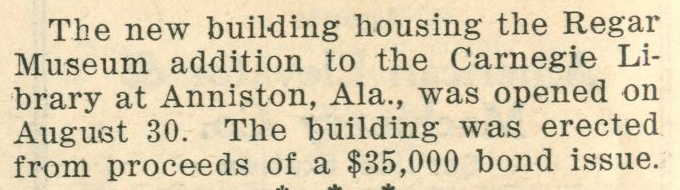
The September 25, 1930 Dixie Manufacturer reported that the building housing the Regar Museum addition to the Carnegie Library had opened on August 30. It said the building was erected with proceeds from a $35,000 bond issue. That sum paid toward a place to keep and show the collection; it was not a stated purchase price for the birds. [1]
A later letter preserves Regar’s view of the move. In excerpts published by the Historical Society of Montgomery County, he regretted Norristown’s loss of collections but expressed pride in the institution bearing his name in Anniston. His disappointment about securing a lasting home belongs alongside Walker’s earlier report of an active bird club. There had been people who cared in Pennsylvania, too. [6] [7]
A collection outlives its buildings
The Carnegie Library was not the last stop. The collection later occupied the Calhoun County War Memorial building, and the new Anniston Museum of Natural History opened in 1976. African mammal mounts donated by John B. Lagarde helped widen its scope. [2]
The birds’ journey makes the museum’s history larger than a single gift. Werner prepared specimens; Regar kept and expanded the collection; a bird club used it as a meeting place; Anniston supplied a new home. The surviving postcard, club report and construction notice let us follow that shared work—one display, one gathering and one building at a time. [1] [2] [3] [4] [7]
Explore the original records
Open these records at the archive or family website for a closer look.
- Read the December 1890 glass inquiry
The original handwritten page asks for display-glass suppliers. It records a request, not a completed purchase.
- Read the bird club’s 1923 report
Printed page 482, PDF page 510. The Norristown report begins below the Utah account.
Sources and further reading
Research notes
The postcard’s sign advertises “Established 1870”; that does not establish the start of Werner’s ownership, and no exact Wonderland founding year is asserted. Regar’s precise purchase year differs among later accounts. The manuscript identification rests on converging evidence, not initials alone; its glass request cannot be matched to a surviving Anniston case. The 1943 letter is known here through the historical society’s published excerpts. City/library minutes, the original transfer inventory and bond accounts remain unexamined. The contemporary notice supports August 30 rather than a later account’s August 31. No claim is made that Bud and Jackie Jones restored Werner’s particular birds.
- The Dixie Manufacturer, September 25, 1930, printed page 22
Birmingham Public Library, item DM-1930-09-25-p-022. Original full-page image inspected. Reports an August 30 opening and construction from a $35,000 bond issue; no city bond ledger or itemized final account inspected. - Anniston Museums and Gardens: institutional history
The museum’s account connects Werner, Regar, the citizens’ fundraising, later buildings and the 1976 opening. Used for the broad institutional sequence, not as an inspected transfer inventory. - New Jersey State Museum: report for 1911, published 1912, pages 5 and 24–25
Original title page, staff list and memorial inspected. Silas R. Morse’s memorial identifies William H. Werner, Wonderland, Lehigh exhibit work and his state-museum role. Its praise and valuation are not independent appraisals. - Newberry Library: Werner’s Wonderland postcard, NBY 421824
John I. Monroe Collection, Curt Teich Postcard Archives; production JM66, catalog decade 1900–1909. Front inspected. The handwritten date does not establish when the photograph was made. - Harvard Ernst Mayr Library: W. H. Werner letters to William Brewster
Original September 22, 1885 and December 14, 1890 manuscript images inspected. The glass inquiry is BHL pages 62150472–62150473. Identification with the Wonderland taxidermist is an inference from the name, bird work and South Bethlehem university/Lamberton references, supported by the New Jersey memorial’s Lehigh connection. No purchase or surviving-case match established. - Historical Society of Montgomery County: Norristown’s Lost Museum
Institutional article, February 12, 2015. Describes the Norristown museum and quotes a 1943 Regar letter to S. Cameron Corson. The complete original letter was not inspected. Conflicting purchase-year accounts and the article’s erroneous whooping-crane extinction claim are not adopted. - Bird-Lore, volume 25 (1923), printed page 482
Original page inspected. Isabella Walker, secretary, reports for the Audubon Club of Norristown: quarterly meetings, lectures, films and a local bird/migration chart. Attendance is the club’s own report.
Read another local story
- Bud, Jackie and the possum that became a star
- One Meteorite Fall, Two Family Stories
 The Library Came to ThemModern illustration by Moss & Sons; not an archival photograph.
Share a photo, memory or landmark
Daniel reviews contributions before anything appears publicly.
Know someone who would enjoy this? Pass it along.