Sylacauga, Alabama · Two family stories
One Meteorite Fall, Two Family Stories
One fragment entered a living room. Another was found on a road. Both belonged to the meteorite that fell near Sylacauga, Alabama, on November 30, 1954. [1] Following the two pieces brings us into two households—and beyond the familiar story of a rock falling from the sky.
In this story
An afternoon near Sylacauga
Ann Hodges was resting on a couch when a fragment broke through the roof, struck a large radio and hit her. The event drew officials, reporters and spectators. A strange afternoon became a public story that she could not easily set aside. [2]
The rock in the road
Nearby farmer Julius Kempis McKinney found the other piece. Smithsonian’s account describes him driving a mule-drawn wagon when the animals balked at a dark rock. He moved it out of the way. After hearing what had happened to Hodges, he returned for it. [3]
The account says his children played with the stone and that he sought help through his postal carrier to arrange a sale. Later reports credited the proceeds with helping him obtain a home and a car; another history describes a farm and used car. The exact purchase details still need the underlying records. What the accounts agree on is the practical value the find brought his family. [3] [2]
The collector between the farm and the museum
The second fragment eventually reached the Smithsonian through a collector. HISTORY This Week identifies Stuart Perry as McKinney’s buyer and places the museum transfer in May 1955. The Smithsonian’s 1955 annual report lists a 1,682-gram Sylacauga stone among meteorites donated by S. H. Perry. [6] [7]
These records support a sale to a collector followed by a museum donation, rather than the often-repeated shorthand that McKinney sold directly to the Smithsonian. The annual report establishes the donor, but does not supply McKinney’s sale price. The original bill of sale is still needed to settle that part of the story.
A photograph preserved by the Encyclopedia of Alabama shows McKinney with his family and the fragment. [4] It gives the second half of the story a face. A discovery remembered through headlines was also something a family held, discussed and eventually let go.

What Ann chose to give
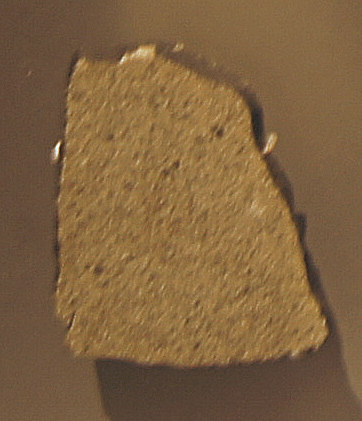
Hodges’s experience took a different course. Ownership was disputed because she and her husband rented the house. Accounts describe litigation and buying offers that did not lead to a profitable sale. Her fragment eventually went to the Alabama Museum of Natural History. [2]
But stopping there leaves out an important part of her decision. In a University of Alabama account, collections manager Brooke Bogan reports that transaction records show reimbursement for debts caused by the strike, rather than a profit. Bogan also says the correspondence emphasizes Ann’s desire to give the meteorite for the benefit of Alabama’s people. [1]
Her decision deserves a place beside the famous accident. In the museum’s account, Ann was also someone choosing what this unusual object could mean for others. [1]
The museum’s specimen record keeps the event concrete: it identifies the Hodges living room near Sylacauga, the date and Ann as collector. [5]
These two families did not have the same experience. Reading their histories together makes room for both the burden of sudden attention and the usefulness of an unexpected find. The rock is remarkable. The people deserve equal care.
Explore the original records
Open these records at the archive or family website for a closer look.
- Julius McKinney and his family with their fragment
The Encyclopedia of Alabama identifies the family in this photograph. View it at the source; it is not reproduced here.
Sources and further reading
Research notes
McKinney’s wagon episode comes from Smithsonian’s later account. The sale price and the exact property purchased with its proceeds remain unresolved. The 1955 annual report’s indexed text names Perry as donor; the complete scan and printed page could not be checked. HISTORY’s transcript identifies Perry as buyer, citing Smithsonian records, but the underlying bill of sale and accession letters were not obtained. Ann’s gift is described through museum staff’s account of correspondence, not a direct reading of those letters. Sources differ on her age and the clock time. No claim is made that the meteorite alone caused her later health or marital troubles.
- University of Alabama, November 29, 2022: A Gift Like No Other
Interviews with museum staff, including the collections manager’s account of transaction records and correspondence. This review examined the article, not the underlying letters. - John C. Hall: Hodges Meteorite Strike
Historical overview and family outcomes; financial details differ from other accounts. - Alice George, Smithsonian, November 26, 2019
McKinney’s discovery and reported proceeds; later secondary narrative. - Encyclopedia of Alabama: McKinney Family
Photograph identification and caption; not a reproduction license. - Alabama Museum of Natural History: Geo:20
Primary collection catalog record. Lists meteorite/core and thin-section material, locality, collecting date and collector; it is not an acquisition-price record. - Smithsonian Institution: annual report for 1955
Indexed text lists S. H. Perry’s donation of a 1,682-gram Sylacauga stone. Full scan and printed page not verified; this is not a sale-price record. - HISTORY This Week, episode 404: A Meteorite Hits Ann Hodges
Transcript p. 13 names Stuart Perry as buyer and dates the museum transfer to May 1955, citing Smithsonian records. Secondary reporting; underlying accession correspondence not supplied.
Read another local story
- The songs Hugh McGraw helped carry
 Goldworth Farm: The Work Beyond the PorchErnest Everett Blevins, CC BY-SA 4.0. Converted to WebP; original framing and visible credit retained.
Share a photo, memory or landmark
Daniel reviews contributions before anything appears publicly.
Know someone who would enjoy this? Pass it along.