Tallapoosa · April 16, 1891
The morning President Harrison stopped in Tallapoosa
A presidential train, a town eager to show its progress, and a short speech about industry, children, citizenship, and law.
On April 16, 1891, a presidential train stopped in Tallapoosa. Steam whistles sounded, a local band played, and Mayor Head welcomed Benjamin Harrison. The next day's Savannah Morning News described a speech from the train's rear platform. For a brief stretch of that journey, a small West Georgia city stood directly in the national conversation. [1]
In this story
A welcome beside the tracks
The newspaper identified the route as the Georgia Pacific line from Atlanta toward Birmingham. It noticed American flags at stations along the way and singled out Tallapoosa's display. The town was associated with New England investment, which gave the visit another layer of meaning: northern money and southern industrial ambitions were already meeting there before the president arrived. [1]
The Haralson County Historical Society locates the stop at the south end of Head Avenue. A photograph on its history page shows the train, a tightly gathered crowd, and the Tallapoosa Hotel behind them. The society identifies Atlanta Street along the hotel and Alabama Street on the near side of the tracks. The hotel is gone, but the picture preserves the relationship between the railroad and the center of town. [2]
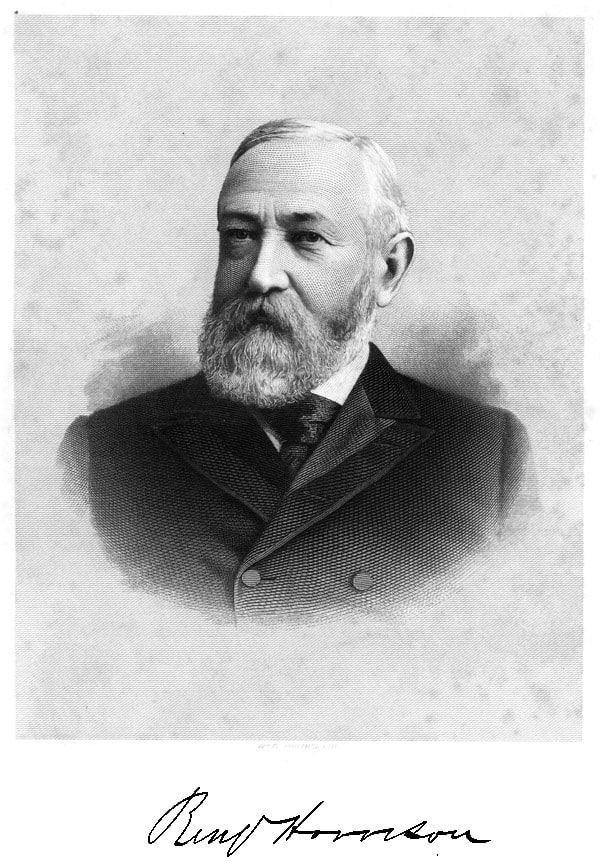
He spoke about work—and then the children
Charles Hedges's 1892 collection preserves Harrison's Tallapoosa address. The president praised the expanding industries and the work of taking ores from the earth and putting them to use. He connected employment with homes, families, and a stable community. Then he turned to something he considered still more important: educating the children who would inherit the responsibilities of citizenship. [3]
Harrison greeted the children and urged training of the mind, reverence for God, and kindness toward other people. The passage sits beside his praise of mills and mines. It shows that he was describing a community's development in terms broader than production alone. [3]
His closing question was brisk: “why not make it all yourselves?” He was urging a region long tied to plantation staples toward more varied manufacturing. Heard in a town attracting outside investment, that challenge connected a national argument about economic development with ambitions being pursued close to home. [3] [1]
A difficult subject beneath the welcome
The speech also addressed elections and obedience to law. Historian Edward O. Frantz examined the visit as part of Harrison's southern tour, arguing that its friendly receptions existed alongside an unresolved conflict over Black citizenship and voting rights. Harrison was trying to encourage national reconciliation while speaking, often indirectly, about constitutional rights. [4]
Frantz gives the Tallapoosa passage particular attention. Compared with an earlier speech in Knoxville, Harrison referred more explicitly here to the Constitution and elections. Yet, in Frantz's reading, his appeal to majority rule remained ambiguous: white audiences could hear a reassuring defense of their own local power where Harrison intended a national constitutional principle. [4]
Remembering this tension keeps the visit in its own time. A warm reception and a speech about shared citizenship did not mean that equal political rights had been secured. The celebration was real; the limits of reconciliation were real as well. [4]
What the surviving record lets us see
The photograph, newspaper, and printed address each contribute something different. The photograph helps place the gathering beside the hotel and tracks. The newspaper records the whistles, band, welcome, and speaking platform. The speech collection preserves the president's argument. Together they give this episode a stronger footing than an anecdote about a famous visitor. [1] [2] [3]
Local remembrance has continued, too. The historical society records a reenactment of the visit at Tallapoosa's 2007 Dogwood Fair. That later event belongs to the story of how a town keeps its history, while the 1891 photograph and contemporary accounts help us distinguish the original occasion from its retelling. [2]
The appeal of the stop is its scale. A national journey briefly passed through familiar streets, and the surviving sources let us recover what was said about work, education, and public duty. Tallapoosa was more than a dot along the route. For those few recorded pages, it was the place where those questions were being put to an audience. [1] [3]
The dates at a glance
- April 16, 1891Harrison travels from Atlanta toward Birmingham and speaks at Tallapoosa. [1]
- April 17, 1891The Savannah Morning News reports the reception and rear-platform speech. [1]
- 1892Charles Hedges publishes the Tallapoosa address in his collection of Harrison's speeches. [3]
- 2007Local historical societies reenact the visit during the Dogwood Fair. [2]
Sources and further reading
- The Morning News, Savannah, April 17, 1891, page 1 — Georgia Historic Newspapers
Contemporary report, headed Harrison in Alabama; route, flags, band, steam whistles, mayor, and rear platform. OCR has errors; details corroborated with the speech collection. Checked October 18, 2026. - President Benjamin Harrison Speaks in Tallapoosa — Haralson County Historical Society
Ron Feigenblatt’s local account includes the crowd photograph, street identification and the 2007 reenactment. Follow the source link to view the visit photograph. - Charles Hedges, Speeches of Benjamin Harrison (1892), pp. 306–308 — Project Gutenberg
Public-domain primary speech compilation. Tallapoosa heading dated April 16; used to distinguish his words from later interpretation. - Edward O. Frantz, A March of Triumph? Indiana Magazine of History 100 (December 2004), pp. 293–320
Scholarly context on racial and regional reconciliation; Tallapoosa interpretation at printed p. 310. Clearly attributed as historical interpretation.