Bowdon history
Bowdon College: A Small Town’s Big Ambition
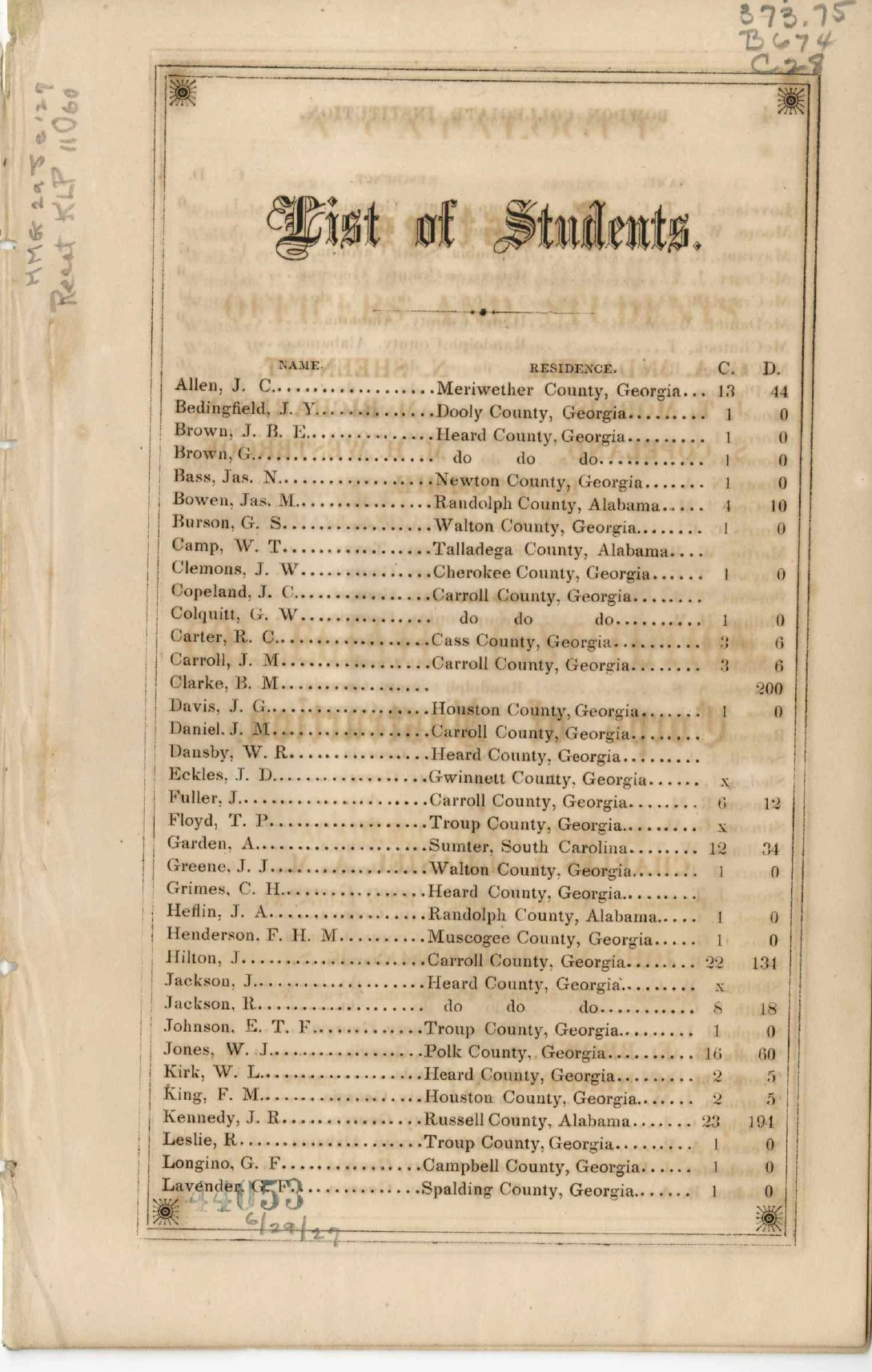
At Bowdon College, a student’s misbehavior could end up in print. The 1858–59 catalogue listed names and hometowns, then added a column of demerits. Some students had none. One had 194; the college’s rules put expulsion at two hundred in a year. [1]
In this story
A college within reach
The little booklet was doing several jobs at once: introducing a school, advertising its courses and reporting on the young people already there. Its student roll reached beyond Carroll County into Alabama, South Carolina, Florida and Texas. E. M. Thompson came from Tampa; W. W. Martin was listed from Fayette County, Texas. Bowdon was drawing students from well outside its own neighborhood. [1]
The school’s 1858 prospectus dates its founding to 1856 and its charter to 1857. Charles A. McDaniel taught ancient languages, moral science and elocution. John M. Richardson covered mathematics, mechanics, engineering and French, as well as military instruction. Between them, they offered a remarkably wide course of study. [8]
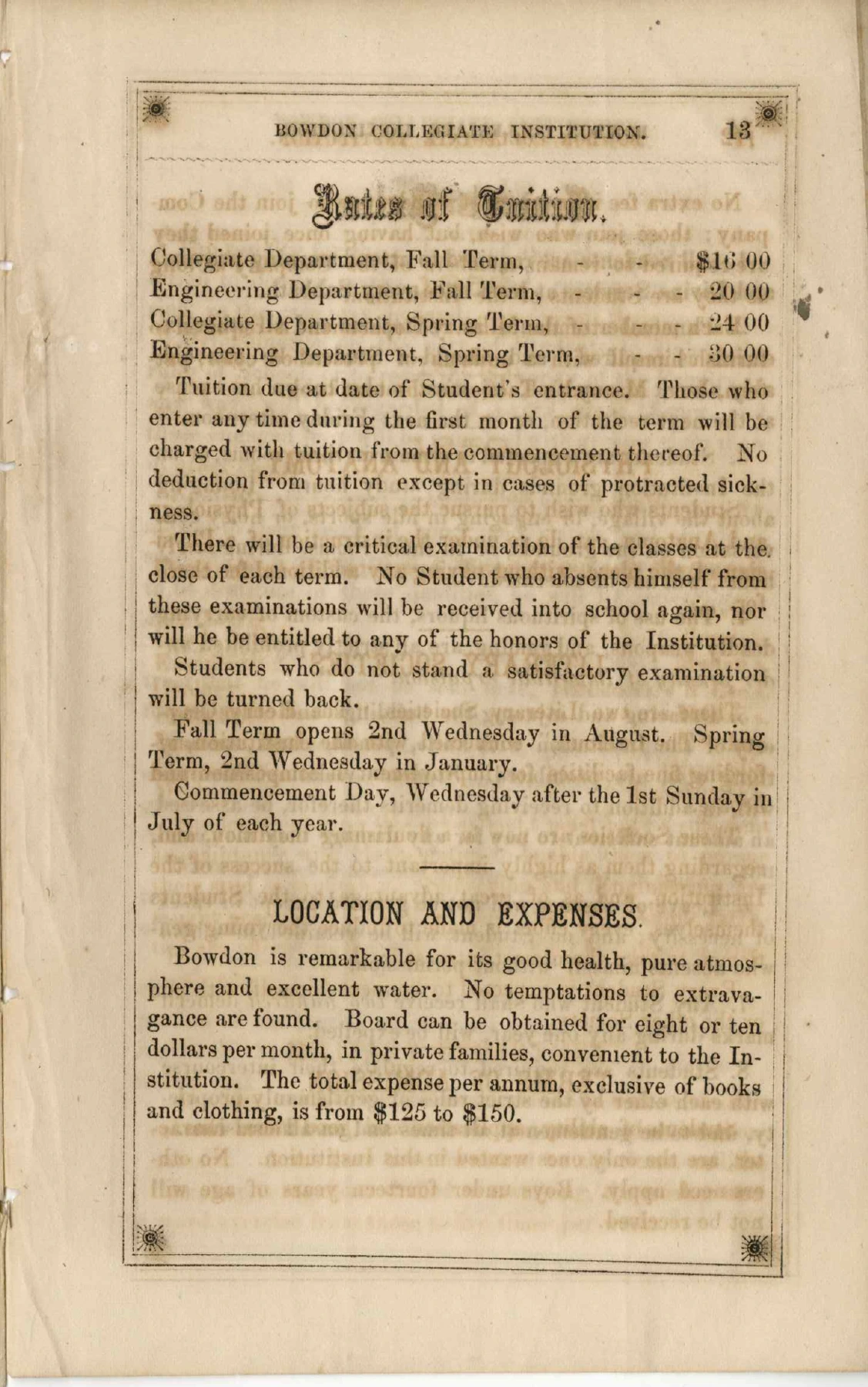
Families still had to find the money. In the 1858–59 catalogue, collegiate tuition was $16 for fall and $24 for spring; engineering cost $20 and $30. Boarding with a local family added eight to ten dollars a month. The college estimated a year’s expenses at $125 to $150, before books and clothing. These were its advertised figures, rather than a surviving household bill. [1]
Those boarding arrangements made the town part of the school. A student could study under Richardson and McDaniel while living at a nearby family’s home. The earlier prospectus spelled out what its usual eight-dollar monthly board covered: room rent, fuel and washing as well as board. An education depended on meals, clean clothes and a place to sleep, too. [8]
Books, instruments and a place to speak
The course list stretched from Latin and Greek to chemistry, geology and astronomy. Mathematics led from arithmetic through geometry to calculus. Engineering had a practical purpose: the 1858 prospectus promised work with surveying instruments in the field, applying mathematics to surveying, navigation, mechanics and engineering. The college wanted students to do something with the calculations. [1] [8]
Not every student had to pursue the whole Bachelor of Arts course. The catalogue offered a departmental diploma for completing one branch of study, or a certificate for demonstrating proficiency in part of it. English grammar and arithmetic remained compulsory foundations: no certificate, diploma or degree without passing examinations in both. [1]
Paying tuition was only part of staying at the school. The catalogue required an examination at the close of each term and said a student who missed it would not be readmitted. Fall began on the second Wednesday in August, spring on the second Wednesday in January, and commencement followed the first Sunday in July. These were published requirements, not evidence that every student met them. [1]
There was also room to try a subject beyond one’s main course. A local physician offered physiology and anatomy without an additional fee. The Henry Clay and Calhoun literary societies gave students practice in composition and debate, and each student was expected to join one. Composition and declamation were required throughout the course; annual prizes rewarded public speaking. [1]
The freedom to explore came with strict rules. Morning prayers and weekly worship were compulsory. During study hours, students were to stay in their rooms or on the grounds. Liquor, gambling and carrying deadly weapons could mean immediate expulsion. Even marking the buildings with a pencil or chalk brought demerits and a bill for the damage. The published conduct column was part of a much larger effort to keep students accountable. [1]
When lessons gave way to war
Military drill had been part of college life before the Civil War. The state supplied arms, and the company practiced marching and musket and sword exercises three to five times a week. Joining was voluntary, but a student who joined had to provide his own uniform and remain in the company while enrolled. [1]
In 1861, Confederate service interrupted the college. McDaniel went to war with students and died at Perryville, Kentucky, in 1862. Later accounts give sharply conflicting totals for the students who died; the familiar historical marker’s figure of 128 cannot be treated as a verified count. The scale of the disruption is clear even where the arithmetic is not. [3] [4] [5]
A quieter record marks the return to education. Georgia Archives holds the trustees’ 1867 expense account for state-supported instruction of impoverished, disabled Confederate veterans. Its description identifies ninety-seven students, with their entry dates and expenses recorded by quarter. The college had another job to do: help men whose lives had been altered by war return to study. [2]
Who could become a college student?
The early records contain an easily missed distinction. The 1858 prospectus announced a separate primary and female school for younger boys and girls, explicitly saying it was not controlled by the college’s officers. The next catalogue counted eighty-five pupils in that school separately from its ninety-two listed students. Girls receiving an education nearby did not necessarily mean women had entered the collegiate course. [1] [8]
The later chronology remains disputed. The historical marker places coeducation in 1869; the National Register history gives July 1872 for the trustees’ decision; an archives summary says women were admitted from the opening. But by 1873–74, the student list leaves no doubt that women were studying in the college. [2] [3] [5] [6]
The surviving transcription names Miss M. M. McDaniel beside W. C. Adamson as the two seniors. Women also appear among the sophomores, freshmen and business students. Teacher preparation admitted both sexes and offered certificates according to the level a student was qualified to teach. [6]
Commencement put names to those opportunities. Adamson was assigned an address; McDaniel, an essay. The National Register history identifies Mary McDaniel as an 1874 graduate. Adamson’s congressional biography confirms his graduation that year, followed by law practice in Carrollton and twenty years in the U.S. House. Before that public career, he was a Bowdon student preparing to speak. [5] [6] [7]
Another generation on the same ground
The town’s attachment outlasted the founding generation. The National Register account credits former members of the college’s wartime company with bringing about the two-story brick college building dedicated in 1901. Legislation creating Bowdon State Normal School followed in 1919, tying its future more closely to training teachers and state support. [3] [5]
That support did not last. Georgia Archives dates the announced withdrawal to 1933. Residents kept a junior college going into the middle of the decade, but Bowdon College closed in 1936 as state-supported higher education developed in nearby Carrollton. [2] [3] [5]
The college’s end was not the end of teaching there. Bowdon High School moved into the brick building it left behind. A different generation came to the same ground with books and lessons of its own. The college had held on for decades; the place it made for education lasted beyond it. [5]
Explore the original records
Open these records at the archive or family website for a closer look.
- The college building, catalogued 1899
The archive dates the photograph from field notes and describes the building’s replacement in 1900.
- The student body, about 1900
The record says 1900 or just after; the photograph does not supply an exact exposure date.
- The college orchestra, 1915
Georgia Archives identifies an orchestra with its instruments. View the photograph and its caption at the archive.
- Examine the Bowdon Volunteers roster at UWG
A later roster with individual service notes; it has not been matched to the college’s enrollment list and does not resolve the disputed wartime death total.
Sources and further reading
- Bowdon Collegiate Institution, Catalogue of Officers and Students, academic year 1858–59 (Atlanta, 1859)
University of West Georgia, Bowdon College collection LH-0052, Box 1, Folder 10. Original catalogue visually inspected: printed pp. 2–5 (faculty, student homes, conduct and separate school count), 6–11 (courses, credentials, speaking and engineering), 12–15 (societies, admission, fees, board and rules). The ninety-two students and eighty-five primary/female pupils are separate categories; this is not evidence that eighty-five girls attended college. - Georgia Archives, Bowdon College finding aid
Charter chronology; 1856 Ben Hill letter; 1867 expense record describing ninety-seven students; 1933 funding announcement and 1936 closure. Its statement that women were admitted from the opening conflicts with later policy dates and does not distinguish the separate early school for girls. - Georgia Historical Society, Site of Bowdon College marker
Marker transcription records the 1919 normal-school legislation and local junior-college continuation in 1934–36. Its 128 deaths among 144 students and 1869 coeducation date are commemorative claims requiring corroboration, not settled totals. - Lost Colleges, Bowdon College
Secondary account citing Mignon Wessinger and Judy Copeland Rowell, Bowdon College: A Glorious History. It reports approximately half the wartime students died, in conflict with the marker; the original book and a complete service roster have not been audited. - Bowdon Historic District, National Register nomination (2009)
Bowdon Historic District nomination (2009), printed pp. 18–19 and 23: McDaniel’s death at Perryville in 1862; former college soldiers’ support of the 1901 brick building; July 1872 coeducation policy; Mary McDaniel’s graduation in 1874; 1936 closure and subsequent high-school use. Its wartime enrollment/return figures also differ from the marker. No exact casualty count or statewide “first” is adopted here. - Bowdon College catalogue, 1873–74, transcribed by Dena W.
Transcription of the 1874 catalogue: named women in senior, sophomore, freshman and business classes; admission of both sexes to teacher preparation; commencement address and essay assignments. The original catalogue pages for this edition were not inspected. Names retain the catalogue’s initials rather than assumed identities. - U.S. House of Representatives, William Charles Adamson biography
Independent congressional biography confirms William Charles Adamson’s Bowdon College graduation in 1874, law practice in Carrollton and House service from 1897 to 1917. - Bowdon Collegiate Institute, Course of Study, 1858
University of West Georgia, Bowdon College collection LH-0052, Box 1, Folder 15. Original booklet visually inspected: faculty and founding/charter statement (PDF p. 2); printed p. 5, field practice and room/fuel/washing included in board; printed p. 6, the separately governed primary and female school. An earlier prospectus, not the same financial schedule as the 1858–59 catalogue. Published in Atlanta by William Kay in 1858.
Read another local story
 The Library Came to ThemModern illustration by Moss & Sons; not an archival photograph.
 A school map from 1918. A different view of home.Georgia school survey · 1918
- From Old Camp to Japan: William Turner’s letters home
Share a photo, memory or landmark
Daniel reviews contributions before anything appears publicly.
Know someone who would enjoy this? Pass it along.