Rockmart and Van Wert history
Rockmart: The Town Built on Slate
A slab from the quarry was only the beginning. Before Rockmart’s stone could cover a roof, it had to be cut, split and dressed into pieces thin enough to handle and strong enough to last. [1]
In this story
Three jobs under one roof
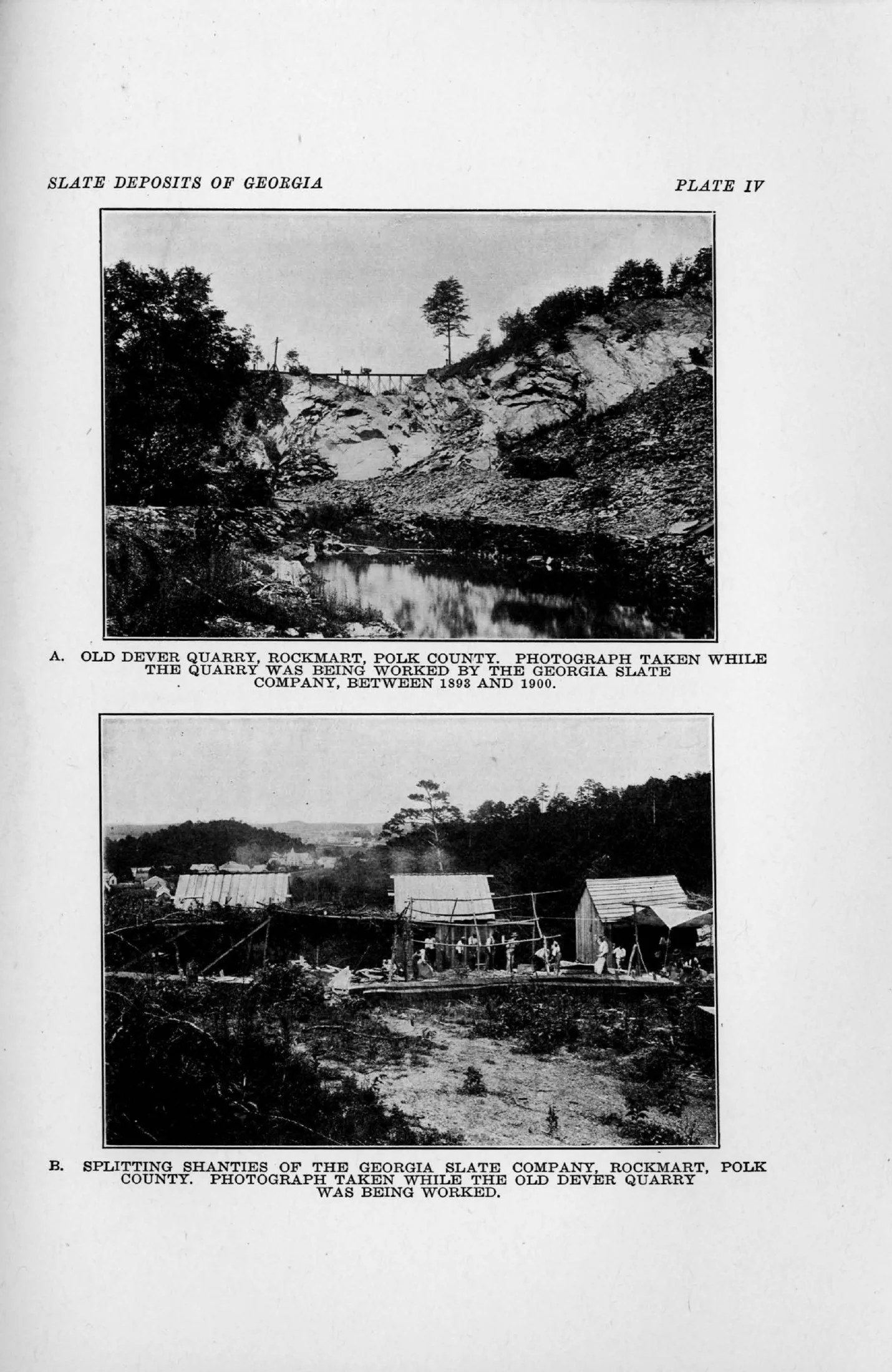
In an old photograph, the men doing that work are small beneath the roofs of three open-sided sheds. Rough ground fills the foreground. Published in a 1918 state geological report, the picture identifies the buildings as the Georgia Slate Company’s splitting shanties at Rockmart. Beyond the names of owners and companies, it preserves a glimpse of a working place. [1]
The report describes the trade’s usual three-man team: a block-maker, a splitter and a dresser. Large slabs first went to sawing tables, where rough edges were removed and blocks cut to useful sizes. Under the sheds, skilled hands carried the work through its successive stages. The report’s account is a description of the trade, rather than an identification of each man in this photograph. [1]
The finished roofing pieces were commonly only an eighth to a quarter of an inch thick. Split them too thin and more would break in handling. A roofing “square” meant enough overlapping slate to cover ten feet by ten feet; an ordinary square weighed about 650 pounds. Thin stone was still heavy stone. Getting it onto a roof began with a great deal of lifting below. [1]
Two towns and a railway
The quarries were here before Rockmart had a town charter. Nearby Van Wert had already served as a county seat before county boundaries changed and that role went elsewhere. In the 1860s a proposed railroad offered another way for this corner of Polk County to reach a wider world. [2]
Seaborn Jones owned land along the projected route. In 1871 he had it surveyed for a new town. The National Register history links the town plan and the name Rockmart to the expected market for local slate. Stone underground, lots on a survey and a railway on the way made a promising combination. [2]
A familiar local account says Van Wert refused the railroad a right-of-way while Jones welcomed it. The historical society presents that refusal as one version of the story, and it remains unverified. The firmer outline is a new town developing on Jones’s land beside a railway built in stages. Published histories disagree about the first track’s arrival at Rockmart; they agree that the line reached Cedartown in 1879. [2] [4] [7]
A town on paper
On August 26, 1872, Georgia’s legislature incorporated Rockmart, appointed C. T. Parker mayor and named five aldermen. The law set out the town’s boundaries by numbered land lots. A surveyor’s plan now had a council to govern it. [3]
Ten days earlier, however, the same legislature had declared the state’s guarantees on Cartersville and Van Wert and Cherokee railroad bonds void. The promise of a railway came with financial trouble. The two acts sit in the same law book: one creating a town, the other refusing to pay for bonds tied to the railway that helped bring it into being. [3]
Griff Jones and the town around him
A July 14, 1888 newspaper column gives the place faces and names. Griff W. Jones, it reported, had left North Wales twenty-eight years earlier and gone to work in a local quarry. At sixty, he was still a lively figure in the correspondent’s account. His life connects Rockmart to the Welsh skills and migration behind the slate trade. [5]
The column moves easily from quarrying to everyday business. Clay Brothers were making rough and pressed brick on Colonel Dever’s property and working on Beasley and Hoge’s brick store. W. L. Ferguson had bought the Alliance Store. Mayor M. C. Hutchins was only twenty-two, according to the writer, who clearly approved of him. These were the people turning industrial opportunity into a town of shops and public affairs. [5]
The Van Wert Mining and Quarry Company also had a plan: raise $100,000 to establish a bank in Rockmart. The newspaper’s confidence was a report of ambition, not proof that the bank opened. Even so, the older settlement’s name remained part of the newer town’s business life. [5]
Two years later, a federal census bulletin listed four Georgia slate producers: Georgia Slate Company, W. W. Jones & Company, Rockmart Slate Company and Southern Slate Company. Every one had its address and quarry at Rockmart. That short directory places this little town at the center of Georgia’s slate business in the census account. [8]
The cost of the stone
Valuable rock did not guarantee a profitable quarry. Black-powder blasting broke out material at the old Rockmart workings, but also shattered stone that might otherwise have been sold. Waste piled up. Each new load had to be moved around the consequences of earlier work. [1]
At Robert H. Brown’s quarries, the 1918 report identified a particularly expensive arrangement. The sawing and splitting shed stood on top of a ridge, so the slate had to be raised more than a hundred feet. The geologist believed a shed could instead have been placed down the valley. Before a block-maker could begin, the business was already paying to get his material uphill. [1]
The report put the district’s greatest development between about 1880 and 1900. It attributed the later decline to several pressures, including the deaths of experienced operators, higher labor costs and the growing expense of handling overburden and waste. The problem was not simply that the stone had run out. Knowledge, organization and the cost of every movement mattered. [1]
A different future for the same ground
One company tried to make the unwanted material useful. The Rockmart Shale Brick & Slate Company began with a plan to quarry slate and turn the overburden and waste into brick. By the time the geological survey described it, the company was making paving brick rather than commercial roofing slate. [1]
The reason lay in the material itself. Fresh or slightly weathered slate did not make brick tough enough to pass the abrasion test used for paving blocks. More deeply weathered material worked better. Workers sought the softer deposits, some yellow, red or greenish, instead of the fresh stone a roofing operation wanted. The same hillside could support a different business, but only if its operators learned what the material would do. [1]
What the town kept
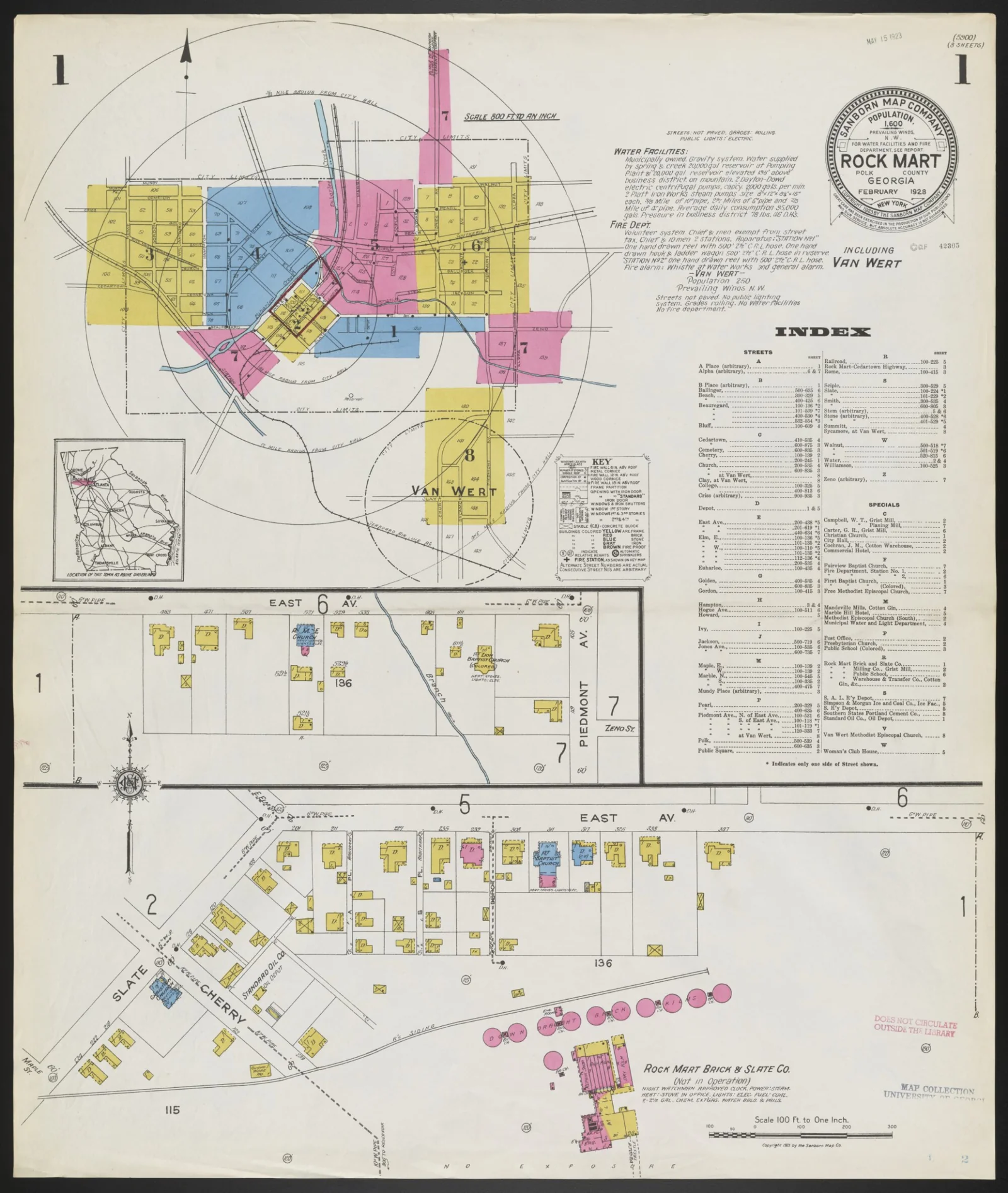
In February 1923, a Sanborn insurance map placed Rock Mart and Van Wert together on the page. Its first sheet drew the Brick & Slate Company and marked it as not operating. That was its status at the survey date, not a record of exactly when it closed. [6]
Elsewhere, the stone had already become part of the town. The 2009 National Register nomination describes an 1880s general store at 111 West Church Street built with local slate. It also records the 1882 Presbyterian church’s load-bearing slate walls, twenty-eight inches thick, and the fish-scale slate covering its bell tower. Quarry work could leave something more lasting than a company name. [2]
Look back at the splitting sheds after seeing those buildings and the old map. The small figures beneath the roofs belong to a larger story: a Welsh quarryman making a life here, merchants building stores, a town following a railway, and workers learning what its stone could become. Rockmart’s name remembers the material. The photograph helps us remember the hands.
Sources and further reading
- H. K. Shearer, Report on the Slate Deposits of Georgia (1918)
Georgia Geological Survey Bulletin 34. Printed pp. 1–3 cover industry history and decline; pp. 37–38 describe quarrying, the general three-man shanty organization, roofing sizes and weight; pp. 65–68 describe Brown’s uphill handling arrangement and the brick company’s materials and abrasion testing. Plate IV (PDF p. 88) supplies the photographs. The three-man description is general trade practice, not an identification of the photographed workers. The upper photograph is dated 1893–1900; the lower is identified as taken while the quarry was worked, without an exact date. Its railway chronology is not adopted because it conflicts with railroad histories. Original 1918 publication is public domain. - Rockmart Downtown Historic District, National Register nomination (2009)
Section 7, printed pp. 4–5: slate store at 111 West Church Street, church dated 1882, 28-inch walls and fish-scale slate tower. Section 8, pp. 12–14: Van Wert, Jones’s survey, incorporation, railroad development and Welsh quarry workers. Detailed narrative gives 1876 for arrival at Rockmart and 1879 for extension to Cedartown. This conflicts with GDOT’s 1871 Rockmart date; the story leaves that arrival year unresolved. - Acts and Resolutions of the General Assembly of Georgia, July–August 1872
Printed p. 7: act approved August 16 repudiating state guarantees of Cartersville & Van Wert and Cherokee railroad bonds. Printed pp. 244–247: Rockmart incorporation act approved August 26; C. T. Parker and five aldermen, boundaries and town powers. The printed act itself spells the name Rockmart, so a claim that this spelling began only in 1924 would require qualification. Primary legal record, public domain. - Georgia Department of Transportation, Historic Railroads of Georgia (2018)
The statewide railroad context dates the Taylorsville–Rockmart narrow-gauge extension to 1871 and the Rockmart–Cedartown extension to 1879. This differs from the 1876 Rockmart date in the National Register nomination and 2007 county assessment. No original operating timetable or construction record resolving that difference was located in this review; the article deliberately avoids choosing one arrival year. - “Rockmart News: A New Bank to be Established There—Other Notes,” Cedartown Standard, July 14, 1888
Polk County Historical Society reproduction and transcription of the contemporary newspaper page. Named businesses, Griff W. Jones’s age and migration, and M. C. Hutchins’s age are reported as the correspondent’s account. The “first quarry” claim is not independently established and is not repeated as fact. The $100,000 bank was proposed, not verified as opened. Original newspaper is public domain. - Sanborn Map Company, Rock Mart, Polk County, Georgia, February 1923, sheet 1
University of Georgia Libraries Map Collection / Digital Library of Georgia. Sheet 1 visibly labels Van Wert and the Rock Mart Brick & Slate Company, with the latter marked “Not in Operation.” The map establishes its status when surveyed, not the precise closing date. The IIIF manifest explicitly states No Copyright—United States. - Gordon D. Sargent, Polk County Historical Society, “About Us” historical account
The right-of-way refusal is introduced as “By some accounts.” This is a later historical narrative, not a contemporary refusal, deed or council minute. No such original record was found, so the story does not present the refusal as settled fact. - William C. Day, Production of Slate, U.S. Census Bulletin No. 8 (1890)
Printed p. 6 (PDF p. 5), visually inspected: directory lists Georgia Slate Co., W. W. Jones & Co., Rockmart Slate Co. and Southern Slate Co., each with Rockmart addresses and quarries. The bulletin reports 1889 production and a contemporary producer directory. Its general national comments about Welsh workers are not presented as a record of Rockmart pay or working hours. Public-domain federal publication.
Read another local story
- When the railroad moved the town
 Southwire: How Carrollton learned to make wireU.S. patent drawing; no copyright notice in original scan. Reproduced under USPTO patent-publication guidance (source 9).
- Bremen hiding in plain sight
Share a photo, memory or landmark
Daniel reviews contributions before anything appears publicly.
Know someone who would enjoy this? Pass it along.