Southwire’s early years
Southwire: How Carrollton learned to make wire
Pete Cofer remembered his arrival at Southwire in 1953 with a plain assignment: “I was shown a box of machinery and told, ‘There it is—you make it work.’” He was a newly graduated engineer. The machinery was an aluminum rod mill. [10]
In this story
First, a shortage
Three years before Cofer arrived, Southwire had opened with twelve employees and three used machines. The company dates its opening to March 23, 1950. Its founder, Roy Richards Sr., already knew the other end of the business: putting up poles and getting electrical lines across the countryside. [1]
In the family’s account, the ambition began close to home. Richards wanted electric light for his grandmother. He started Richards & Associates in 1937, building a business that strung thousands of miles of line before wartime service interrupted it. When he returned, the company says, poles could stand without wire for months because of postwar shortages. A construction crew could put the poles in place; it could not finish a line with material it could not obtain. [2]
Richards decided to manufacture the missing wire. That decision changed the work waiting to be done in Carrollton. Before a factory could supply the construction crews, someone had to buy equipment, arrange production and teach people to run it.
A new trade, familiar hands
Richards turned to a former teacher. Georgia Tech’s account identifies retired professor Major A. A. Case as the man hired to train local workers on wire-manufacturing machinery. Recruits came from farms and textile work. [3]
Carroll County had a long manufacturing history by then. Textile work at Banning dated to the 1840s, and Mandeville Mills had become an important Carrollton employer by the end of the nineteenth century. Farming remained central too: the county counted 3,155 farms in 1954. Southwire began amid that mixture of field work and factory work. [8]
Learning to make wire also meant learning to make more of it. Georgia Tech’s retrospective records two million pounds in Southwire’s first year. In its account, Richards kept pressing for greater speed and efficiency, and in 1953 an Italian machine caught his attention. It cast metal continuously, offering a way to keep production moving. Cofer’s task was to help adapt it to Southwire’s aluminum work. [3]
Keeping the metal moving
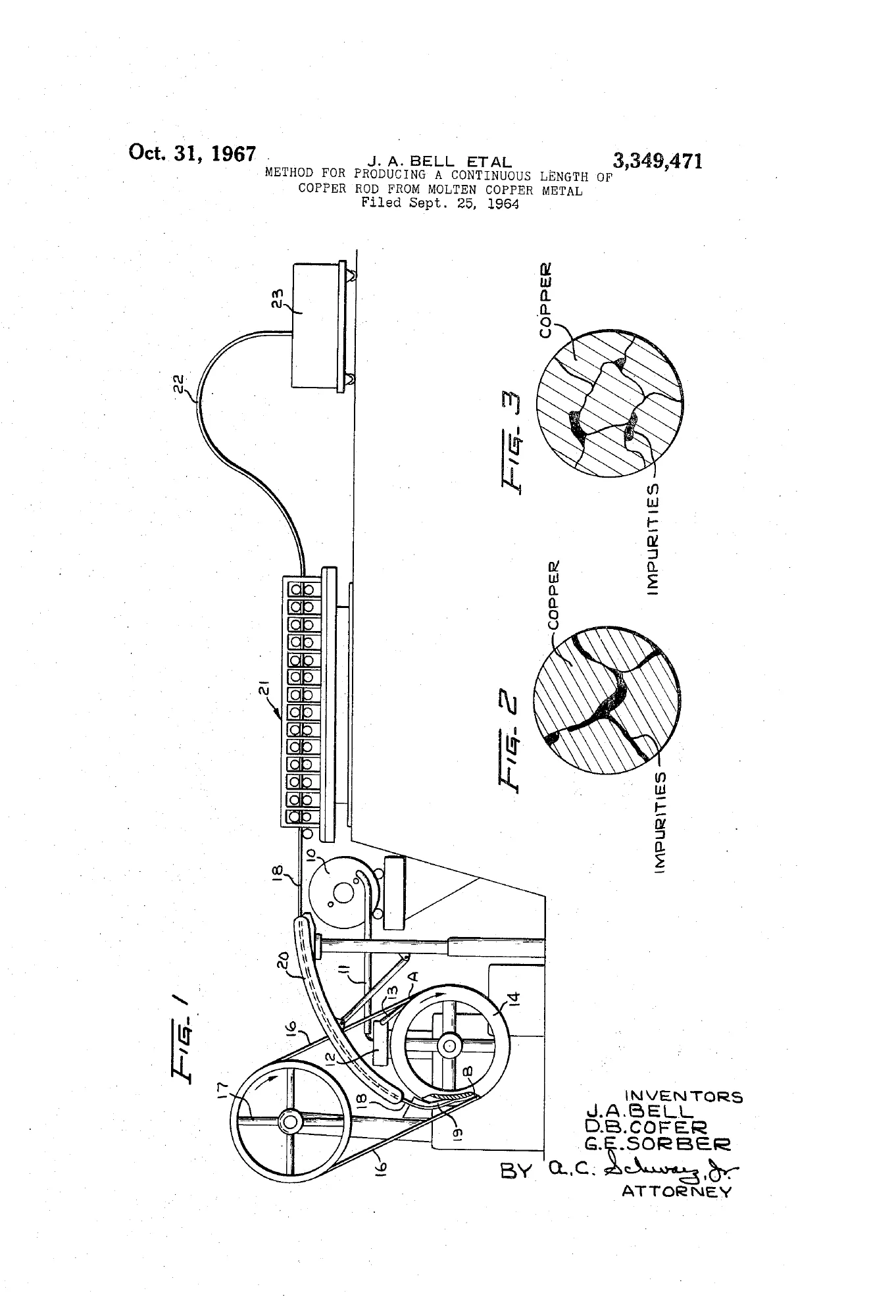
To see the attraction, follow the later patent drawing below. Molten metal enters a groove in a rotating wheel. A moving band closes the groove into a mold while the metal solidifies. The emerging bar then travels into rollers that reduce its size and shape it into rod. Instead of repeatedly starting with a separate cooled bar, the line keeps casting and rolling. [4]
The drawing acknowledges the earlier work of Italian inventor Ilario Properzi. Southwire’s engineers were adapting and improving an existing approach, solving the problems of particular metals and production requirements. A usable system had to do more than produce one promising sample: it had to keep making rod. [4]
Aluminum came first. A Georgia Department of Industry and Trade magazine published in 1968 dates Southwire’s introduction of continuous aluminum casting to 1953. The company’s own timeline highlights 1963, while Georgia Tech identifies that later milestone with the adaptation to copper. The dates mark different stages of the work. [1] [3] [11]
Copper posed another problem
In August 1962, Southwire and Western Electric agreed to develop a copper-rod system in Carrollton. Their target was at least ten tons an hour. Western wanted a system for its Staten Island operation that could handle its accumulated copper scrap and the scrap it expected over the next decade. Both companies committed engineers and shared the cost. [5]
The contract ended in August 1963, and Southwire delivered a new system to Staten Island in 1964. The experiment in Carrollton had become equipment for turning used copper back into material for another job. [5]
The copper still had to survive the trip through the machinery. A patent filed in 1964 by John A. Bell, Daniel B. Cofer and Gilbert E. Sorber addressed cracking associated with impurities, especially lead. Controlling what was in the molten copper helped keep the cast bar from breaking as it was rolled. The patent, issued in 1967, records a particular solution and three contributors. [4]
The people behind the production figures
By early 1968, the state’s trade magazine described a Southwire site covering nearly twenty-five acres. It reported more than 1,300 employees and over 180 million pounds of aluminum, copper and steel products made during 1967. The article was promotional in tone, but its dated figures help convey how far the factory had grown from its twelve-person beginning. [11]
That expanding workplace also had serious conflicts. In 1970, the Fifth Circuit adopted findings supporting civil contempt against Southwire and Richards for violating earlier court decrees during the 1967 union campaign. The findings concerned surveillance, unlawful questioning and discrimination. The court separately upheld protection for certain management statements. [6]
One worker in the opinion was Mrs. Cato, a trainee on a buncher machine. Southwire said she was inattentive and careless. The court upheld the finding that her dismissal was discriminatory, pointing to unequal treatment, departure from warning procedures and its timing after the company learned she was married to a union supporter. Those findings belong to that campaign and period; they are not a description of present-day employment practices. [6]
A production total measures what left the plant. It cannot tell us everything about the people who made it. Their training, skill, pay and treatment belong beside the patents in the history of the place.
The slide rule stayed within reach
When writer Pam Rountree interviewed Cofer in 1992, he was still using a slide rule, though he also worked with computers. Colleague George Ward remembered being asked to finish one of Cofer’s machine-part drawings and joked about his drafting ability. The engineer who solved large manufacturing problems could still leave somebody else a troublesome drawing. [10]
That year, Southwire opened the research center bearing Cofer’s name. In the interview, he stressed the growing need for technical knowledge and urged adults to keep learning actively. Nearly forty years after the box of machinery, the assignment had become larger, but it still required people willing to learn how things worked. [1] [10]
Southwire’s early story can be followed through those practical tasks: string a line, train an operator, make the mill run, keep the copper from breaking. Each one connects an enormous industry to work done by particular people in Carrollton.
Sources and further reading
- Southwire, “History”
Corporate retrospective: opening date, twelve employees, three used machines, and the timeline’s 1963 SCR milestone. These claims are attributed; no original payroll or machine inventory was located. - Southwire, “Family Owned”
Company account of Richards & Associates, the grandmother’s electricity story, wartime interruption and postwar wire shortages. - Candler Hobbs, “The Night the Lights Went On in Georgia,” Georgia Tech College of Engineering, November 18, 2019
Retrospective account of A. A. Case’s training role, first-year production, 1953 aluminum machinery work and the 1963 copper adaptation. The original 1992 Cofer interview and contemporary 1968 state magazine add earlier evidence. - John A. Bell, Daniel B. Cofer and Gilbert E. Sorber, U.S. Patent 3,349,471 (1967)
Original patent scan: filing, inventors, assignees, impurity-related cracking, and acknowledgment of the earlier Properzi process. - Southwire Co. v. U.S. International Trade Commission, 629 F.2d 1332 (1980)
Court opinion’s background records the August 22, 1962 development agreement, engineers and shared costs, Carrollton work, August 1963 termination and 1964 delivery. - NLRB v. Southwire Company and Roy Richards, 429 F.2d 1050 (5th Cir. 1970)
July 27, 1970 opinion; rehearing denied October 28. Court findings concern the 1967 organizing campaign. Narrative distinguishes company explanations from findings and avoids generalizing to present practice. - Morgan Stanford interview by Marcia Fishman, December 7, 1994, Voices of Labor Oral History Project
Southern Labor Archives, Georgia State University. The catalog identifies Southwire organizing as a topic. This is a further-research lead, not evidence for claims in this narrative: the full recording has not been reviewed. Recording carries CC BY-NC-ND 4.0 terms and is not reproduced. - Myron Wade House, “Carroll County,” New Georgia Encyclopedia
County context: textile manufacturing at Banning and Mandeville Mills, and the 1954 farm count. No direct transfer of particular workers from one employer to another is inferred. - USPTO, “Terms of Use for USPTO websites,” Editorial Guidance
Patent text and drawings typically have no copyright restrictions, subject to stated exceptions. Original patent scan was inspected; no copyright or mask-work notice appears. Reproduction preserves the historical drawing and identifies its source. - Pam Rountree, “Southwire’s Mr. Technology,” Georgia Tech Alumni Magazine, Fall 1992, pp. 59 and 62
Original interview with D. B. “Pete” Cofer and colleagues. Both printed pages visually inspected in the Georgia Tech repository scan. The 1953 machinery assignment is Cofer’s recollection, recorded in 1992; the slide rule and computer detail is contemporaneous reporting. Margaret Barrett’s portrait is not reproduced because reuse permission has not been established. - “Southwire Proves ‘It Can Be Done,’” Georgia Progress, vol. 4, no. 1, first quarter 1968, p. 8
Georgia Department of Industry and Trade contemporary promotional account, preserved by the University of Georgia and Digital Library of Georgia. Reports nearly 25 acres, more than 1,300 employees, 1967 output above 180 million pounds, and introduction of continuous aluminum casting in 1953. Figures are attributed to the publication rather than an independently audited company return. Printed p. 8 visually inspected in the complete 24-page scan.
Read another local story
 When the Lights Reached the FarmsPublic domain. Library of Congress, Prints & Photographs Division, Farm Security Administration/Office of War Information collection.
- Bremen hiding in plain sight
- Banning Mills: Work and Life Along Snake Creek
Share a photo, memory or landmark
Daniel reviews contributions before anything appears publicly.
Know someone who would enjoy this? Pass it along.