WHITESBURG AREA · CARROLL COUNTY
The working landscape beneath Banning Mills.
The creek, the mills and the school belong in one story. Bringing their records together reveals a changing industrial community—and a few dates that should remain unsettled.
Banning Mills Industrial Archaeological District entered the National Register of Historic Places on December 29, 2025. Georgia’s preservation office announced the listing on March 11, 2026, identifying a landscape of mills in Snake Creek Gorge near Whitesburg. This official recognition provides a useful starting point for reading the place as an industrial district, rather than reducing it to a single old mill. [1]
EXPLORE A WORKING LANDSCAPE
Four ways to read Banning
Select a part of the story to focus on its evidence and next unanswered question. These are connected subjects across different periods, not a mapped production line.
Water & terrain
Georgia’s preservation office describes four main industrial mills and smaller facilities using Snake Creek’s waterpower between 1847 and 1971. The district occupies the gorge’s ridges and valleys. Its industrial geography begins with usable waterpower, not merely proximity to a creek. [1]
Still to establish: A dated engineering plan is needed to tie each raceway, dam and mill to a particular operating phase. This explorer does not locate individual structures.
Mills & products
The New Georgia Encyclopedia describes textile production alongside paper and pulp operations, followed by changing yarn products in later decades. Think of a changing collection of businesses, rather than one unchanged factory running continuously. [2]
Still to establish: Output, equipment and ownership must be dated separately for each mill. The statewide “first” claims have not been established here.
School & daily life
The 1918 state school survey describes Banning School on mill land, in a room also used as a church. It records one teacher, five grades and average attendance of 28 over the preceding three years. The school-year length is left blank. [3]
Still to establish: This white-school survey does not document every mill family or Black residents’ schooling. It cannot establish wages, housing terms or workers’ views.
Closures & reuse
The encyclopedia records intermittent closures and the end of mill operations in 1971. Georgia DCA confirms the district’s National Register listing on December 29, 2025, announced March 11, 2026. [1] [2]
Still to establish: The operating range is not proof of uninterrupted production. Historic recognition does not by itself establish visitor access to every ruin.
A school makes the industrial story more human
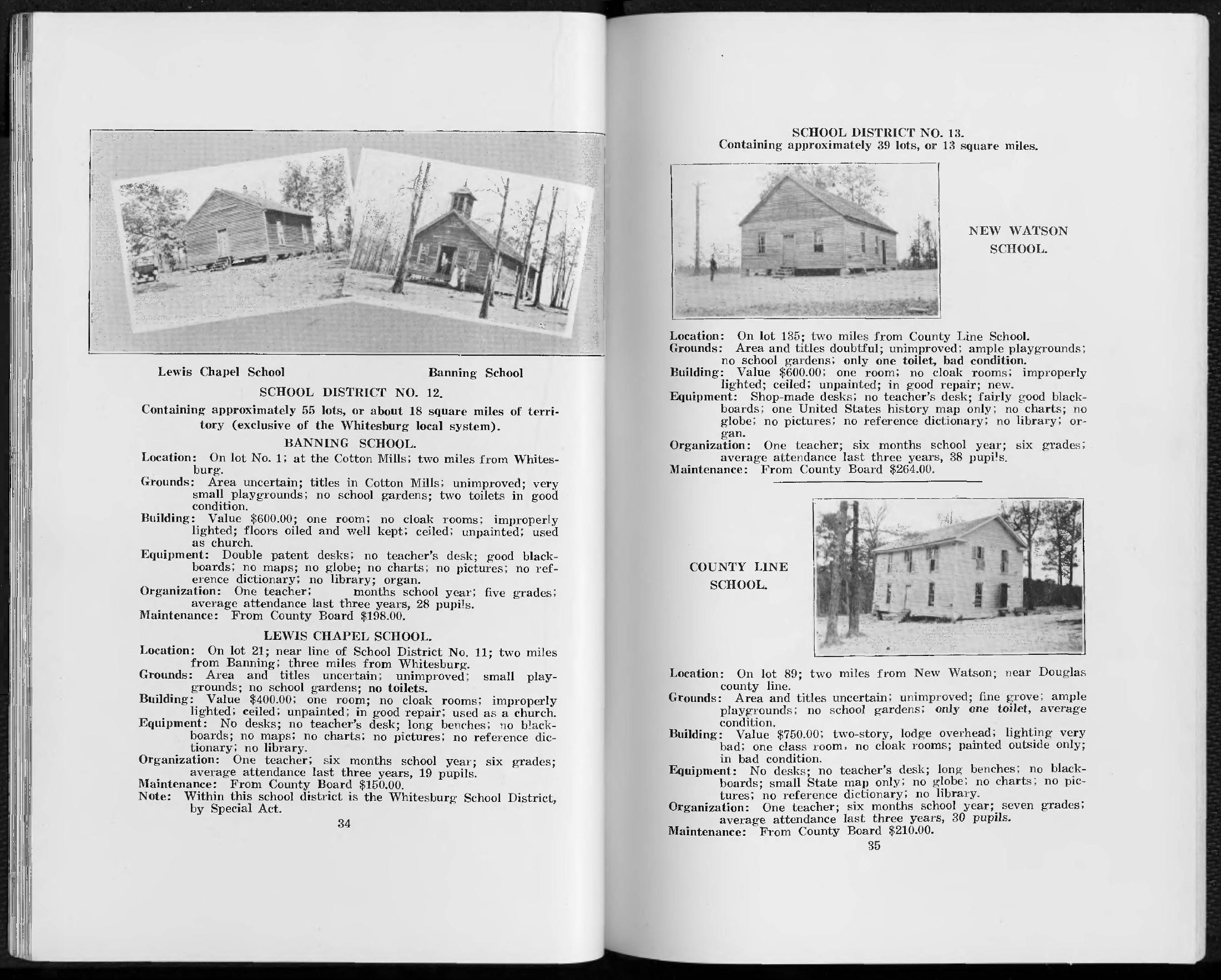
The survey places title to Banning’s school grounds with the cotton mills. It describes one classroom, an organ, no library and a building also used as a church. These details establish overlapping uses of the property; they do not tell us how the mill, church and school divided authority. [3]
That distinction opens specific questions. Who selected the teacher? Who maintained the building? Were the terms recorded in a lease, deed or school-board agreement? The interactive school comparison puts Banning alongside seven other entries without turning one administrator’s judgments into a ranking of communities.
Where the histories disagree
There is enough evidence to tell a useful story without smoothing away conflicting dates. The following accounts are later narratives; the underlying original transactions still matter.
| Question | Published accounts | Our treatment |
|---|---|---|
| The early mill fire | New Georgia Encyclopedia: 1851. The operator’s expanded history: 1852. [2] [4] | Unresolved here; do not silently choose a year or invent two separate fires. |
| Amis-era development | The encyclopedia describes reopening in 1866; the operator describes an Amis mill completed upstream in 1861. [2] [4] | Different buildings or phases may explain the accounts, but original records must establish that. |
| First electricity? | The operator discusses competing early-lighting accounts and acknowledges uncertainty. [4] | No statewide “first” asserted. Lighting a store, lighting a mill and powering machinery are different milestones. |
A mill’s name, an owner’s name and a location must be matched before dates are merged. Deeds, company charters, insurance plans and contemporary notices can establish that sequence more securely than a smooth timeline assembled from summaries.
Follow the workers as well as the machinery
Georgia State University’s Southern Labor Archives catalogs a Banning, Georgia collection, L1987-09, with preservation-era material and a copied historical photograph. It is a concrete lead for further research, not a photograph we have examined or permission to reproduce it. [5]
Payroll, household records, company housing agreements and interviews would let a later edition ask how employment and home life changed. We have not established those answers. The school record supplies one documented connection between industry and community; it should not stand in for all the people who lived or worked here.
If you want to see the place
Use the operator’s current visitor information to check activities and access. This historical feature is not a ruin-access map, and the boundaries of a registered district do not establish where visitors may walk. Our diagrams and comparisons identify subjects for understanding, not unsurveyed paths.
Sources and research limits
- Georgia Department of Community Affairs, March 11, 2026, new National Register listings. Official confirmation of the December 29, 2025 Banning listing and the district’s industrial scope. Full nomination not retrieved.
- Arden Williams, Banning Mill, New Georgia Encyclopedia, updated April 18, 2023. Secondary industrial chronology; early-date conflicts identified rather than resolved.
- M. L. Duggan, Educational Survey of Carroll County, Georgia, 1918, printed p. 34. Original scanned page inspected; school figures and missing field checked visually.
- Historic Banning Mills, expanded site history. Operator’s account with documentary references; its early chronology differs from the encyclopedia. Underlying deeds and newspaper scans not independently inspected here.
- Georgia State University Southern Labor Archives, Banning, Georgia collection, L1987-09. Catalog lead; original holdings not inspected.