Carroll and Heard county history
When the Lights Reached the Farms
The fifty-acre farm had poultry houses, a dwelling, a school-bus route and something worth mentioning separately: electric light. In October 1939, a seller south of Villa Rica advertised those features together with “city conveniences.” The asking price was $1,600. Electricity had become something a country property could offer a buyer. [1]
In this story
A line out to the farms
Two years earlier, Carroll’s new rural electric system had come alive. Carroll EMC dates that beginning to July 31, 1937: 117 miles of line serving 344 members in rural Carroll and Heard counties. A $118,000 Rural Electrification Administration loan financed the undertaking. Construction began in March. [2]
An August 1936 organizing meeting had drawn roughly four hundred to five hundred people. Attorney Robert D. Tisinger had been visiting farmers and rural leaders to build support for the cooperative. [2]
The places named on its later commemorative marker are still familiar: Victory, Tyus, Burwell, Star Point, Bowdon Junction, Center Point and Hickory Level, among others. Each meant another community to reach. These were the first lines of a system that would continue to grow. [3]
A farmer who became a lawyer
Tisinger knew country life firsthand. His law firm’s biography describes a boy who rode a horse to school in Bowdon, then attended Carrollton’s Fourth District Agricultural and Mechanical School. There, part of his work was helping raise food for the cafeteria. He later attended night classes while working for the railroad. [4]
In 1932, with the Depression limiting the law business available to him and his brother, he returned to the family farm. He farmed for a year before joining his brother’s practice, and continued managing the farm afterward. Bringing power into the countryside was a project he approached with experience on both sides of the office door. [4]
The wire inside the house
A pole beside the road could carry electricity past a home. Using it inside meant another undertaking: wiring the rooms, installing equipment and paying for the work. Congress recognized that distinction in the Rural Electrification Act of 1936. Section 4 addressed generating plants and distribution systems; Section 5 authorized loans for wiring premises and acquiring and installing electrical and plumbing equipment. [5]
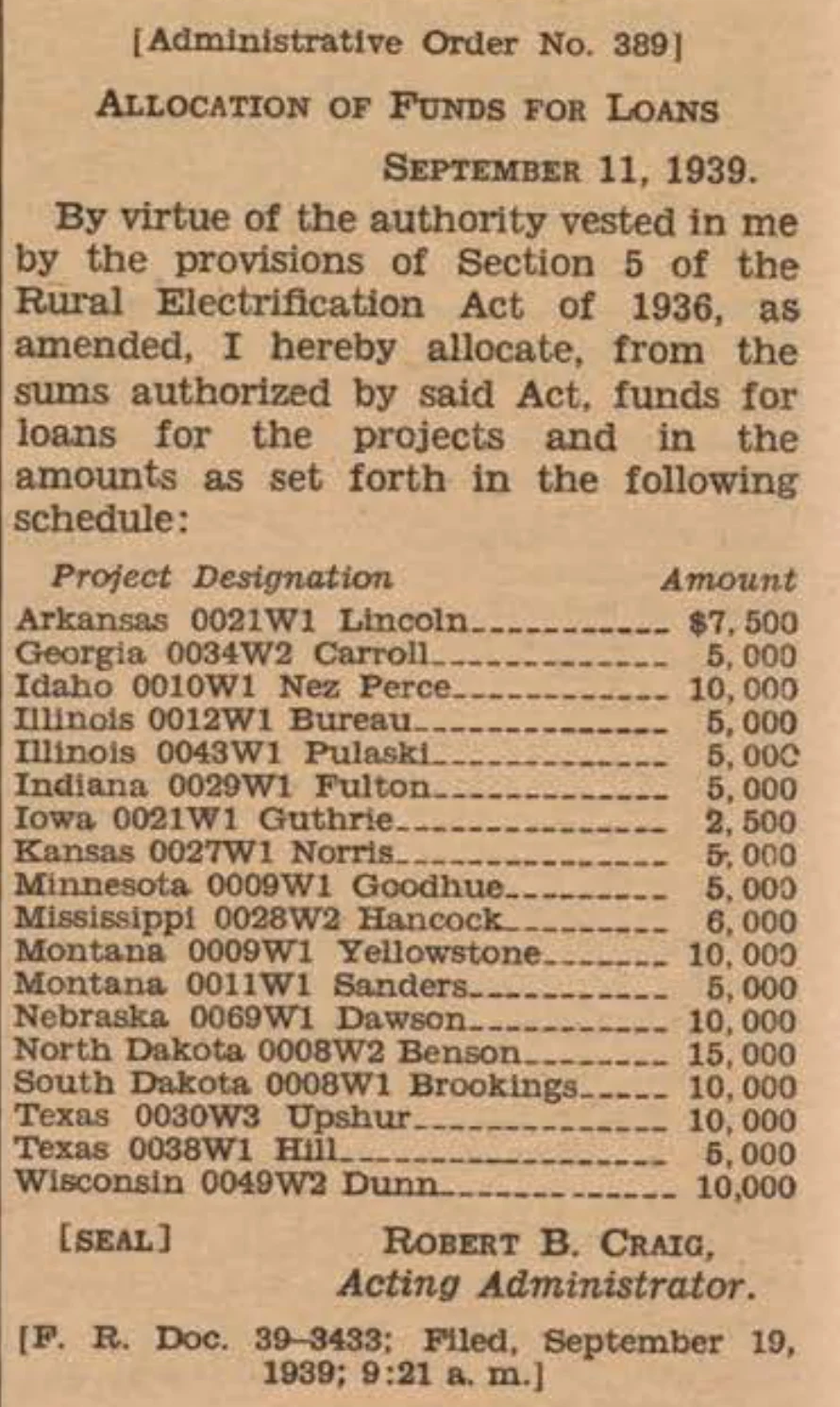
That second part of the program left a small but revealing Carroll entry in the Federal Register. An order dated September 11, 1939, allocated $5,000 for “Georgia 0034W2 Carroll” under Section 5. Published nine days later, the line appears among projects from Arkansas to Wisconsin. Its purpose becomes clearer when read beside the act: the program extended beyond the poles to the equipment that made power useful. [5] [6]
The order records an allocation for loans. It does not identify the families who borrowed, the appliances they chose or the amounts eventually spent. Even so, it shows that household installation had its own financing provision, separate from the larger job of building a distribution system. [5] [6]
Learning what power could do
There was also the question of how to use the new service. In September 1937, Georgia’s Department of Agriculture announced that engineer James G. Rossman would advise farmers and communities about obtaining electricity and making practical use of it once installed. The announcement appeared in the Market Bulletin, amid farm prices and agricultural advice. [7]
Commissioner Columbus Roberts named radios and refrigerators, but his list also reached into the working farm: pumps, machinery for cutting wood, and feed mills. The promise was wider than a better-lit room. A motor might take over a repeated chore, provided the farm had the equipment and could meet its cost. That was the work Rossman was being sent to discuss. [7]
The notice reported inquiries from farmers who already had electricity as well as those hoping to get it. Connection and useful adoption were two different stages of the same change. [7]
Something a buyer would notice
The Villa Rica advertisement put electric light alongside improvements a buyer could count and locate: two equipped poultry houses, a brooder house, rural delivery and a school-bus road. The fifty acres stood four miles south of town. [1]
The notice does not identify the supplier or record a sale. It shows what one seller thought a buyer should know: electric light belonged among a farm’s selling points. [1]
Inside a Carroll County home
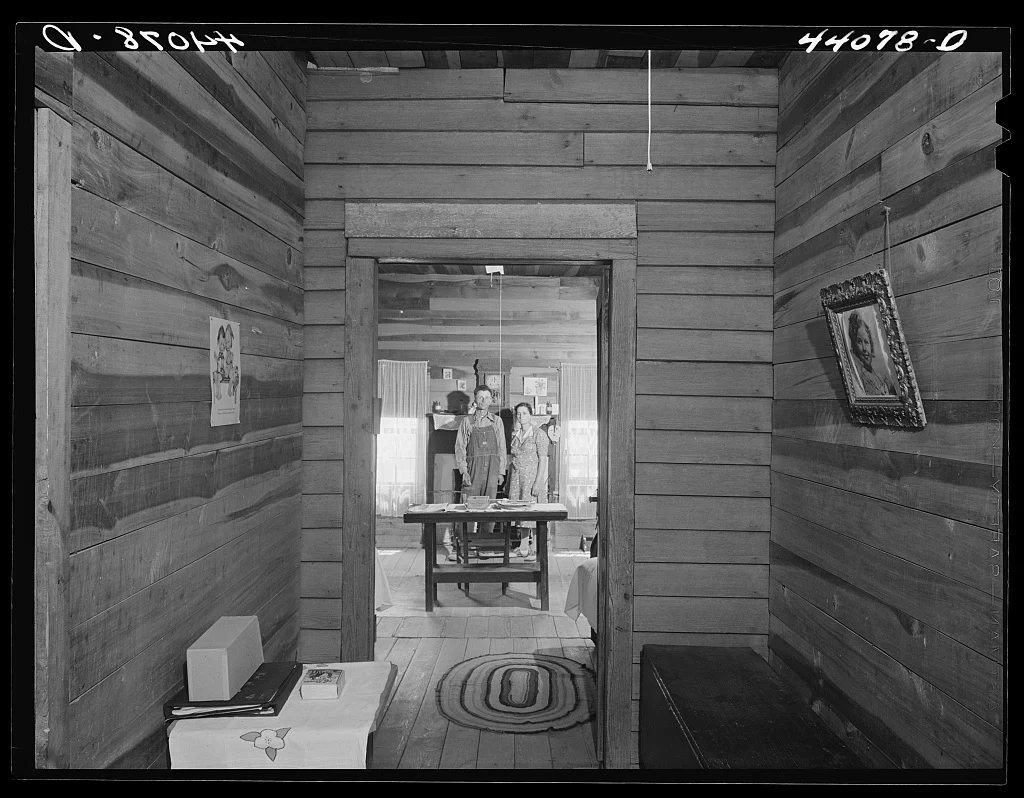
In April 1941, photographer Jack Delano stepped inside the home of Mr. and Mrs. Lemuel Smith in Carroll County. His photograph looks through a succession of doorways toward the couple. A framed portrait hangs on a plank wall; a small rug lies on the floor. Overhead, a light fixture and its hanging pull cord belong to the room as plainly as the furniture. [8]
Delano was documenting the family for the Farm Security Administration, whose borrowers they were. Other photographs in the series show family members working on the farm. One identifies Lemuel plowing while his son Colie plants peas. Household change and familiar field labor could exist in the same family’s life at the same time. [8] [9]
The photographs do not establish when the Smiths’ electrical service began or who supplied it. Their value here is more intimate: they let us look inside a local farm home a few years after the first cooperative lines were energized. [8]
Set beside that room, the records become easier to understand. The long runs of line, the money for wiring, and the practical advice all concerned places like this: a house people lived in and a farm they worked. Rural electrification reached its destination at the wall, the ceiling and the machine someone could finally put to use. [5] [6] [8]
Explore the original records
Open these records at the archive or family website for a closer look.
- Robert D. Tisinger’s recorded recollections, July 17, 1981
UWG’s catalog describes recollections of a home wired before power arrived. This edition uses the catalog as a listening lead; the recording has not been transcribed or used for quotations.
- The Smith family together at home, April 1941
Another Delano photograph shows reading, crochet, children’s toys and a radio. A radio alone does not establish connection to a particular electric system.
Sources and further reading
Research notes
Carroll EMC’s later institutional history supplies the opening figures. The two Market Bulletin issues, 1936 federal act, 1939 allocation and 1941 FSA photographs provide contemporary evidence. The allocation names no individual borrowers or purchases; the farm advertisement records no completed sale. Neither establishes that the Smiths were among the first 344 members.
- Georgia Market Bulletin, October 2, 1939, p. 5
Original page visually inspected: fourth-column poultry-farm advertisement, four miles south of Villa Rica. Asking price and features, not a sale record. - Carroll EMC, institutional history
Later institutional history supplies the opening figures and organizational account. Original membership roster not inspected. - First REA Substation in Carroll County, 1987 marker transcription
Commemorative list of early communities served. Marker photograph by David Seibert is linked at the archive, not republished. - Tisinger Vance, Robert D. “Bob” Tisinger biography
Family-firm account of schooling, railroad work, return to farming in 1932 and entry into his brother’s practice in 1933. - Rural Electrification Act of 1936, 49 Stat. 1363–1367
Original federal law visually checked, especially sections 4 and 5 on printed p. 1365. Used to explain the historical loan categories, not current eligibility or electrical-work guidance. - Federal Register, September 20, 1939, p. 3998, Administrative Order 389
Original page visually checked. September 11 order allocates $5,000 to Georgia 0034W2 Carroll under section 5. An allocation does not establish disbursement, named borrowers or purchases. - Georgia Market Bulletin, September 15, 1937, p. 2
Original p. 2 visually inspected: “Plans to Assist in Rural Electrification.” A statewide advisory program, not evidence of a particular Carroll farm visit. - Jack Delano, Mr. and Mrs. Lemuel Smith in their Carroll County home, April 1941; Library of Congress
Original caption catalog, LOC item 2017794451, digital ID fsa.8c35385. Photograph visually inspected through LOC’s own reproduction. Caption identifies FSA borrowers, not their electricity supplier. - Jack Delano, Lemuel Smith plowing while Colie plants peas, Carroll County, April 1941
Original FSA caption identifies the family members and work. The photograph is not used to infer their electricity supplier.
Read another local story
 Southwire: How Carrollton learned to make wireU.S. patent drawing; no copyright notice in original scan. Reproduced under USPTO patent-publication guidance (source 9).
 Biscuits, pies and the people who fed West GeorgiaPublic domain. Published in New York in 1898; Library of Congress explicitly permits free use and reuse. Credit: Library of Congress / Internet Archive.
Share a photo, memory or landmark
Daniel reviews contributions before anything appears publicly.
Know someone who would enjoy this? Pass it along.