HARALSON COUNTY · LIFE BESIDE THE RIVER
The People Beside the Tallapoosa
Five stories from the 1890s follow the people who hauled grain, kept a mill running, taught school, sang together, and gathered by the river.
Story 01 · A. J. Estes • 1895–1898
A family to feed. A road to mend.
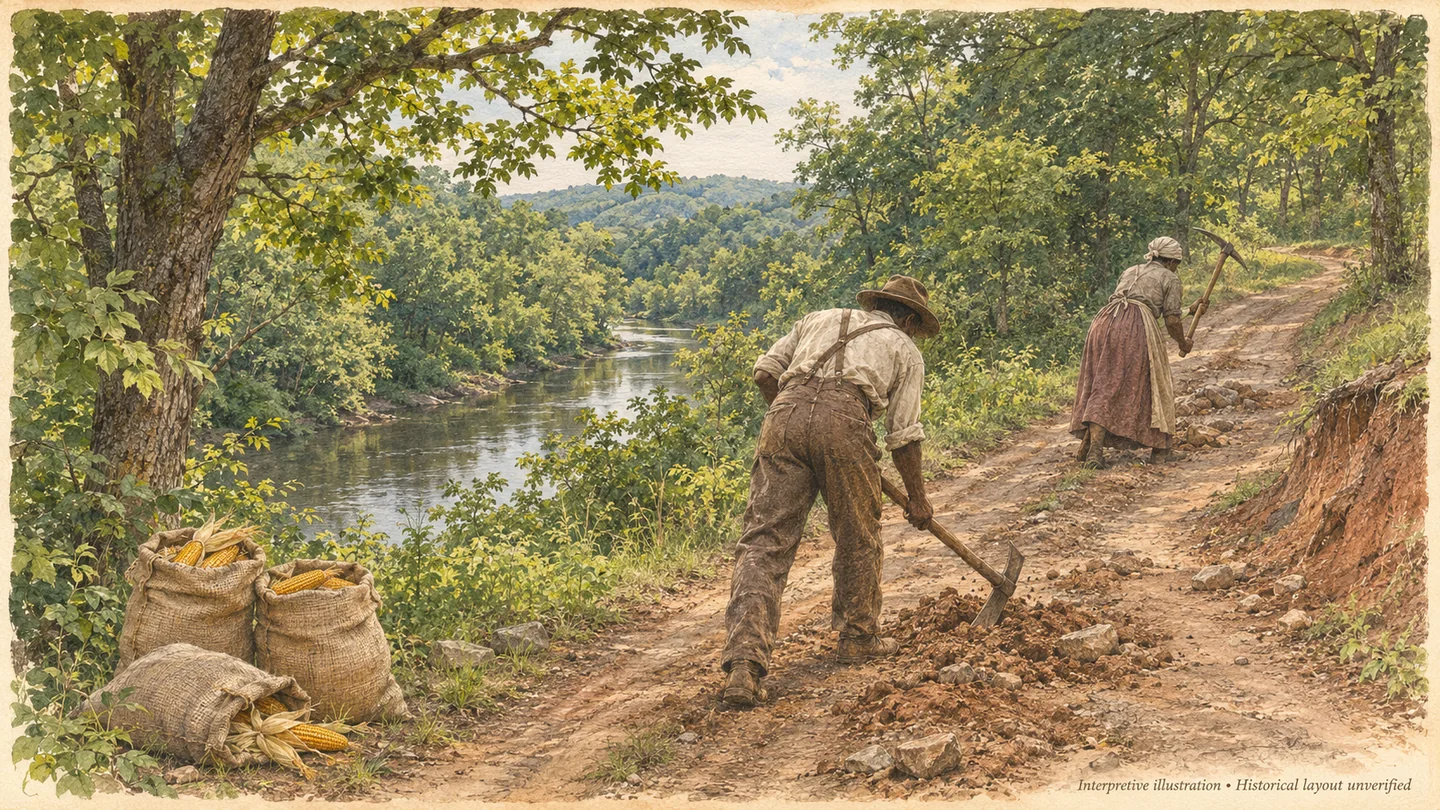
In July 1898, A. J. Estes wrote to Buchanan’s Banner-Messenger about the road to his mill along the Tallapoosa River in Haralson County. He said he was disabled and depended on grinding to feed five young children. His letter addressed a disagreement over a picnic and dancing, but it ended with a practical request. He asked his neighbors to help work the road on August 2 and offered to sharpen their mattocks and picks for free. A mattock is a tool for digging and chopping.
A mill could turn a family’s corn into meal, but first someone had to get the grain there. Estes offered to get the tools ready for the neighbors who would help mend the road.
The valley and the traces of the mill
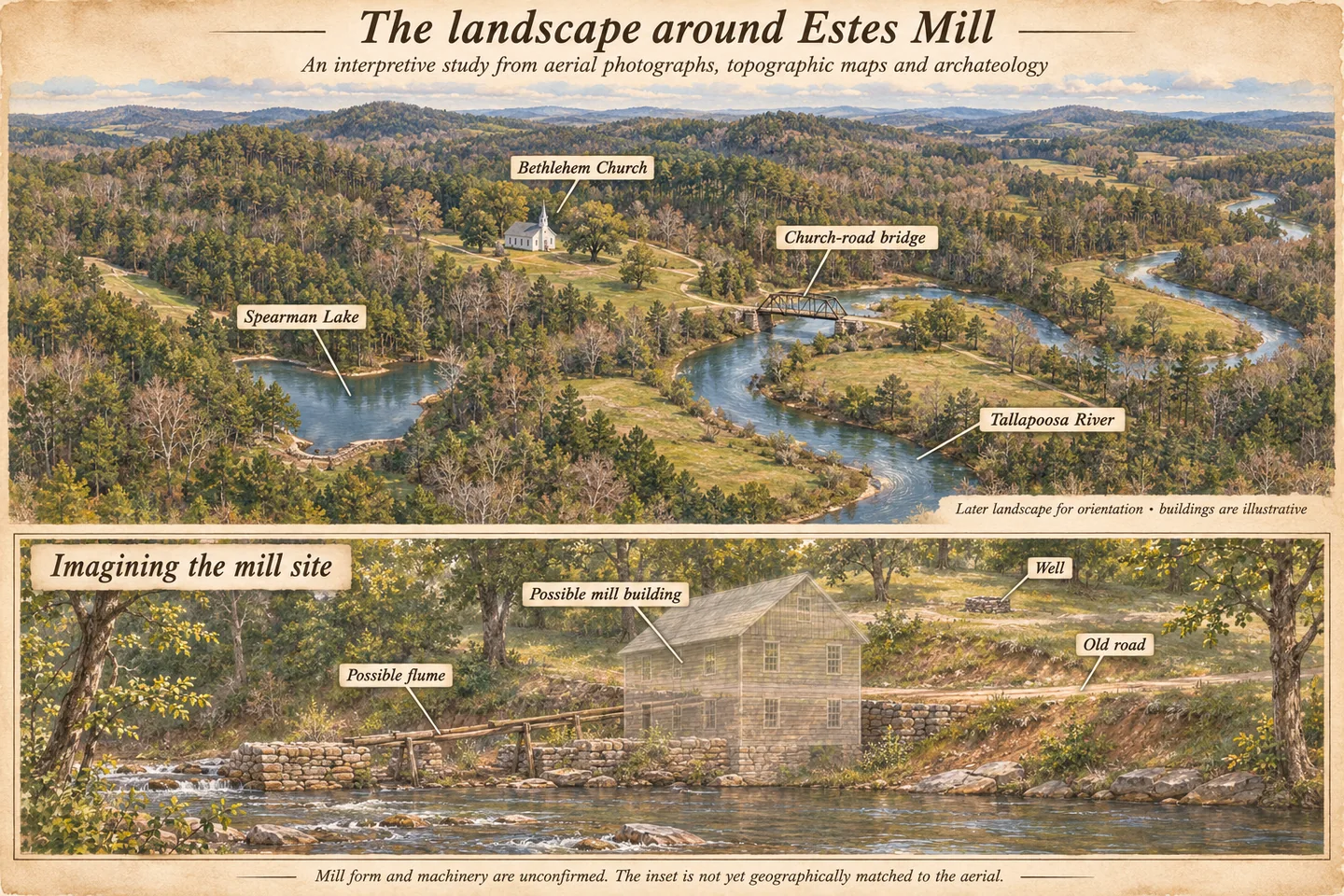
Newspaper notices let us follow pieces of the work. A late-December 1895 report said Mr. Estes was having lumber sawed for a dam at Big Shoals. In June 1896, another reported A. J. Estes traveling to Rome with G. W. Abernathy and buying material for the mill he was building. By August 1897, Cage Ford of Buchanan was reported to be adjusting Estes’s new mill.
Then a customer comes into view. An April 1898 correspondent reported Will Ayres taking a load of grinding to A. J. Estes’s mill. A brief item gives us something a ruin cannot: the name of a person who brought work there.
1896-01-02 · image 51896-06-04 · image 51897-08-26 · image 51898-04-07 · image 51898-07-28 · image 5
What the records tell us
Estes’s disability and family circumstances are his own published account. These notices document activity under his name; matching every reference to the archaeological site remains unfinished. They do not establish the mill’s original founding date, machinery type, or closure year.
Story 02 · Bethlehem Church • 1896–1897
When Bethlehem sang all day
The newspaper recorded the gathering almost like a timetable: a leader, a turn at the music, a break, then another leader. At Bethlehem, singing could fill a day.
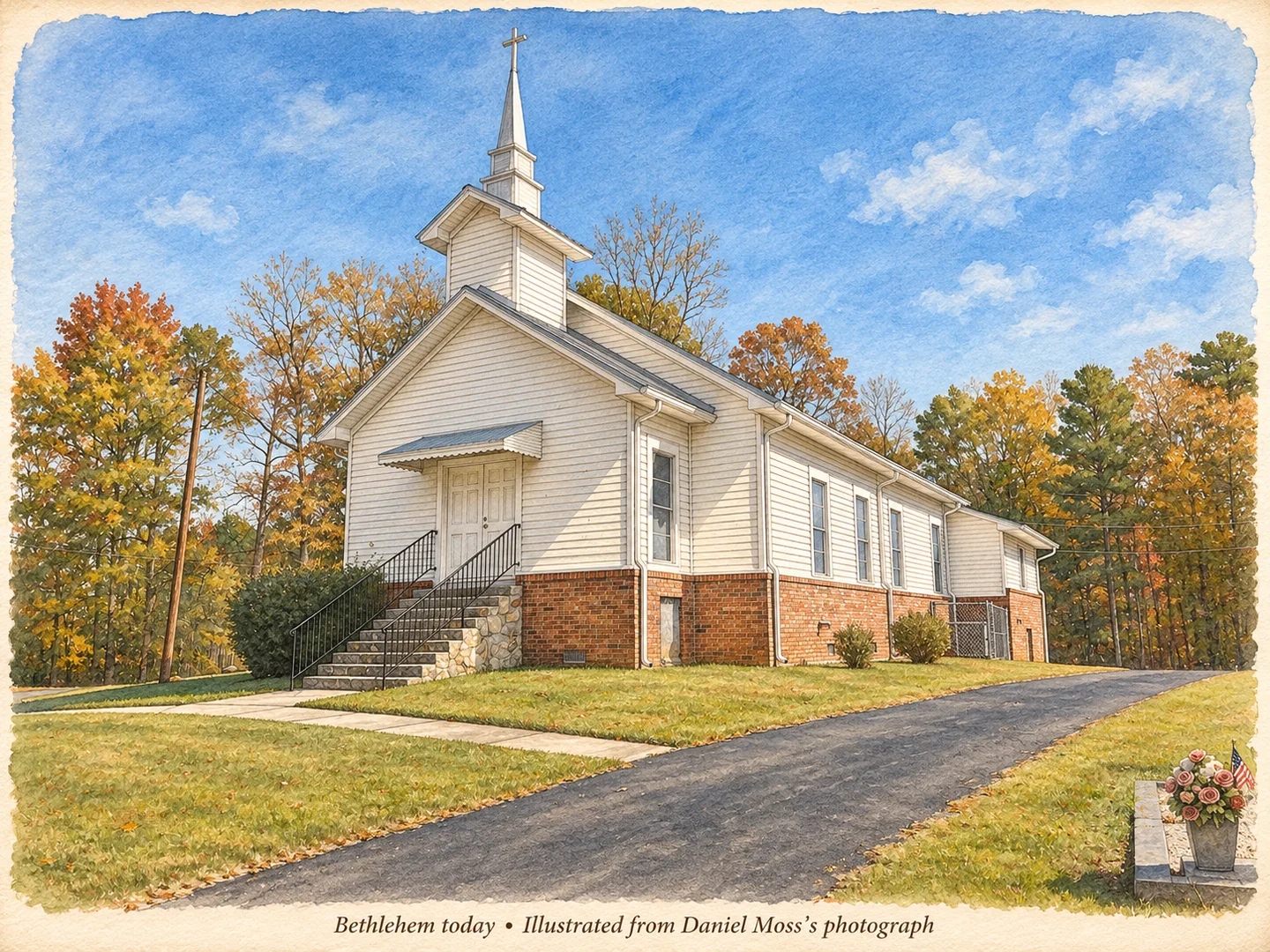
A report published June 4, 1896, described an all-day singing at the church. J. C. Brown served as president, and the opening included prayer by the Rev. J. Fincher. The account named the people arranging the program and those leading the music. Among the leaders were people named Ayres and Fincher, along with B. O. Munroe.
There were twenty-five-minute turns, short breaks, and an hour’s recess. Those details help us understand the occasion. People were sharing responsibility for a program with enough structure—and enough participants—to last beyond a single service.
A July 1897 report provides another program of leaders and timed sessions. Singing appears as a recurring part of community life, not merely one memorable afternoon.
A present-day photograph shows the white church, its steeple, and the nearby cemetery. The newspaper records the people who gathered under the same church name in the 1890s. The building they sang in remains to be identified.
We cannot recover their voices from the page. We can recover the care they took to name the people who led them.
What the records tell us
The reports name leaders and give the length of their turns. Details such as the songs and songbooks remain unknown.
Story 03 · Flatwoods schoolhouse • July 1897
Nora Weatherly left the door open
One small school notice offered a second chance without telling us who took it.
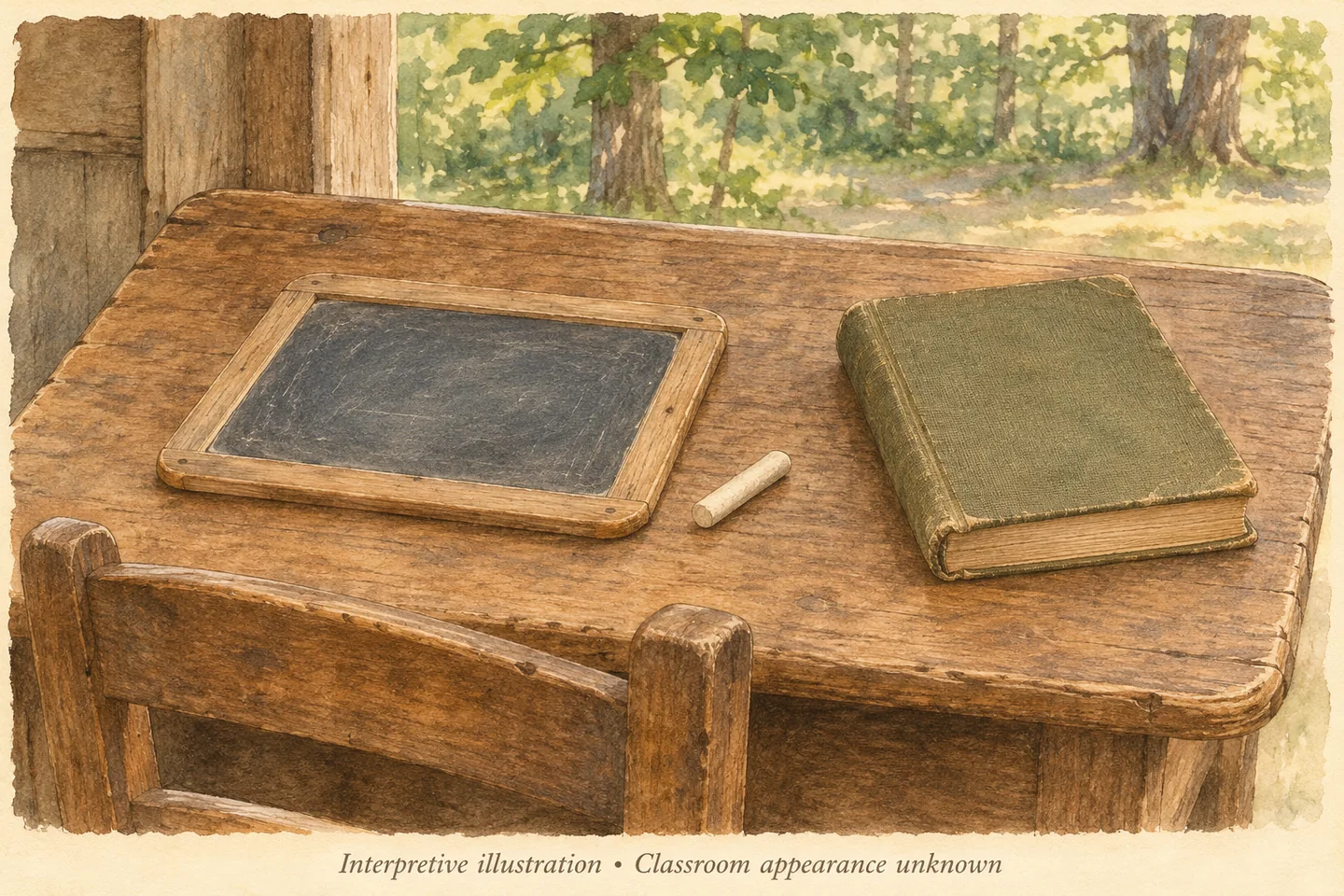
Writing from Estes Mill in July 1897, a correspondent reported that Miss Nora Weatherly had begun school at Flatwoods schoolhouse on July 5. She would also teach people beyond school age for $1.25 a month.
The amount makes the offer tangible. This was a stated price for instruction, not a vague expression of goodwill. But the notice does not tell us whether it was easy or difficult for a particular household to pay, how many people enrolled, or what their lessons covered.
It does tell us that the school’s invitation extended beyond the usual school-age pupils. Someone reading the local news could learn that being older did not put instruction out of reach altogether.
The surrounding columns reported singings, fishing parties, and other neighborhood happenings. Among them was a teacher making a practical offer to people whose school years might already have passed.
We do not yet have Nora Weatherly’s full story. For now, we have her name, the schoolhouse, the starting date, and a monthly price. Those few particulars preserve an opportunity that would otherwise be easy to miss.
1897-07-15 · image 3
What the records tell us
The notice gives the fee and who could take lessons. A school register or teacher’s record could tell us who actually enrolled.
Story 04 · Estes Bridge and mill • July 1898
The picnic that reached the newspaper
A mill could be a place to gather as well as a place to work. In July 1898, a gathering at Estes became a disagreement serious enough for people to explain themselves in print.
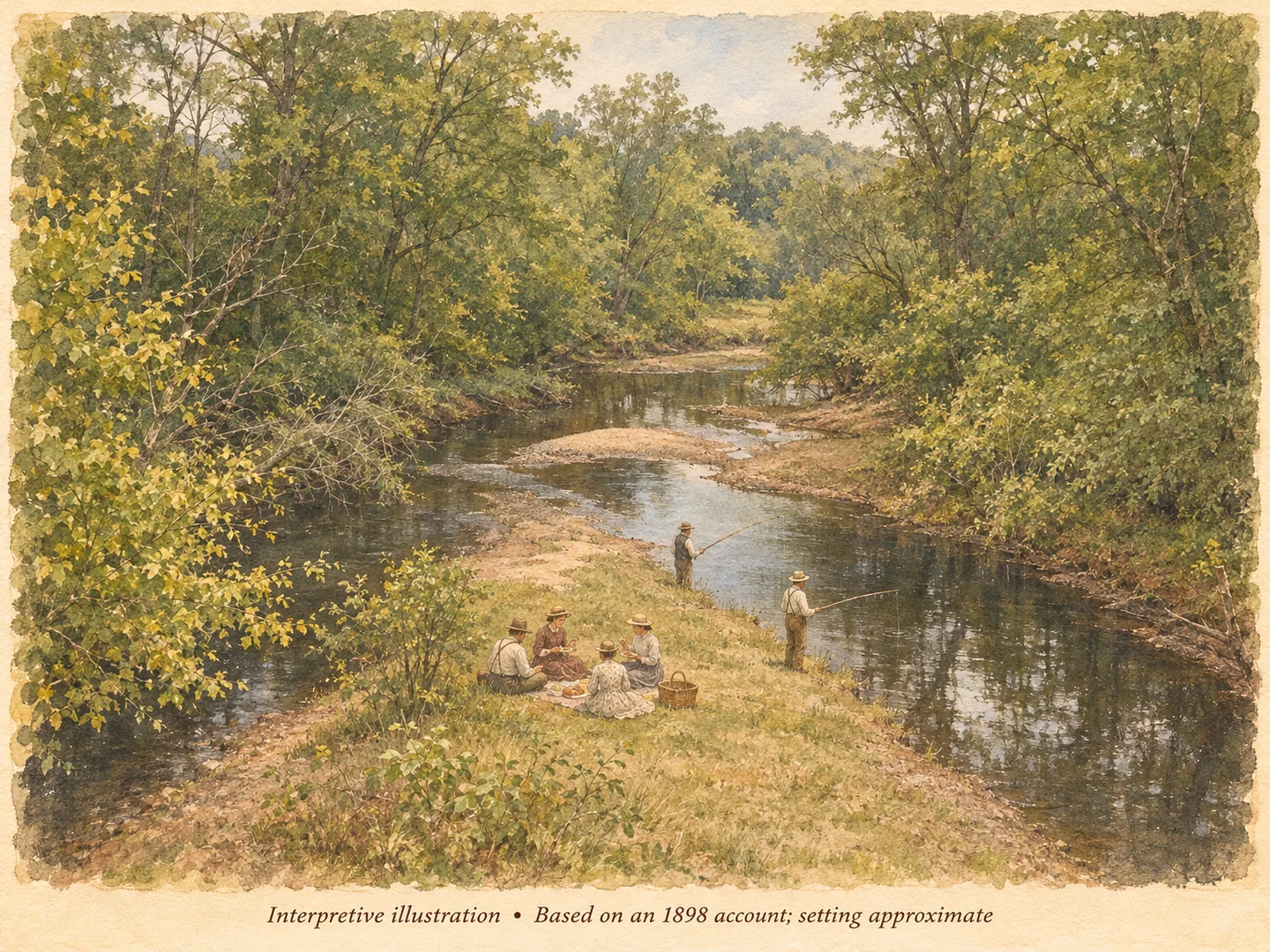
An Estes Mill letter published July 14 described a July 2 picnic at the writer’s millhouse. According to that account, some people stayed to fish, ate dinner at noon, and fished again during the afternoon. The same letter objected to plans for dancing.
Two later letters show why one account is not the whole story. W. H. Fincher defended the Bradley literary and debating society’s planned picnic. He said most of its site-selection committee belonged to Bethlehem Church, acknowledged that permission had not been requested, and denied that the society intended a dance. He distinguished society members from other people who appeared.
A. J. Estes said he welcomed young people’s social gatherings but opposed a ball. He also alleged that people threatened to take their grinding business elsewhere unless he allowed fiddle playing. Fincher’s account likewise mentioned a nonmember threatening to stop patronizing the mill over dancing.
These were neighbors arguing about permission, recreation, conviction, and business. Their published words deserve to remain distinct. We need not decide who was entirely right to see why the argument mattered: a place that supplied one family’s income was also somewhere other people wanted to spend a summer day.
What the records tell us
The July 14 signature appears to read A. G. Estes, and the July 28 letter is signed A. J. Estes. The exact identity of the bridge mentioned in the correspondence remains open.
Story 05 · J. B. Weaver and the Eaves post office • July 1898
More than grinding at Latham
For a mill customer, a simple question mattered: could the mill get the work done?
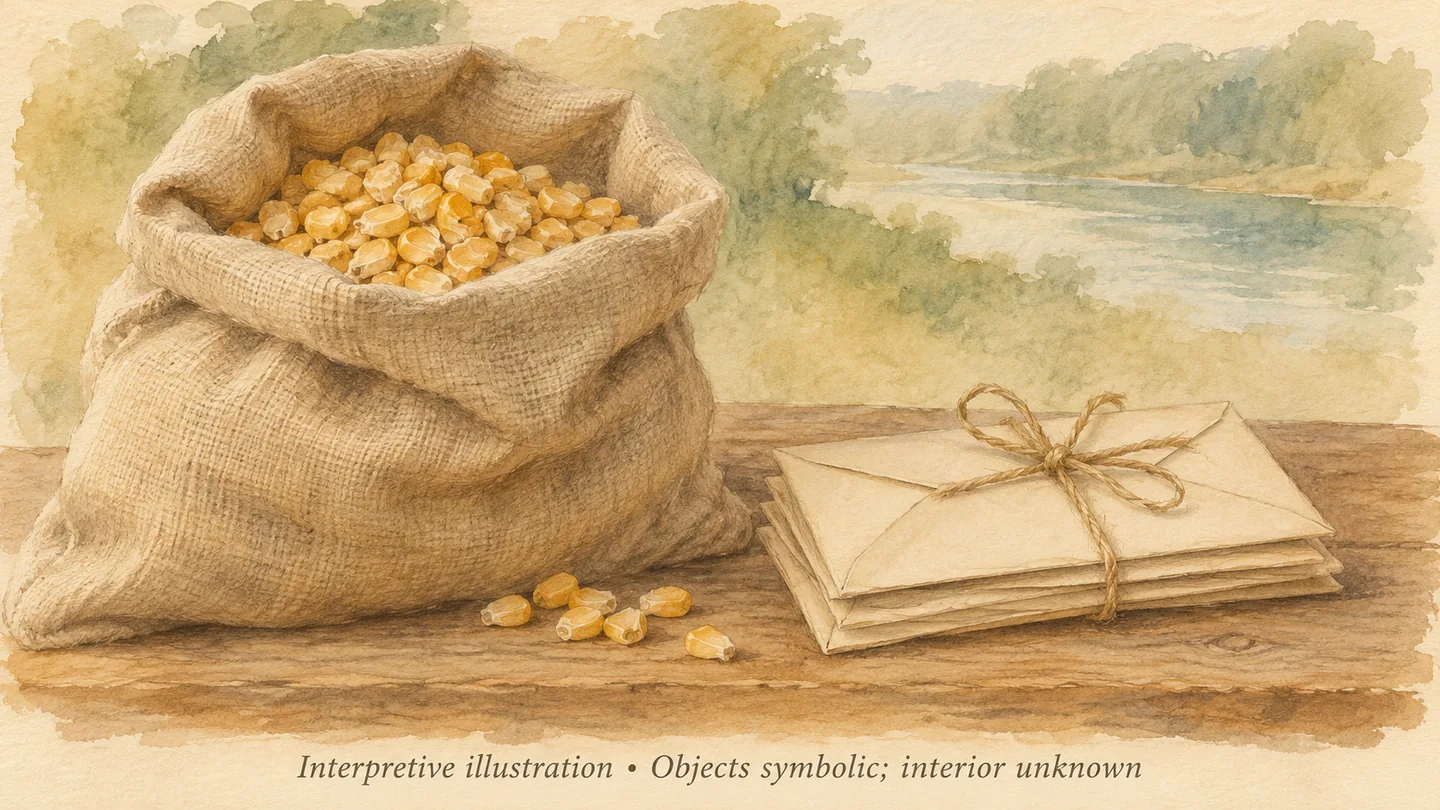
In July 1898, J. B. Weaver announced that Latham mill had caught up with its grinding and had plenty of water for more. The notice addressed two practical concerns together: waiting work and the water needed to keep the operation useful.
Another item on the same newspaper page reported a new post office at Latham mill. Its name was Eaves, and Weaver was the postmaster.
That gives us a second reason someone might have business at this particular mill. Grain processing and postal service occupied the same local destination. We cannot reconstruct an individual customer collecting letters and meal on one visit, but the two services were there.
1898-07-14 · image 8
What the records tell us
Eaves was at Latham mill, a separate place from the Estes and Munroe mill sites. The newspaper documents the appointment of the postmaster. The mail route and delivery schedule remain unknown.
Mill explainer · A visit for grain or meal
You have corn. Now what?
You have grain, but you need cornmeal for cooking. A mill could do the grinding. Before setting out, though, you would want to know what the mill offered and when it worked.

Choose what you need
I have corn to grind
Holcombe advertised grinding on Wednesdays and Saturdays. That gives you something practical to plan around: bring your grain on an advertised grinding day.
Grinding breaks dry kernels into meal. The illustration explains that transformation; it omits much of a working mill’s machinery. We have not established Estes’s exact mechanism, preparation requirements, or grinding charge.
I have corn, but want meal already made
On other days, the advertisement offered an exchange of sound corn for ready meal. You did not necessarily need to wait for your own grain to be ground.
The advertisement does not give an exchange ratio. We should not assume a sack of corn bought an equal sack of meal.
I want to buy meal
Meal was also offered for cash. A customer did not have to bring a crop of corn to use this option. No numerical price appears in the advertisement.
What could affect the trip?
The road: Estes’s 1898 appeal for neighbors to help with road work shows that reaching a mill took maintenance.
The water and waiting work: at the separate Latham mill, Weaver announced in July 1898 that he had caught up with grinding and had plenty of water for more.
The miller’s skill: a later Carrollton advertisement named an experienced miller as part of its sales pitch. These were businesses offering a service that required people as well as equipment.
With that in mind, Will Ayres’s short newspaper mention becomes easier to understand. His reported load of grinding at Estes’s mill was an ordinary job worth making a trip for.
See the power behind the work
The river did more than pass the mill.
A water-powered mill turns the movement of water into the movement of machinery. In this possible arrangement, water held above the downstream level flows through a controlled channel, turns a wheel, and leaves through a lower channel. A shaft and gears carry the rotation to the grinding stones.
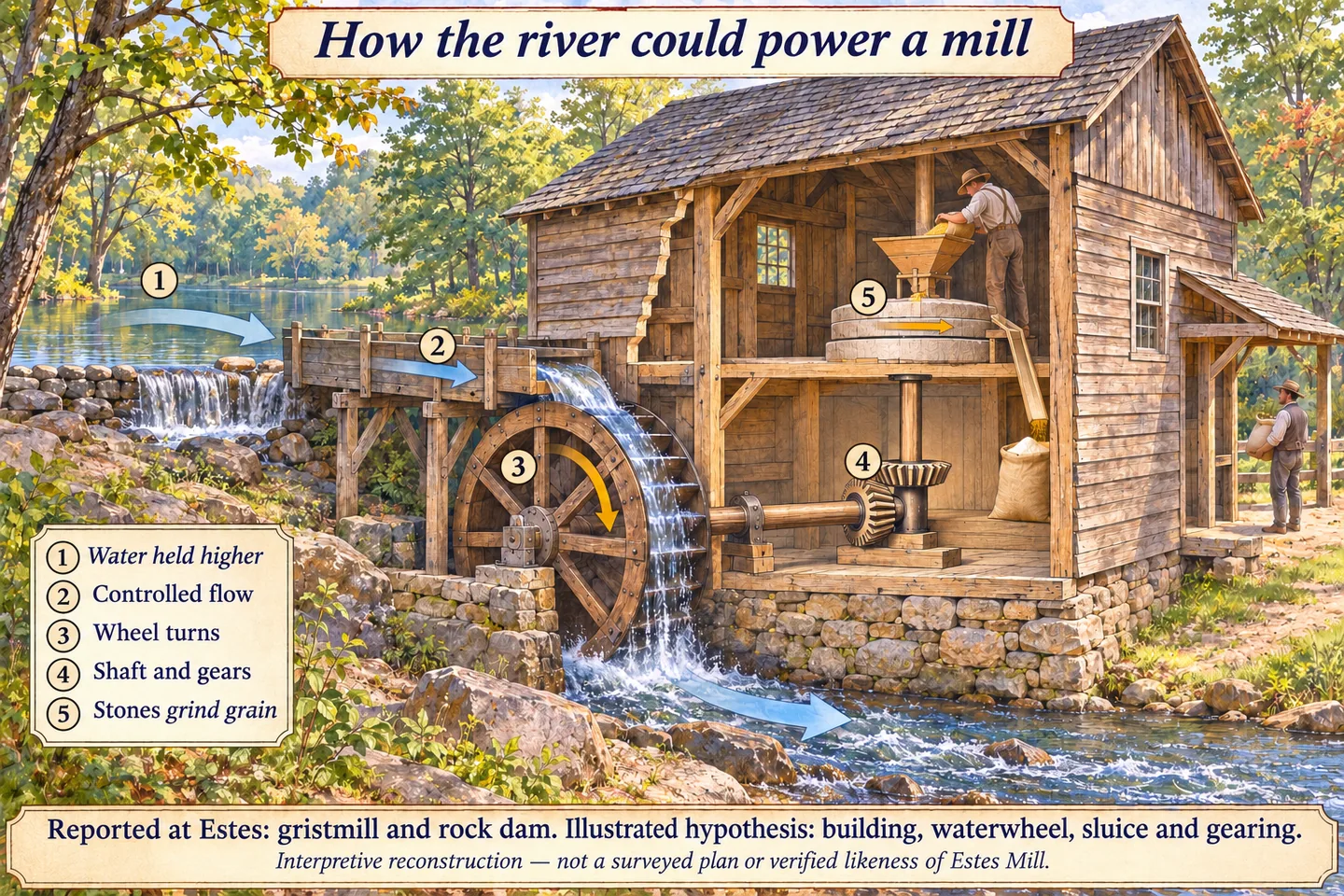
Follow the work through the picture
- Hold water higher. The difference between upstream and downstream water levels provides usable energy. A dam can help create that difference.
- Control the flow. A gate and channel direct water toward the power mechanism. Water does not need to pass through the grinding room.
- Turn the machinery. Here, an illustrative external wheel turns a horizontal shaft. A turbine is another possible water-power arrangement; Estes’s mechanism is not established.
- Carry the rotation inside. Gearing can change the direction and speed of rotation. The pictured gears are simplified, not a buildable design.
- Grind the grain. In a conventional stone arrangement, the upper stone rotates over a stationary lower stone. Grain enters near the center and is ground as it moves outward. Water supplies power; it is not mixed into the cornmeal.
What belongs to the evidence?
Reported in the study: a descendant described Estes as a gristmill with a rock dam; another interview recalled a well and stone foundation after the mill building was gone.
Recorded in contemporary newspaper notices: dam lumber, purchases for mill construction, adjustment of a new mill, and customers bringing grinding.
Reconstructed for this illustration: the entire building appearance, wheel, sluice, gearing, pond shape, foundation layout, workers and spatial arrangement. This is one explanatory possibility, not a verified likeness or surveyed plan of Estes Mill.
Read another local story
 Bethlehem, Beside the TallapoosaPhotograph by Daniel Moss.
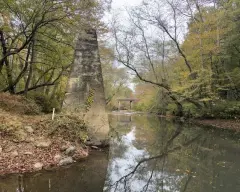 The Mill in the Road’s NamePhotograph by Daniel Moss.
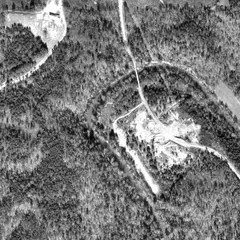 The Road That Reached the RiverASCS aerial, January 26, 1972 · UGA Libraries / Digital Library of Georgia. Public domain. Thumbnail reduced from the article’s original crop. Display thumbnail resized; full image and sources in the story.
What story should we tell next?
Is there a person, place or piece of local history you’d like to see on Moss & Sons? Perhaps your family has photographs, letters, an old business record—or a memory you’d like to share.
You don’t need to have the whole story. Tell us what you know, and we can start there. Daniel reviews contributions and confirms permission before anything is published.
Know someone who would enjoy this? Pass it along.