Atlanta airport · Two names, a changing city
Who were Hartsfield and Jackson?
You have probably heard the airport’s name more often than the stories of the two men in it.
In this story
Two mayors, different chapters
William B. Hartsfield and Maynard Jackson were Atlanta mayors, not a pair of aviation inventors or airline founders. Their names reached the airport at different times: Hartsfield’s in 1971, Jackson’s in 2003. Atlanta History Center connects the first with the airport’s early development and the second with its major rebuilding in the 1970s. The combined name compresses decades of civic choices into a few words. [1]
An airport needs more than suitable ground. Someone must argue for spending public money, secure agreements and keep a project moving across elections. Someone also has to answer the harder questions: who receives the work, and who gives up a home or neighborhood so the airport can grow? The two names offer an entry into that larger history.
Hartsfield saw a future in flight
Hartsfield was an Atlanta native who studied law while working in a law office and entered the Georgia bar in 1917. Elected to city council in 1922, he helped choose the former Candler Speedway for an airfield. Atlanta leased the site in 1925, well before his first term as mayor began in January 1937. His mayoral service ran from 1937 to 1941 and again from 1942 to 1961. [2]
His early aviation work included practical improvements. Atlanta History Center describes his leadership of the city’s landing-field committee, pursuit of airmail service and support for lighting that permitted night flying. Each step made the field more useful. The story is less about a single grand unveiling than about giving a young airport enough capability to become part of a growing transport network. [3]
The city behind the airport
Hartsfield’s long administration also belongs to Atlanta’s history of segregation and gradual change. The New Georgia Encyclopedia describes his development of a biracial electoral coalition after the white primary ended in 1946. Atlanta’s public schools began desegregation in August 1961, near the end of his mayoralty. Its familiar “too busy to hate” image was a civic claim, not proof that racial exclusion had disappeared. Remembering the change also means remembering how late it came. [2]
Demand kept changing the airport itself. Atlanta History Center reports that the terminal opened in 1961 exceeded its intended annual passenger capacity within its first year. By 1980 a much larger terminal complex had opened. A photograph of the earlier terminal is available in the Center’s airport exhibit, a reminder that the place travelers recognize today was not built all at once. [1]
Jackson asked who would share in the work
Maynard Jackson was elected in 1973 and became Atlanta’s first Black mayor. His family history connected him to the city’s struggle for political participation: his grandfather John Wesley Dobbs helped organize Black voters, and his mother Irene Dobbs Jackson integrated the Atlanta Public Library by obtaining a library card in 1959. Jackson graduated from Morehouse and later earned his law degree at North Carolina Central University. [4]
As mayor, he pressed for minority-owned firms to receive a larger share of municipal contracts. Airport construction became a major test of that commitment. The New Georgia Encyclopedia describes both substantial minority participation in the new terminal and conflict with parts of the white business establishment over his policies. These were arguments about access to public economic opportunity as well as the speed and cost of construction. [4]
The policy reached beyond the airport. Atlanta History Center points to increases in women and minority city employees and the creation of Neighborhood Planning Units to give residents a role in zoning decisions. Jackson served two consecutive terms and returned for a third in 1990. Airport history sits within that broader effort to change who could participate in governing Atlanta. [5]
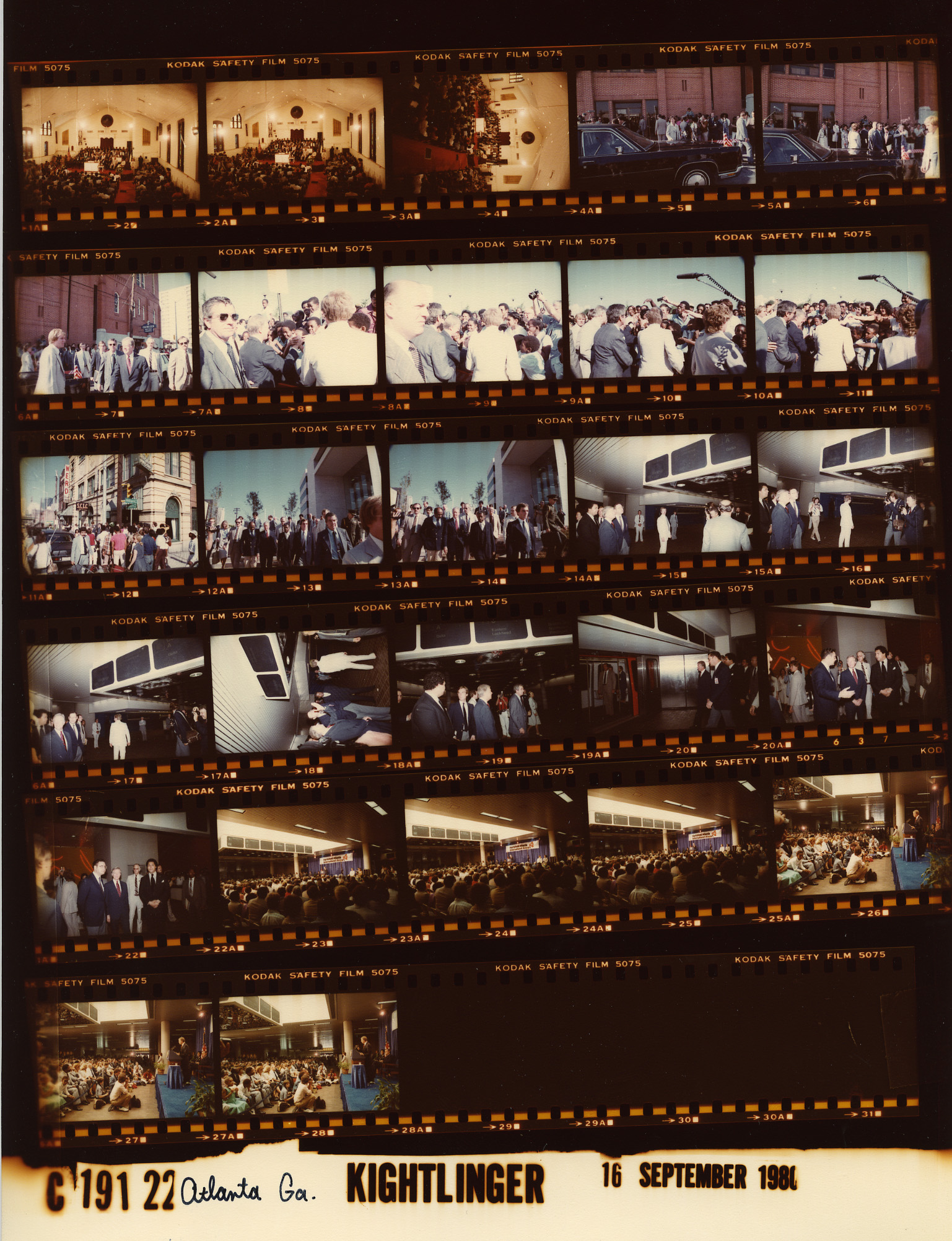
Carter White House Staff Photographers · National Archives, NAID 847082. The sheet is marked Kightlinger. No Copyright – United States.Enlarge this recordNational Archives record

An administrator remembers the difficult part
George Berry, whom Jackson appointed to manage the airport, left a particularly useful account. In a 2009 oral-history interview held by the University of Georgia, he remembered negotiations with airlines, difficult financing and controversy surrounding expansion. He also recalled acquiring developed land and clearing subdivisions. The terminal project involved places where people already lived. [6]
Berry described Jackson’s insistence on minority contracting as another central challenge, then recalled the new terminal opening in 1980. His interview is a participant’s retrospective, with his own judgments about the leaders he served. It offers something a celebratory timeline cannot: a view of the administrative work and disputes behind the finished building. Readers can open the transcript at the airport-management section, beginning around 24:43. [6]
What the name helps us remember
One useful way to read the two names is as a connection between establishing an aviation center and debating how its growth should benefit the city. That is an interpretation, not a complete biography of either mayor. Other mayors, administrators, designers, contractors and workers belong in the account too, as do the residents affected by expansion.
The next time the full airport name passes across a screen, it can carry a little more meaning: public ambition, technical work, contested opportunity and the people whose lives were changed on the ground while others learned to travel farther through the air.
Sources and further reading
Sources reviewed October 25, 2026. This is an airport-focused account, not a complete assessment of either mayor. Citywide contracting percentages are not presented as airport-only figures. Berry’s recollections are attributed as oral history, and his 2009 employment figures are not used as current statistics.
- Atlanta History Center: the airport in Atlanta in 50 Objects
Renamings, terminal changes and a photograph of the earlier terminal. - Louis Williams, New Georgia Encyclopedia: William B. Hartsfield
Career chronology, aviation work and the political context of his mayoralty. - Sophia Dodd, Atlanta History Center: Key Figures of the Atlanta Airport
Early aviation advocacy. Conflicting purchase-year and “first” claims are not repeated here. - Bradley R. Rice, New Georgia Encyclopedia: Maynard Jackson
Family, election and municipal-contracting context. - Atlanta History Center: Maynard Jackson in Atlanta in 50 Objects
City employment, neighborhood participation and terms in office. - University of Georgia: George Berry interview, February 2, 2009
Richard B. Russell Library, Reflections on Georgia Politics; Bob Short interviewer. Airport expansion begins around 24:43 in the indexed transcript.
Read another local story
- The river beneath the runwaysAbout 4 min read
- The working town beside the airportAbout 5 min read
- Bored at Atlanta Airport? Explore Before You Board
Share a photo, memory or landmark
Daniel reviews contributions before anything appears publicly.
Know someone who would enjoy this? Pass it along.