Haralson County history
A Little Gold in Haralson County
One of Haralson County's gold stories begins with a pan of potatoes.
In this story
Something in the dirt
In a geological report published in 1896, the state preserved an account of William Owens noticing bright specks of gold while potatoes from his patch near Tallapoosa were being washed. An investigation of the patch revealed a rich surface deposit. Something in the dirt had been worth a closer look. [1]
According to that account, Owens began mining and eventually built a twelve-stamp mill on Walker Creek. He worked both the surface deposits and the gold-bearing rock. The story had grown from a household chore into a venture requiring machinery and labor. [1]
After the rain
A second account brings the story back down to the size of something a person could pick up.
In his 1909 report on Georgia gold deposits, geologist S. P. Jones described the property of J. W. Harris, adjoining the Edwards mine in Haralson County. A little gold had been panned from gravel in a small gulch. Harris also had several particles of fairly coarse gold that his son had collected from the bottom of the gulch after showers of rain. [2]
The report does not give the son's name or age. It leaves us with that small, memorable detail: gold noticed on the ground after rain. Alongside descriptions of machinery and rock formations, somebody thought that discovery was worth recording.
Beyond the barren quartz
The larger workings had their own moments of discovery, and their own uncertainties.
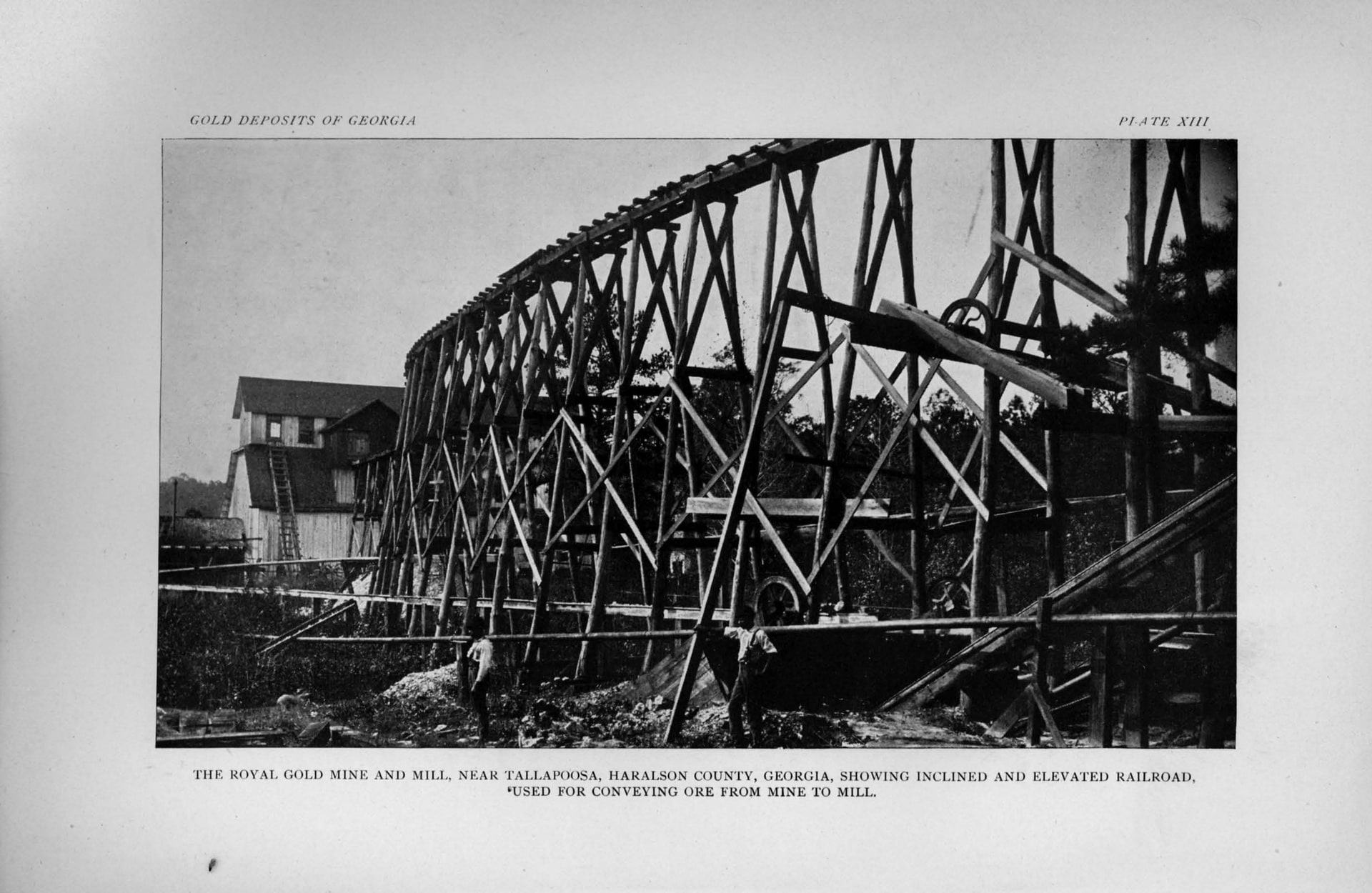
The Owens property passed through other hands and became known as the Hollins mine and, later, the Royal mine. By the time mining writer William M. Brewer visited in February 1897, its underground workings offered a story about how difficult the ground could be to read. [1] [3]
Brewer remembered seeing the property in 1894. Earlier miners had encountered a mass of barren quartz that appeared to have replaced the ore they were following. Work had stopped. When the tunnel was later extended, however, gold-bearing material was found beyond that obstruction. [3]
On his return, Brewer could examine the result for himself. Ore was being mined from workings above the tunnel on the 75-foot level. At the surface, the mills were running, and he could see that their collecting plates were catching gold. [3]
He was careful about what that proved. He would not estimate the ore's grade simply from the appearance of the plates. His account gives us both the excitement of finding ore beyond an apparent dead end and the limits of what a visitor could honestly say about its value. [3]
The work that followed
There were practical reasons for that caution. A later geological study of west-central Georgia described how miners often began with stream gravel and weathered deposits before following the gold into harder, unweathered rock. At depth, the amount of gold could diminish. Even where enough remained to interest miners, separating it from pyrite-bearing ore presented another problem. The Royal was among the mines that used chemical treatment to address that difficulty. [4]
The place we call home
Taken together, these records give Haralson County a gold story with a human scale. There is the work of noticing something, the decision to investigate it, and the much larger effort of following it underground. There are also gaps: names we have not recovered, details the reports never supplied, and questions that their authors left open.
The potato patch, the gulch after rain, and the tunnel beyond the barren quartz each offer a way into that history. They let us picture the people paying attention to this ground, trying to understand what it held.
Their stories give us another reason to look carefully at the place we call home.
Sources and further reading
- W. S. Yeates, S. W. McCallie and F. P. King, A Preliminary Report on a Part of the Gold Deposits of Georgia (1896)
Bulletin 4-A, printed p. 250 and its footnote: Owens, the twelve-stamp mill and the Hollins/Royal names. The potato-patch account was recorded long after the reported discovery. Early accounts differ on discovery details, so this article does not assert an exact discovery year. Plate XIII supplies the photograph. - S. P. Jones, Second Report on the Gold Deposits of Georgia (1909)
Bulletin 19, printed p. 141: the Harris property adjoining the Edwards mine and the son’s find after rain. Jones does not say he witnessed the collection. - William M. Brewer, “Gold Mining in Georgia,” Engineering and Mining Journal, March 20, 1897
Printed p. 280: his visits, the barren quartz, the extended workings and the running mills. His milling observations do not establish a production total or profit. - Jerry M. German, The Geology of Gold Occurrences in the West-Central Georgia Piedmont (1988)
Bulletin 107, printed p. 13: weathered deposits, deeper ore and difficulties recovering gold from pyritic material. The Royal gold mine in this article is near Tallapoosa.
Know someone who would enjoy this? Pass it along.