Tallapoosa mining history
Royal-Vindicator: the machinery behind Haralson's gold
An elevated ore railway, heavy stamp mills, steam engines, and a stubborn problem inside the rock: a closer look at the Royal-Vindicator gold mine.
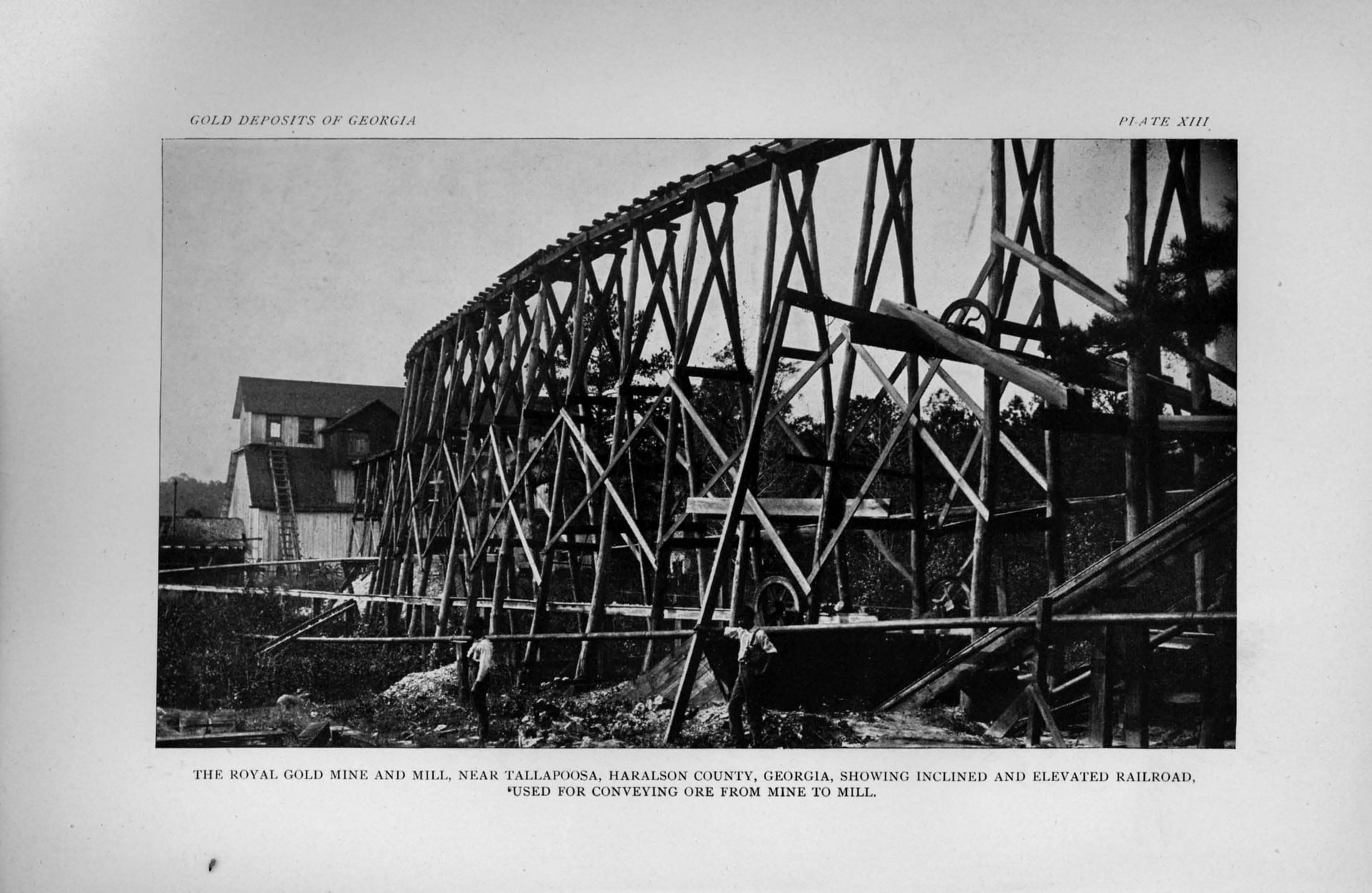
The most striking feature in an 1896 photograph of the Royal Gold Mine is its elevated railway. A long line of timber supports carries the track toward the mill, while people standing underneath give the structure its scale. The caption explains its purpose: moving ore from the mine to the mill. Here, near Tallapoosa, gold mining had become a substantial mechanical undertaking. [1]
In this story
The same mine, several names
Older records call the property the Hollins mine and connect it with the Camille Gold Mining Company. The Royal Gold Mining Company bought it in 1896, and the site later became known as Royal-Vindicator. These changing names can make one mine appear to be several different places. Its historical setting was near Walker's Creek outside Tallapoosa. [1] [2] [3]
The 1896 report traced the discovery to William Owens in the early 1840s and repeated a story that gold was noticed while potatoes were being washed. It is a memorable account preserved in an early survey, although the geologists were writing decades after the reported discovery. The machinery they inventoried gives us firmer detail about the developed operation. [1]
Twenty heavy stamps, then a larger plant
The 1896 inventory listed a twenty-stamp mill, with each stamp weighing 950 pounds. It also recorded a Blake rock crusher, automatic feeders, and eight Frue vanners, machines used to concentrate crushed ore. The mill was part of a sequence: break the rock, crush it more finely, and separate the heavier mineral-bearing material for further treatment. [1]
By the survey published in 1909, the description had changed. S. P. Jones recorded four ten-stamp batteries, concentrating tables, an adjoining Huntington mill, and a substantial roasting and chlorination plant. Those descriptions belong to different snapshots of the mine. Together they show how much equipment owners assembled in their efforts to make the deposit pay. [2]
The hard part came after digging
Getting gold-bearing rock out of the hillside did not guarantee a profitable mine. The early survey described quartz stringers and schist with abundant sulfides, and reported that operators struggled to recover the gold from this material. This was the problem behind the word refractory in later descriptions: ore that resisted the simpler treatment methods available to the operators. [1] [2]
The roasting and chlorination equipment represented an effort to address that difficulty. The historical interest lies in the whole system. The elevated railway moved ore; the mills reduced it; concentration and chemical treatment aimed to recover what crushing alone could not. Royal's story is as much about processing a difficult material as finding it underground. [1] [2]
Power, pumps, and a place to live
The 1896 equipment list included a 150-horsepower Corliss engine, another engine, two boilers, an air compressor, drilling machines, and several pumps. Water had to be managed alongside broken rock and mechanical power. Earlier operators had installed pumping machinery after the Civil War, according to the same account. [1]
The list also included seven laborers' cottages, a commissary, a blacksmith shop, a superintendent's residence, and an assay office. These details widen the picture beyond shafts and machinery. Housing, supplies, repairs, and testing all had places in the operation. The report does not tell us every worker's story, but its inventory preserves evidence of the community and daily work surrounding the mine. [1]
Expensive equipment, interrupted work
Jones found that the mine had been idle for several years when it was examined for the 1909 survey; the underground workings were inaccessible. He nevertheless regarded its treatment plant as one of the state's most extensively equipped. Those two observations belong together. A large mill could testify to serious investment while also standing unused. [2]
A later geological account describes another operating period from 1914 to 1917 under the Royal Vindicator Mines Company, followed by investigation without renewed production in the mid-1930s. Still later exploration studied the deposit again. These were successive attempts and investigations, rather than one uninterrupted gold-producing enterprise. [3]
Look again at the railway
The old photograph rewards a second look after reading the machinery list. Its trestle joins one part of a much larger process. Beneath the broad label gold mine were jobs involving timber, steam, stone, water, metalwork, and mineral testing. Royal-Vindicator gives Haralson County a remarkably tangible place in that history: a documented industrial operation whose ambitions can still be read in an ordinary photograph. [1]
The dates at a glance
- Early 1840s, in the 1896 accountWilliam Owens is credited with the early discovery and workings; the potato-washing story is a retrospective account. [1]
- After the Civil WarThe survey describes a ten-stamp steam mill and pumping machinery under Windom & King. [1]
- 1896The Royal Gold Mining Company acquired the property. The state survey published the elevated-railway photograph and a detailed equipment inventory. [1] [2]
- 1909 reportJones described a substantial plant, including forty stamps, while reporting that the mine had been idle for several years. [2]
- 1914–1917A later geological history identifies an operating period under the Royal Vindicator Mines Company. [3]
Sources and further reading
- W. S. Yeates, S. W. McCallie, and F. P. King, A Preliminary Report on a Part of the Gold Deposits of Georgia (1896)
Bulletin 4-A, Hollins mine, printed pp. 250–252 and Plate XIII. Equipment figures follow this inventory; the photograph was published in 1896. - S. P. Jones, Second Report on the Gold Deposits of Georgia (1909)
Bulletin 19, printed pp. 140–141. The later forty-stamp inventory and account of idle workings describe a different survey date. - Proceedings of the Symposium on the Economic Mineral Deposits of the Southeast: Metallic Ore Deposits (1990), Royal Vindicator study
Royal Vindicator study, printed pp. 50–52. Supports the 1914–1917 operating period and mid-1930s investigation. This article does not assign a single final closure date.