Cleburne County · Gold country
Arbacoochee: the gold rush just across the state line
Before California drew the prospectors west, Arbacoochee grew around rich gravel, hard work, and the uncertain promise of gold.
Long before California's gold rush, miners were washing gravel at Arbacoochee, just across the state line from West Georgia. The district became one of Alabama's important early mining places. Its story leads through creek gravel, hillside workings, a growing community, and the practical problem that could stop even promising ground: getting enough water to work it. [1] [3]
In this story
A gold community before Cleburne County
We locate Arbacoochee in Cleburne County today, but the gold rush came before the county. Cleburne was created on December 6, 1866, from parts of Randolph, Talladega, and Calhoun counties. The mining excitement belonged to the 1830s and 1840s, when discoveries around Arbacoochee and neighboring Chulafinnee attracted people to land that had been home to Creek and Cherokee communities. The familiar county name can therefore hide an earlier geography. [2]
How large did Arbacoochee become? Later accounts suggest thousands of people, but their numbers and dates differ. The Encyclopedia of Alabama's mining article estimates about 5,000 residents by 1845; its county article describes some 5,000 miners reaching the wider area by 1836. Those statements describe different places and populations. They help convey the scale of the excitement, but they should not be treated as a precise town census. [1] [2]
The riches were in the gravel
A U.S. Geological Survey history identifies Arbacoochee's placers as Alabama's richest. Much of the recovered gold came from weathered deposits around Gold Hill and gravel along Clear Creek. A placer is a concentration of gold in loose material, rather than gold still locked inside a solid vein. That distinction changes the picture: this was not simply a story of miners following a glittering seam deep underground. Much of the work involved moving and washing earth. [3] [1]
The equipment could be straightforward, but the labor was substantial. A nineteenth-century federal mining account described the region's progression from pans to rockers and sluice boxes. It specifically recorded an earlier report of hillside washing at Arbacoochee using a ditch and trenches. Running water helped carry away lighter material while the heavier gold was collected. The historical account also mentions mercury, part of an extraction practice whose environmental consequences belong in the story alongside the discoveries. [4] [1]
A promising deposit still needed a workable operation
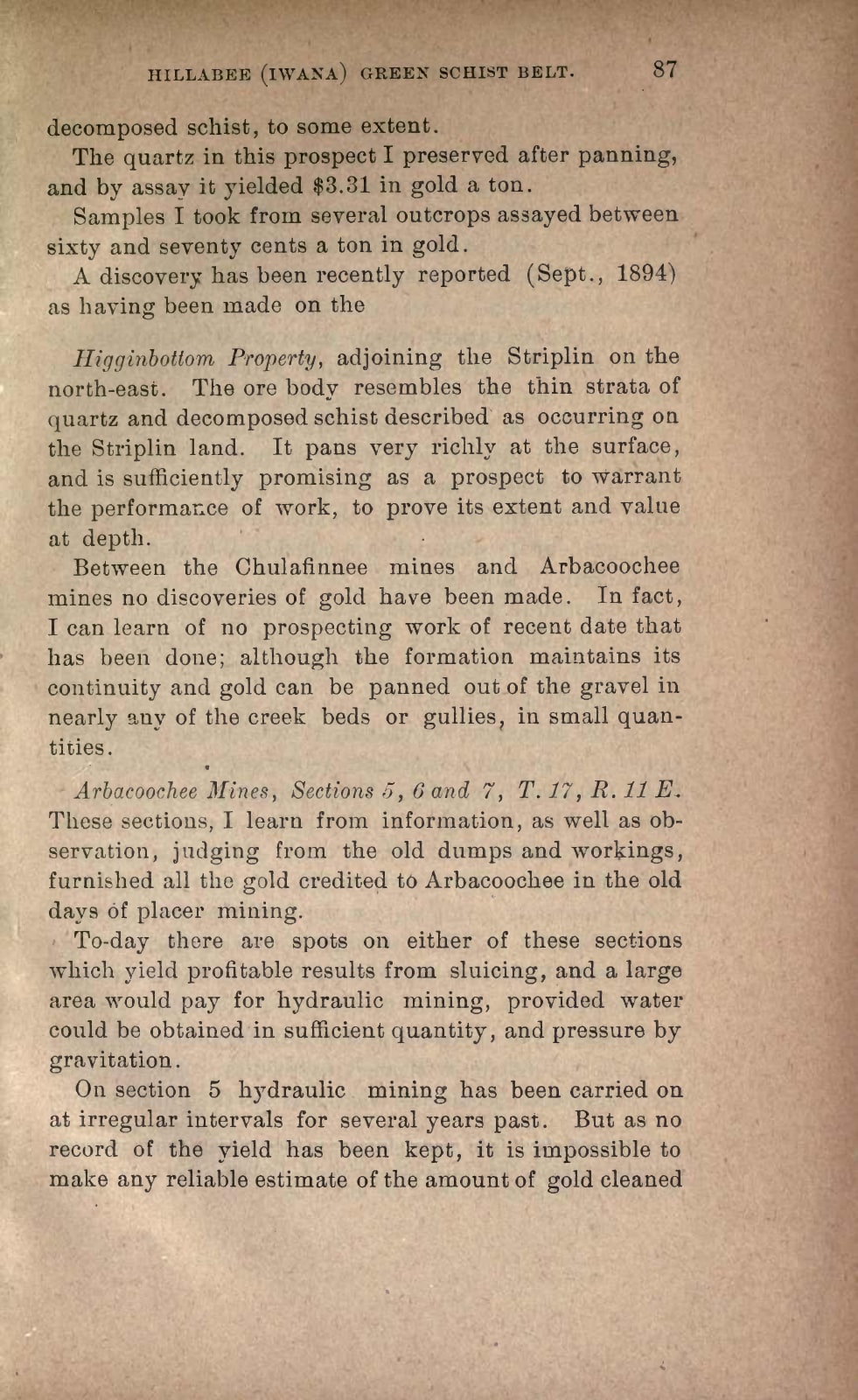
William M. Brewer's 1896 Geological Survey of Alabama report brings the work down to a practical scale. He identified old workings in sections 5, 6, and 7 and found places where sluicing still yielded results. Yet he repeatedly separated finding gold from finding ground that would pay to work. Color in a pan was encouraging; it did not establish a profitable mine. [5]
Water was one obstacle. Brewer reported a proposed supply for part of the Denson property that would have to come from the Tallapoosa River, roughly two and a half miles away. He also said that intermittent hydraulic work had left no reliable production record. He would not turn stories about rich pockets and large nuggets into dependable totals. That caution, written while mining memories were much fresher, is a useful check on the grand claims that still circulate. [5]
A community rose around the diggings
A preservation nomination prepared in 1974 remembered a settlement with a hotel, drugstores, saloons, churches, small frame houses, and tents. It also described a surviving two-story brick store, with living quarters above the business. These are details from that historical assessment, not a description of what stands there now. They remind us that a gold rush required food, shelter, supplies, and ordinary household work as well as prospectors. [6]
California's gold discoveries pulled miners west in 1849, but Arbacoochee did not stop producing a history on one dramatic day. The USGS account says only a few miners remained at work by 1874 and describes later attempts to develop underground deposits. The 1974 nomination likewise notes intermittent mining into the early twentieth century. The better story is a boom followed by decline and repeated attempts to revive it. [3] [6]
Arbacoochee makes our nearby hills part of the larger American gold story. Its strongest surviving evidence is wonderfully specific: gravel beds, water supply, recorded workings, and a surveyor willing to say what he could not prove. Those details make the place more interesting than a treasure legend alone. [3] [5]
The dates at a glance
- 1830s–1840sGold mining grows around Arbacoochee and Chulafinnee; later population estimates vary. [1] [2]
- 1849California's gold rush draws miners away from Alabama. [1]
- 1866Cleburne County is created after the mining boom's early years. [2]
- 1896Brewer publishes field observations and cautions about missing production records. [5]
Sources and further reading
- Gold Production in Alabama — Encyclopedia of Alabama
George Garner; distinguishes the estimated 1845 town population from wider regional accounts. Checked October 18, 2026. - Cleburne County — Encyclopedia of Alabama
County creation and Indigenous context; its 1836 figure concerns miners in the area, not necessarily Arbacoochee's town population. - Principal Gold-Producing Districts of the United States, USGS Professional Paper 610 (1968), pp. 7–8
Cleburne County section: Gold Hill, Clear Creek, early activity, decline, and later lode work. Historical mining evidence, not present access information. - USGS Twentieth Annual Report, Part VI, Mineral Resources (1899), p. 114
Historical placer methods; cites Tuomey's account of hillside sluicing at Arbacoochee. Used only for historical practice. - W. M. Brewer, A Preliminary Report on the Upper Gold Belt of Alabama (1896), pp. 87–89
Primary field report on water requirements, irregular hydraulic work and the limits of production estimates. - Arbacoochee preservation nomination, Alabama Historical Commission, 1974
Later historical assessment with oral-history sources. Building descriptions refer to the 1974 record.