Paulding County history
Yorkville's gold mine: from a creek to a 460-foot tunnel
Gold in a creek in 1855 led to an eight-stamp mill, underground workings, and repeated attempts to develop a mine near Yorkville in Paulding County.
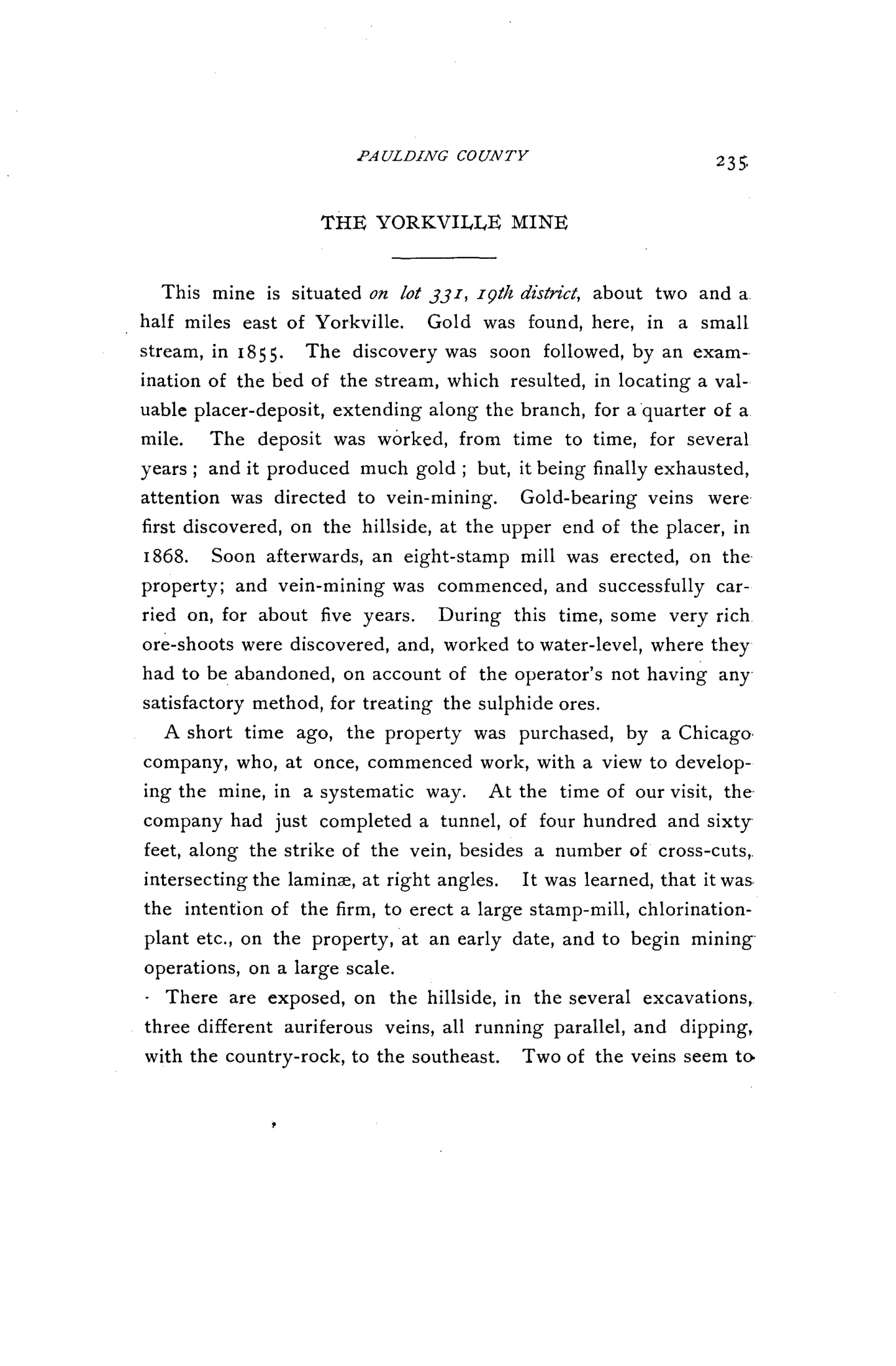
The first clue was in a small stream. Georgia's 1896 geological survey says gold was found near Yorkville in 1855, followed by a placer deposit stretching about a quarter of a mile along the branch. A few decades later, the same property had a long tunnel driven into the hillside. In those two facts lies a whole change in the character of local mining. [1]
In this story
Following the gold upstream
The Yorkville mine lay about two and a half miles east of the community, on land lot 331 in the nineteenth district. The survey describes several years of intermittent work in the stream deposit before miners turned their attention to veins in the hillside at its upper end. It dates the vein discovery to 1868; the later 1909 account gives 1869. The records agree on the larger sequence, even where the year differs. [1] [2]
Placer mining worked gold that weathering and flowing water had freed from rock and concentrated in sediment. Following that gold back into the hillside meant a different undertaking: working the rock that contained it. Yorkville's history connects the familiar image of washing creek gravel with mills, shafts, and underground development. [1] [2]
Eight stamps and a difficult boundary
Soon after the hillside discovery, an eight-stamp mill was erected. The 1896 account says vein mining continued successfully for approximately five years. It also records the obstacle that interrupted the work: rich ore shoots were followed down to water level, where the operators lacked a satisfactory method for treating the sulfide-bearing ore. [1]
That is a more revealing explanation than a simple story of all the gold running out. The stream deposit and the underground material posed different problems. An ore sample could contain gold while the available equipment failed to recover enough of it economically. Yorkville's difficulty was part of the larger challenge of moving from weathered surface material into less-altered rock. [1] [2]
The Chicago company's tunnel
Another attempt brought a Chicago company to the property. Jones later dated the beginning of that work to about 1894. When the earlier survey's investigators visited, a tunnel had been completed along the direction of the vein, with crosscuts driven across it. Their report measured the tunnel at 460 feet. [1] [2]
The developers intended to add a larger stamp mill and a chlorination plant. Those were plans reported at the visit, not proof that the proposed operation was completed. In 1909, Jones said the company had failed to put the mine on a permanent working basis. He gave the tunnel length as 450 feet. This article's title follows the 1896 measurement, the account made while the workings were in better condition for examination. [1] [2]
Three veins in the hillside
The early geologists described three roughly parallel gold-bearing zones dipping southeast with the surrounding rock. Two appeared to be separate ore shoots rather than continuous veins. The third, then being worked, averaged about fifteen feet across over the exposed distance. Quartz, dark mica schist, and gold-bearing pyrite were part of the material they described. [1]
Those distinctions mattered to anyone deciding where to dig next. A rich pocket did not automatically continue unchanged through the hill. Crosscuts and tunnels allowed operators to examine the deposit beyond its surface exposure. The surviving account is valuable because it records what the surveyors could see, alongside the developers' hopes for what further work might reveal. [1]
Interest returned during the Depression
Yorkville's story continued beyond the nineteenth-century effort. A February 1935 issue of Georgia's Forestry-Geological Review reported prospecting in the old mine's placer and saprolite deposits under J. Sproul Colbert. Saprolite is deeply weathered rock that retains traces of its original structure. The report placed that activity within a wider revival of interest in Georgia gold. [3]
The state's mineral directory for 1935, published in March 1936, also listed Yorkville Mine and manager J. S. Colbert. These entries document renewed attention; they do not supply a verified production total or establish continuous operation. Small notices like these help connect the famous discoveries to the less familiar later chapters. [4]
More than an isolated hole in the ground
The 1896 survey also described nearby Barton property, with shafts, short tunnels, an open cut, and a small stamp mill. Yorkville belonged to a local cluster of attempts to understand and work the gold-bearing ground. Read together, these records preserve a history of observation, machinery, investment, disappointment, and renewed effort—all within a part of Paulding County many people know primarily through its roads and communities today. [1]
The dates at a glance
- 1855The 1896 report dates the stream-gold discovery and beginning of placer work to this year. [1]
- Late 1860sVeins were found on the hillside: 1868 in the 1896 report, 1869 in the 1909 retelling. An eight-stamp mill followed. [1] [2]
- About 1894A Chicago company began development, according to Jones's later account. [2]
- 1896 reportSurveyors described a completed 460-foot tunnel and proposed additional treatment machinery. [1]
- 1935–1936 recordsState publications recorded renewed prospecting and listed Yorkville Mine in the mineral directory. [3] [4]
Sources and further reading
- W. S. Yeates, S. W. McCallie, and F. P. King, A Preliminary Report on a Part of the Gold Deposits of Georgia (1896)
Bulletin 4-A, Yorkville and Barton properties, printed pp. 235–236. Original account of the creek discovery, eight-stamp mill and 460-foot tunnel. - S. P. Jones, Second Report on the Gold Deposits of Georgia (1909)
Bulletin 19, printed pp. 142–143. Its 1869 discovery date and 450-foot tunnel differ from the earlier report; both versions are identified in the story. - Forestry-Geological Review, February 1935
Page 8: contemporary state notice of renewed prospecting under J. Sproul Colbert. - Forestry-Geological Review, March 1936: Georgia Mineral Directory 1935
Page 7: lists Yorkville Mine and manager J. S. Colbert. The entry records the business without a production total.