Haralson & Carroll County history
Reeds Mountain: the mining story beside Bremen
A railroad, a mountain, and thousands of tons of pyrite: the industrial story hidden in Georgia's 1918 survey of Reeds Mountain near Bremen.
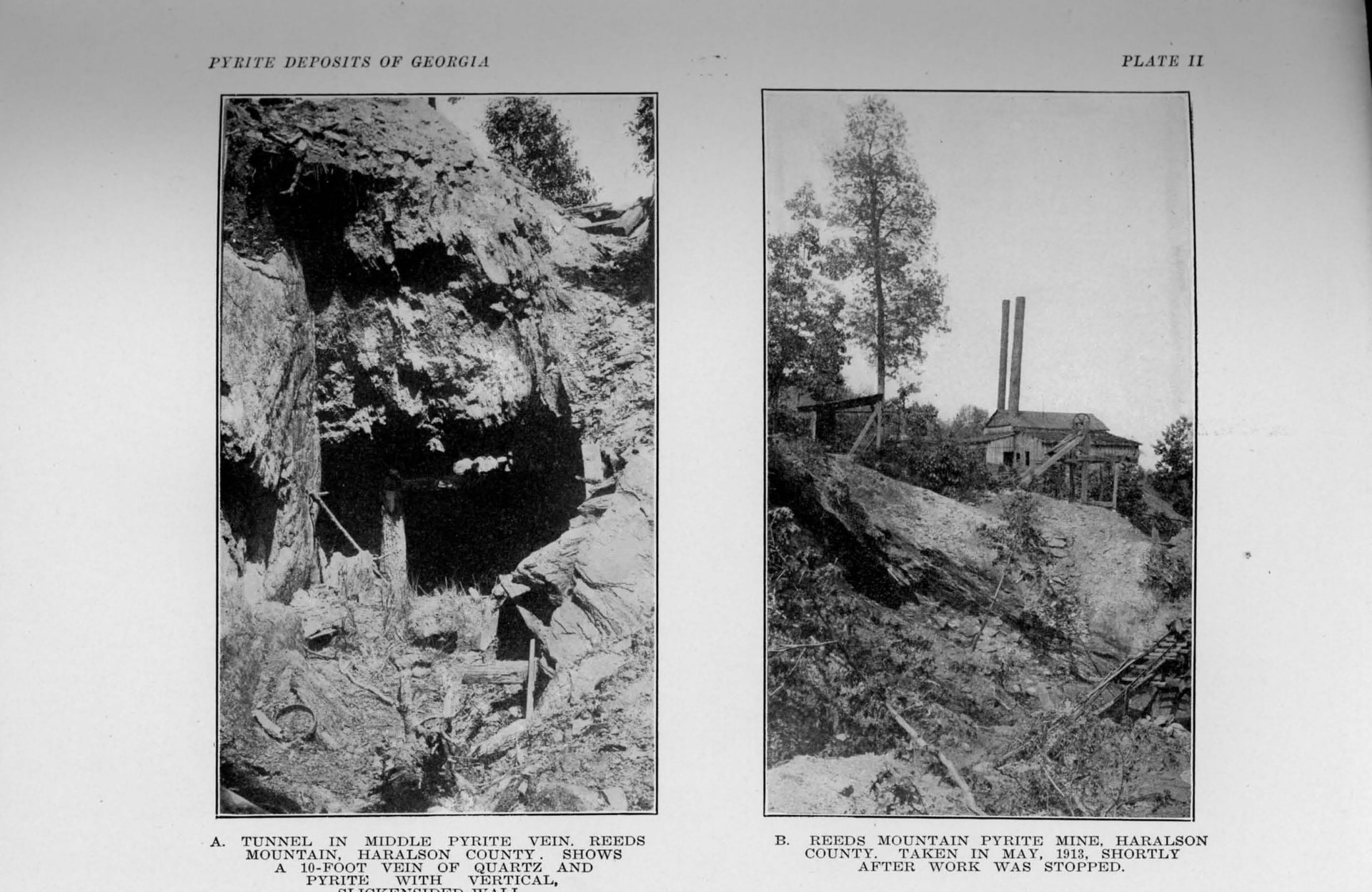
An old photograph of Reeds Mountain shows a mill with two tall smokestacks standing above a cut in the hillside. Another shows the dark mouth of a mine tunnel. Both appear in Georgia's 1918 geological survey, and both belong to the countryside beside Bremen. The mineral at the center of this story was pyrite, an iron sulfide valued as a source of sulfur. [1]
In this story
A shaft before the Civil War
The story began before the familiar mill photograph. The 1918 report says citizens of Carroll County, organized as the Carrollton Mining Company, sank a vertical shaft about 60 feet deep before the Civil War. They were prospecting in an era when copper discoveries at Ducktown encouraged people to examine other rusty mineral outcrops. Work at Reeds Mountain stopped in 1861. [1]
Around 1900, B. F. A. Saylor and Robert Munford worked the gossan, the weathered iron-rich material above the sulfide deposit. The survey recorded a report of approximately 100 railcar loads shipped. That figure was information the geologists received, rather than a shipping ledger reproduced in their book. [1]
The years that sent ore down the railroad
The clearest production figure belongs to the Reeds Mountain Mining Company. The survey says it leased the property about 1910, operated for roughly four years, and shipped approximately 4,000 tons of pyrite concentrates. Concentrates were the mineral-rich product left after separating much of the unwanted rock. The number describes that operating period, not a proven lifetime total for every activity on the mountain. [1]
The old photograph adds a useful detail: its caption dates the mill view to May 1913, shortly after work stopped. Because the narrative uses approximate years, the photograph and text are best read together without forcing them into an exact opening-and-closing calendar. [1]
A good railroad connection, a difficult water supply
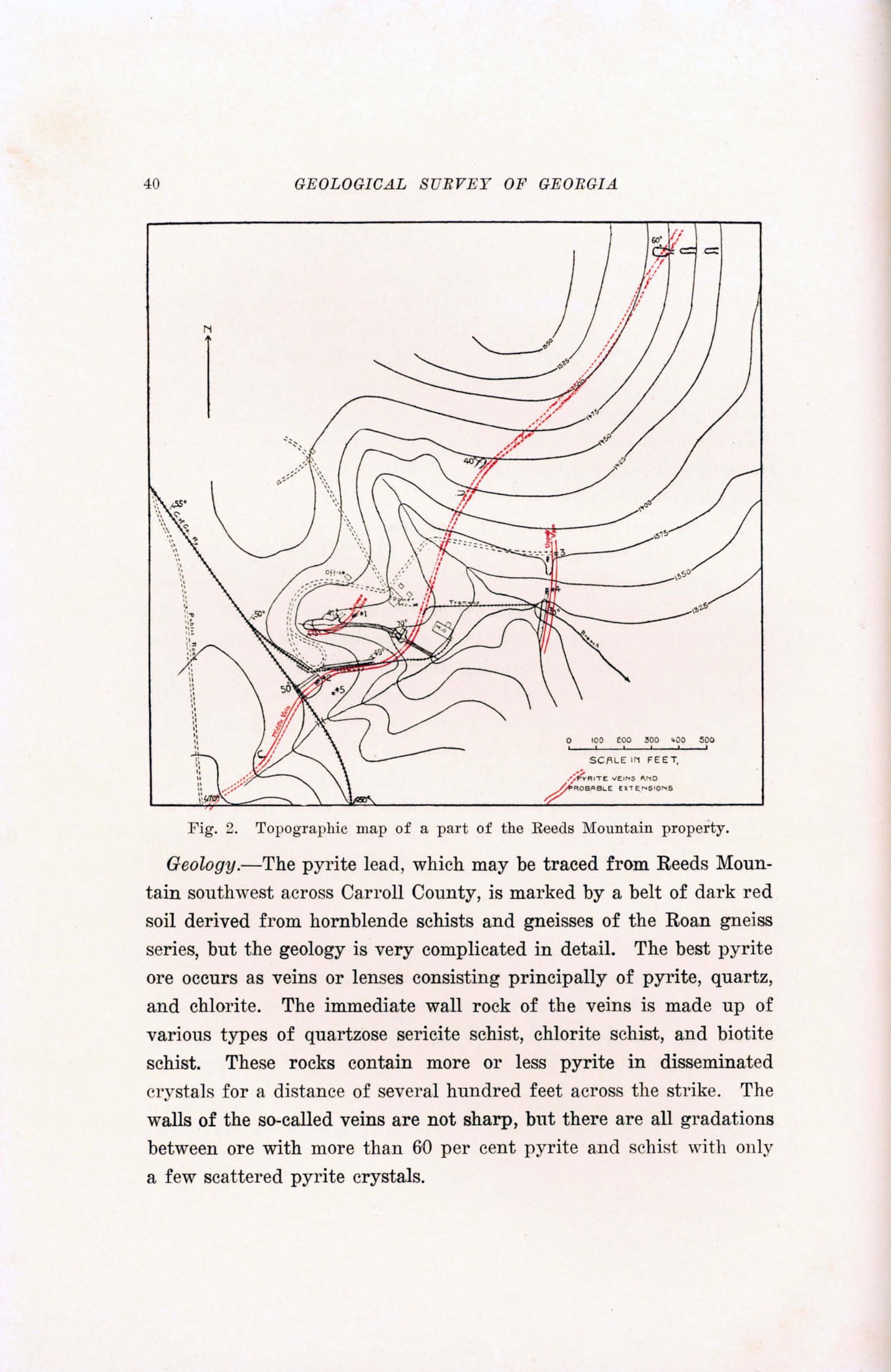
The property described in 1918 crossed the county line, taking in land in both Haralson and Carroll counties. The Central of Georgia Railway ran through both tracts and across the outcrop of a pyrite vein. Bremen, nearby at the crossing of the Central and Southern railways, was the nearest town and post office. This was a mine tied directly to the transportation network. [1]
Water presented a different problem. Reeds Mountain stands on the divide between the Tallapoosa and Little Tallapoosa drainage systems. The survey noted that streams flowed away from the mountain, so a substantial supply for processing would have to be brought uphill from farther downstream. The same high ground that exposed mineral-bearing rock complicated the work of treating it. [1]
New machinery in a time of wartime demand
By April 1918, most old machinery had been removed, leaving two boilers. The Southern Pyrites Ore Company had ordered crushers, jigs, and concentrating tables, with some equipment already on the property. A plant expected to handle 50 tons of ore daily was being prepared. That was a proposed capacity; the report does not establish that the plant subsequently reached it. [1]
The timing mattered. Georgia's later statewide mining history identifies 1916–1919 as the high point of the state's pyrite industry, as disrupted imports and demand for sulfuric acid for explosives increased interest in domestic deposits. Pyrite also supplied sulfur for fertilizer manufacture. A small operation near Bremen belonged to an industrial story reaching well beyond West Georgia. [1] [2]
What the photographs and map preserve
The 1918 report preserves more than production figures. Its photographs record a tunnel and mill, and its topographic sketch marks workings against the shape of the land. They give us a way to understand how a mine occupied a hillside: where material was removed, where it was processed, and how the railroad fitted into the operation. [1]
The authors were candid about what remained uncertain. They said the workings were still limited and treated estimates of the deposit's total size as highly speculative. That distinction makes the documented history more interesting. Reeds Mountain held real industrial effort, real shipments, and ambitious plans—but the plans and the shipments are different kinds of evidence. The old pages let us keep both in view. [1]
The dates at a glance
- Before 1861The Carrollton Mining Company sank a roughly 60-foot prospect shaft; work stopped in 1861. [1]
- About 1900Gossan was worked for iron ore; the survey records a report of approximately 100 carloads shipped. [1]
- Early 1910sThe Reeds Mountain Mining Company shipped approximately 4,000 tons of pyrite concentrates during an operating period the report describes as about four years. [1]
- May 1913A surviving mill photograph was taken shortly after work stopped, according to its original caption. [1]
- April 1918Equipment for a proposed 50-ton-per-day plant was ordered and partly on site. [1]
Sources and further reading
- H. K. Shearer and J. P. D. Hull, A Preliminary Report on a Part of the Pyrite Deposits of Georgia (1918)
Bulletin 33, printed pp. 38–51; Plate II and Figure 2. The approximate operating dates and dated May 1913 photograph are preserved as distinct evidence. - Georgia Department of Transportation, Mining and Mineral Industries of North Georgia: A Historic Context
Pyrite discussion, printed p. 43. Used only for short statewide wartime context; the original 1918 report governs mine-specific facts.