Haralson County · Families, vineyards & memory
Budapest, among the trees
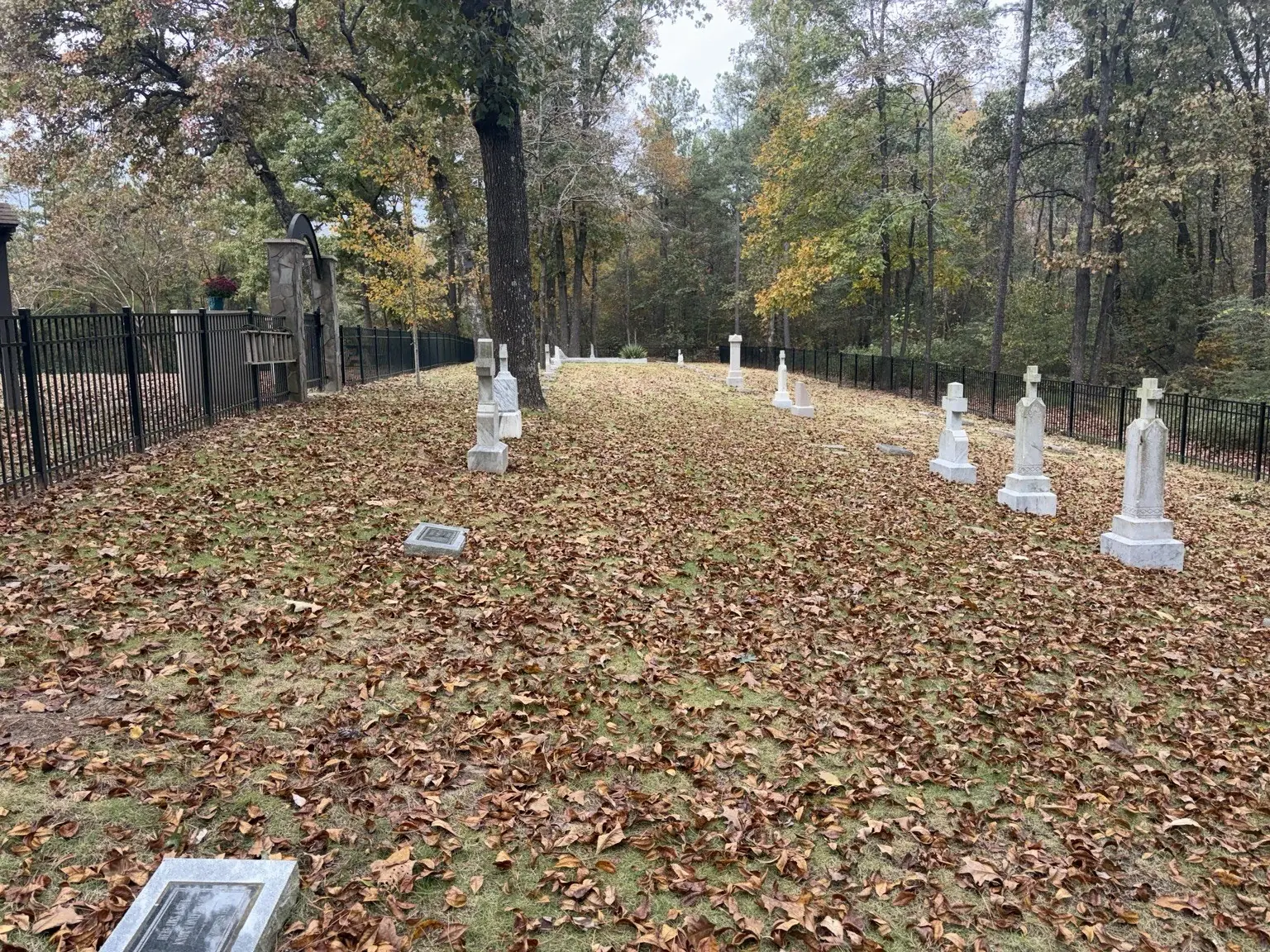
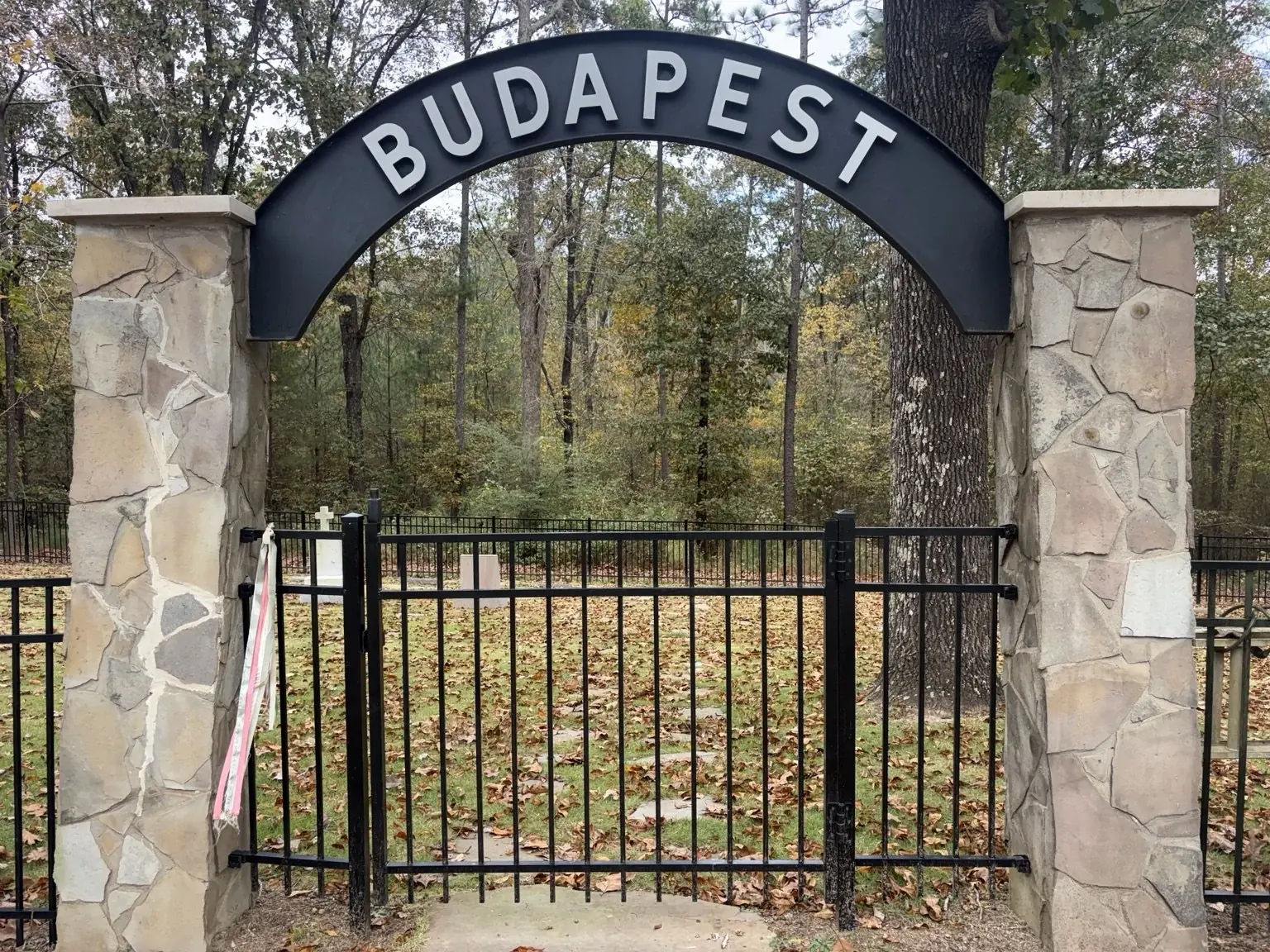
I went to Budapest Cemetery alone. I took photographs of the entrance, the signs, the graves, and the wooded ground around them. The name over the gate belongs to a city an ocean away. The ground beneath it is here in Haralson County.
In this story
A little cemetery with a long reach
There is a black fence around the cemetery and a stone-pillared entrance. Fallen leaves cover parts of the grass. Some monuments stand tall; other markers sit close to the ground. A path of flat stones leads between them. Beyond the fence, the trees continue.
It is a small place to hold so much movement.
The roadside marker gives the broad account: immigrant families, vineyards, communities named for places in their homeland, and a wine business undone by Georgia prohibition. That explains why a cemetery called Budapest is here. It leaves a great deal to ask about the people inside it. Who brought them south? What did they expect to find? What did they build? Where did their children go?
Those questions become harder to leave alone when you read the stones.
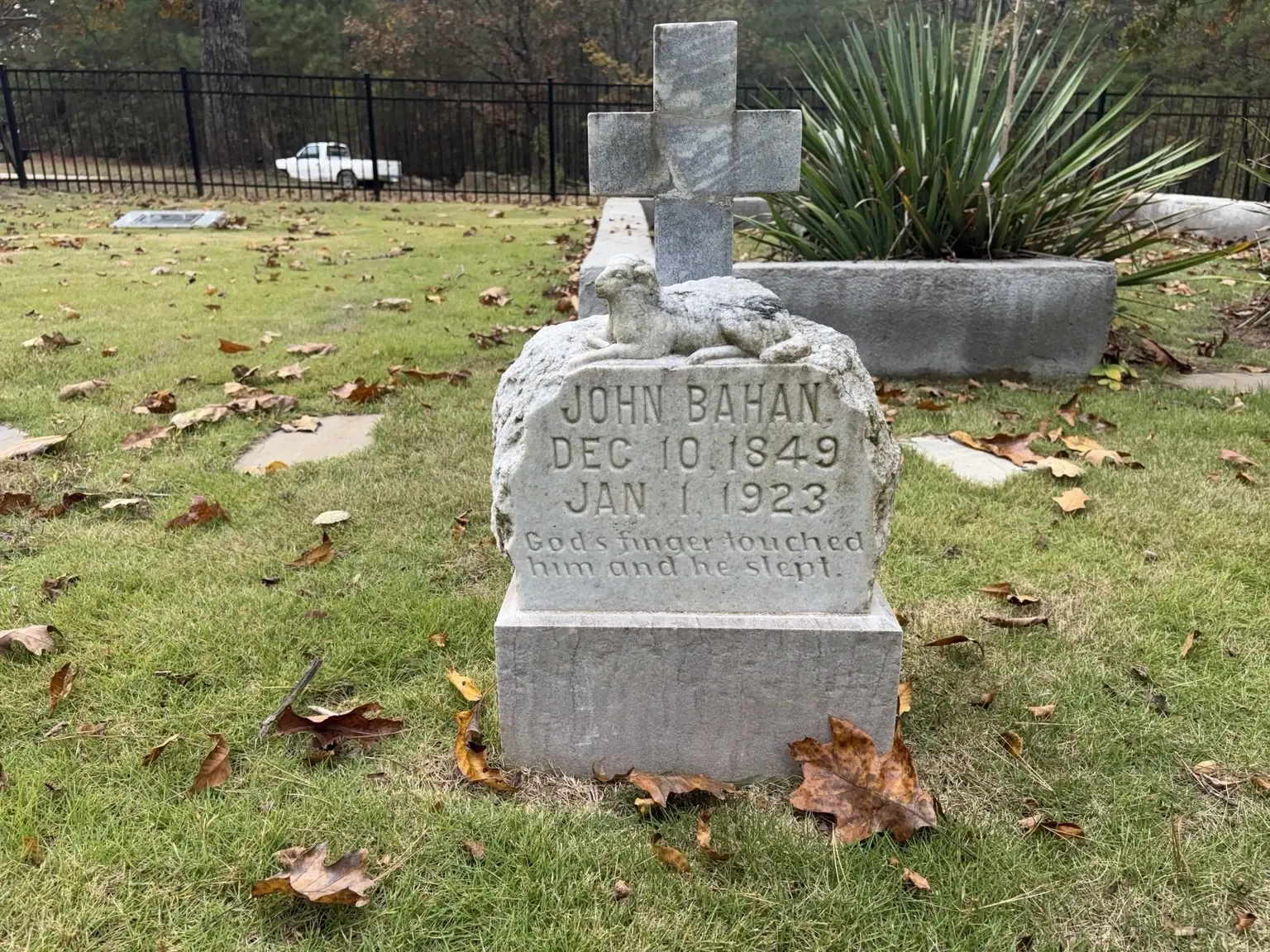
Joseph Ecsedy’s monument records April 14, 1864, and March 28, 1919. Below the dates are three words: “Rest in peace.” John Bahan’s stone, with its cross and resting lamb, records a life from December 10, 1849, to January 1, 1923. Louis and Mary N. Fekete share a monument: his death in 1946, hers in 1964.1
The dates immediately stretch the story beyond the familiar turning point of 1908. They do not establish where these people lived every year, but they show that this cemetery continued to receive and remember people long after the vineyard boom.
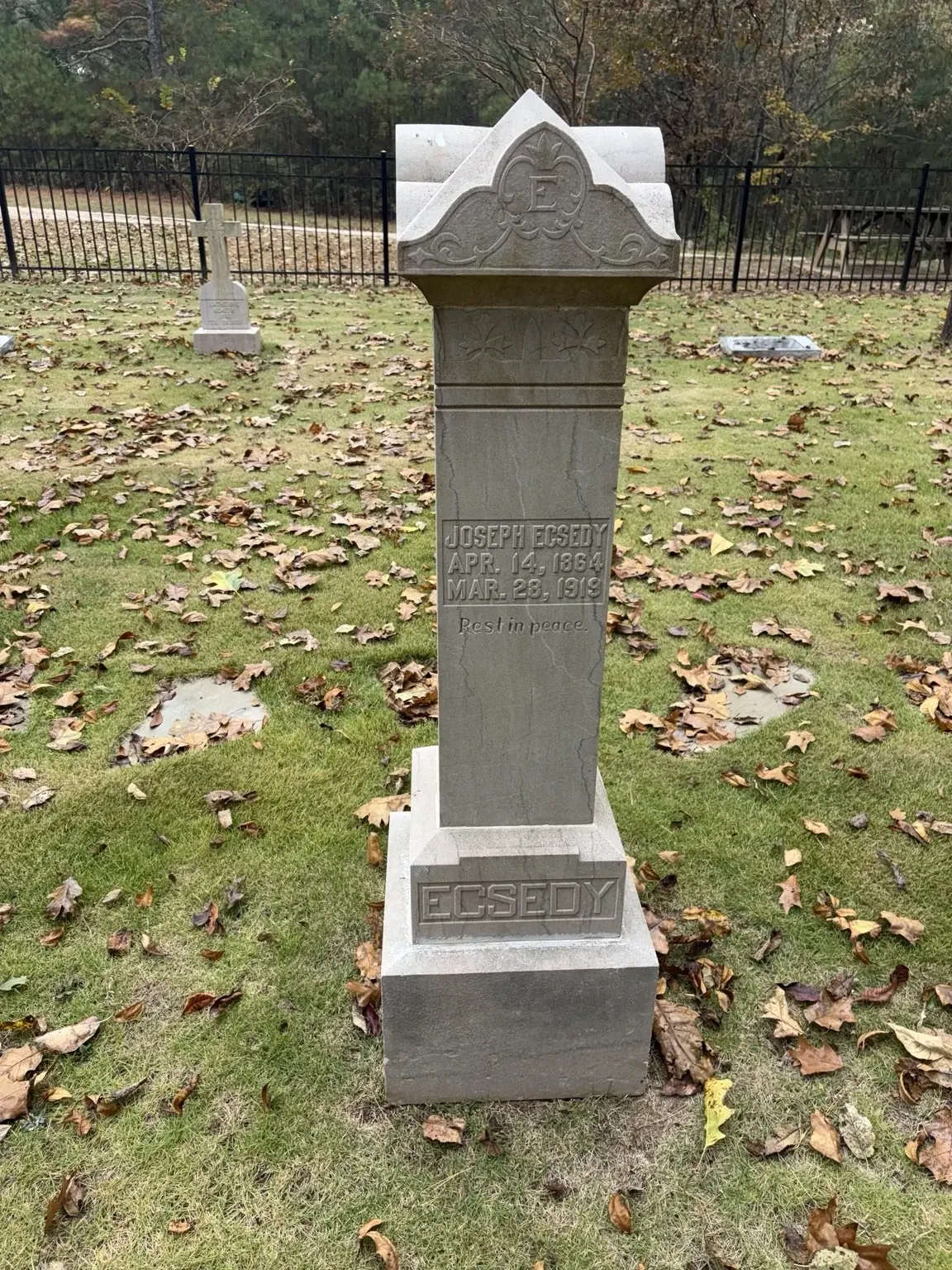
The cemetery is a good place to begin because it makes us start with names. Before deciding what the colony meant, we ought to give its people room to have lives.
Why bring a vineyard here?
Ralph Lincoln Spencer appears repeatedly in the history of the settlements. He was a developer looking for ways to make this part of Georgia grow. The later National Register history of North Tallapoosa places the fruit-growing ventures within a larger period of industrial promotion, financial trouble, and attempts to rebuild the local economy. Vineyards belonged to that changing business landscape.7
For a promoter, land could become lots, factories, mines, or farms. For a family, the same acreage had to become something more practical: enough work and income to keep a household going.
Peggy Kimball’s account, preserved by the Haralson County Historical Society, says Spencer sought people who knew how to grow grapes and make wine. It describes recruitment among Hungarian farmers then working in Pennsylvania coal mines, assisted by specialists including a Catholic priest. In her account, families received ten-acre allotments, with two acres planted and eight still to plant. The home, horse, and buggy were an inducement offered to the priest.3
That is a more useful picture than a vague promise of prosperity. It joins expertise to land and gives the church a place in the effort to establish a community. But “allotment” leaves an important question unanswered. Without the original agreements, we cannot call those acres a gift or say exactly how each family paid for them.
We can, however, read a sales pitch from the same place and period.
A separate enterprise, the Southern Homestead and Fruit Growing Company, issued a prospectus catalogued as 1895. It offered five-acre tracts around Tallapoosa: unplanted land for $100 to $175, or land with two acres planted for $170 to $245. Buyers were offered half down and monthly payments. Its calculations projected future harvest income against the cost of establishing a vineyard.6
Those were that company’s terms, not a recovered Budapest contract. Still, the booklet helps us hear the commercial argument being made around these hills. Land could be bought in manageable pieces; fruit could turn acreage into income; buyers could be shown a calculation that made the venture look attainable. A printed forecast could make the future seem unusually close.
What it could not do was guarantee that the harvest, market, weather, or law would cooperate.
For those of us who live nearby, that overlap matters. Places we encounter as separate stops—a mine, a cemetery, an old town—can belong to the same larger story of people trying to make a living from this land.
The newspaper caught them building
The short notices in old newspapers bring us closer to the beginning than a later summary can.
In its May 16, 1895 issue, the Banner-Messenger printed a Waco correspondent’s report, dated May 8, that Hungarians had begun building a town between Waco and Tallapoosa. Here is the settlement in the act of becoming a place.4
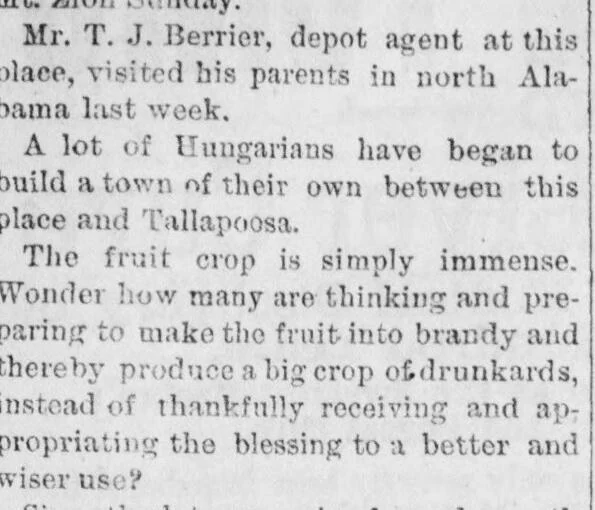
By July, the same paper carried a report that contracts were being arranged for twenty-five more houses at the Hungarian village it called “Budah,” two miles west of Waco. The wording describes plans, rather than twenty-five finished homes, but it is evidence of ambition and expected growth.5
The chronology is less tidy than a single founding date suggests. The historic marker begins with 1888; other histories emphasize the 1890s. Recruitment, a first arrival, company organization, and the construction of a village need not have happened at once. The 1895 reports give us a firm point to hold: people were building, and more houses were being discussed.
The three names most often associated with the settlements are Budapest, Nitra—or Nyitra—and Tokaj, also written Tokai. They should not be treated as interchangeable. The cemetery organization describes Budapest as a community that included several ethnic backgrounds and Nitra as predominantly Slovak, associated with what is now Old Ridgeway Road. Its account of Tokai connects that name with farming settlement beyond Nitra. The precise development of Tokaj remains less securely documented in the sources gathered here.2
These distinctions matter because the phrase “Hungarian colony” can make a varied group of people sound like a single household. The names on the signs preserve attachment to places overseas. They do not tell us that everyone spoke the same language, arrived together, or wanted exactly the same thing.
A town is built by many decisions, even when a marker has room for only one paragraph.
One road south began in Manhattan
The Rados give us a way to follow the story through a household.
In a family biography contributed to Haralson GAGenWeb, Joe Conley wrote that Ignatz Rado and his wife, Julia Anna Poor Rado, lived in Manhattan. Ignatz made saddles and pocketbooks. Conley said a Catholic priest, named there as Father Janoscik, urged the family to move to the Budapest settlement.10
This is family testimony, not a recovered employer’s ledger or recruitment letter. Even with that distinction, it offers something valuable: a named worker with a trade and a remembered connection through which the Georgia opportunity reached him.
The contributed accounts place several Rado children’s births in New York before the move south, and a younger child’s birth in Budapest afterward. They put the family’s Georgia arrival in 1895. The complete route remains unconfirmed: we have not recovered a ship manifest or a record of the journey south.11
What emerges is already more particular than the claim that everyone came straight from a Pennsylvania mine. At least in this family’s remembered history, Manhattan had been part of the journey.
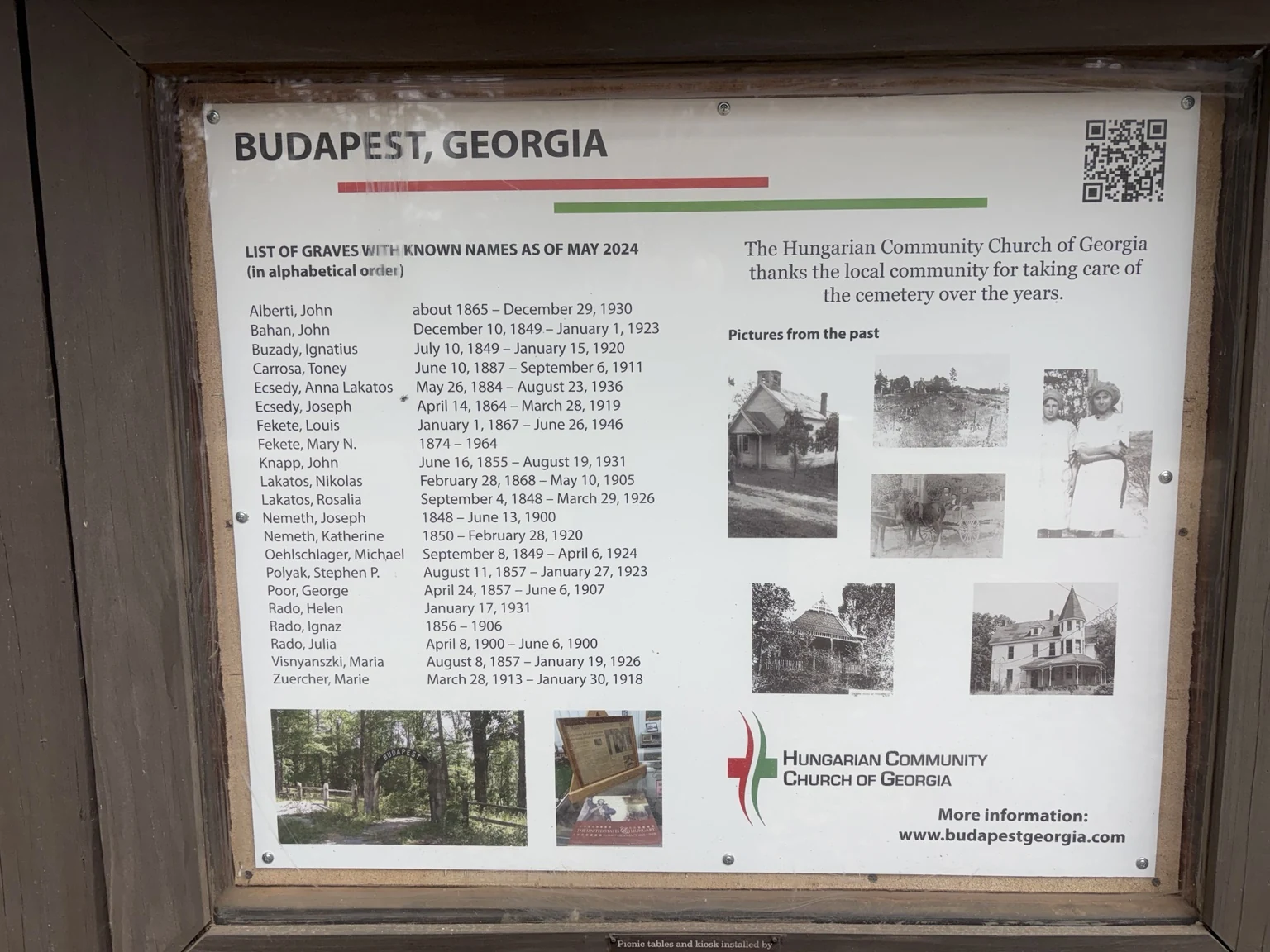
The cemetery’s list includes Ignaz Rado, a spelling variation of the father’s name, and Julia Rado, an infant whose dates are given as April 8 to June 6, 1900. The family accounts identify the child as Ignatz and Julia’s daughter. The sign records a life of less than two months.111
Statistics can tell us whether a settlement was growing. A child’s name asks us to remember what happened inside that growth. The families were establishing homes, raising children, and burying people they loved while the business story was still being written.
The skill was part of the promise
The immigrants’ knowledge was central to the vineyard venture. Land alone could not produce the product Spencer wanted.
In May 1899, The Sunny South described a colony of fifty Hungarian families four miles east of Tallapoosa, occupying about 700 acres, with two-thirds in vines. It noted that they planted more closely than American growers and made their own wine. This was favorable reporting, not an agricultural census, and its numbers should remain the reporter’s description of that place and moment.13
Even so, it shows the settlers as people making practical decisions about cultivation and production. The writer noticed their methods. Their knowledge was visible in the use of the ground.
Earlier that year, the same newspaper reported a favorable appraisal by Washington wine experts of wine from the Tallapoosa vineyard of the Reverend Francis Januschek. The notice connects the priest to a working vineyard whose product was being promoted beyond Georgia.12
The families also needed the ordinary services that make a settlement livable. The cemetery organization’s history names Frank Bukszar and his family as operators of a general store. A December 1906 newspaper dispatch describes a Budapest restaurant kept by a man identified as Woehl and his wife.214
The restaurant appears in a report of a violent incident, with conflicting details in other coverage. The incident cannot responsibly be reconstructed from what we have. The business itself is worth noticing: a couple serving food in a community usually remembered only for grapes.
That is one of the difficulties of recovering everyday life. A newspaper may preserve a restaurant because something went wrong there, while saying little about its ordinary working days. We should not allow the event that made the news to become our entire picture of the people.
The visible cross on John Bahan’s stone and the church described in the settlement histories belong to that daily life as well. Worship, family, trade, and work occupied the same community. The vineyard was its economic undertaking; the residents had to build the rest of a life around it.
What happened after 1908?
Georgia enacted statewide prohibition in 1907, effective January 1, 1908. The turning point here came years before national prohibition took effect in 1920.15
For a community built around wine, that change struck at the purpose of its investment. The ground, vines, buildings, and knowledge were still there. The conditions under which the product could be made and sold had changed.
Yet the warning signs had not all waited until 1908. On the same July 1895 newspaper page that reported plans for additional houses, a Tallapoosa correspondent said the Georgia Fruitgrowing and Winery Association had stopped work for a couple of weeks and had partly resumed. The writer supplied no dependable explanation. We cannot turn that short interruption into a complete diagnosis, but neither can we describe the years before prohibition as uninterrupted success.5
A Tallapoosa promotional booklet published in 1908 described the Budapest residents growing grapes and some tobacco. It also acknowledged that state prohibition had substantially interfered with their wine production. The account is especially useful because it records disruption and continuing agricultural activity in the same passage.16
The familiar short ending says the families left. The records that follow ask us to slow down.
In a camping-trip account published in the Carroll Free Press in August 1913, Jesse Travis described traveling through “Budhapest.” A member of the party bought Hungarian tobacco there. It is a small transaction, but it places someone buying something in the village five years after prohibition began. It does not identify the seller or establish where that tobacco had grown.17
Then there is a family moving back.
A train to Bremen, and neighbors waiting
Conley’s Estavanko family history describes Adam Estavanko’s movement between Pennsylvania coal work and Georgia’s Nitra settlement. It says that after his wife Maria died in 1915, his widowed sister-in-law Mary came to help care for his children. In the family account, she agreed to marry him if they returned to Haralson County; it also describes ill health from his years in the mines.18
The remembered arrival is wonderfully specific. They came by train to Bremen, where Nitra neighbors met them with mules, horses, and wagons to carry the family and its belongings home. Conley also wrote that Adam dismantled a house near Beech Creek, marked its logs, and rebuilt it on Estavanko Loop Road. These details remain family recollection rather than independently confirmed events.18
They deserve that clear attribution—and a place in the account. The surviving family memory gives the move a station, a receiving community, and the work of making a home. It also places the return well after the date often used to close the colony’s story.
In November 1920, the Carroll Free Press carried another tangible piece of Budapest’s later life: an advertisement for sixty acres on the main highway, with three or four dwellings, three barns, wells, and running water. The contact was S. G. Rado.19
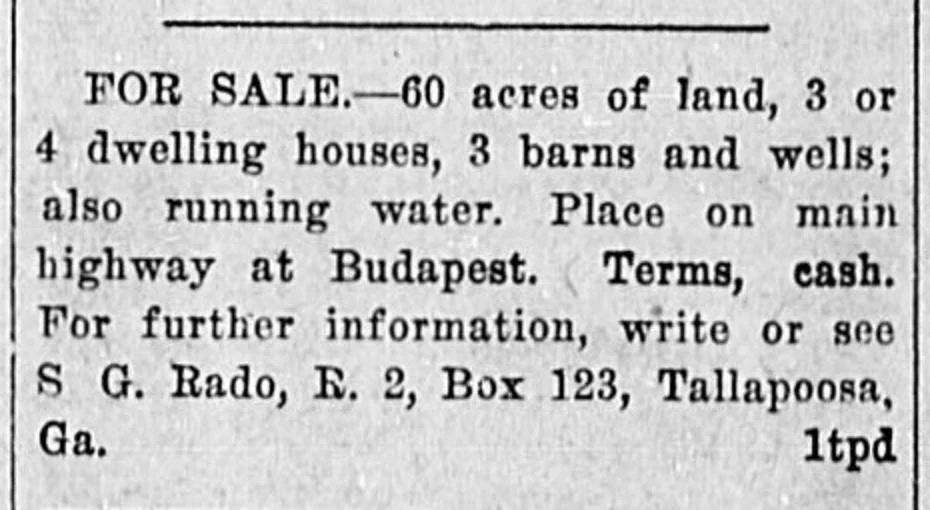
Whatever the outcome of the proposed sale, the advertisement presents buildings and acreage as a place with continuing use and value. Budapest had a history after its best-known business declined.
From Budapest to Ohio
The Rado and Estavanko stories eventually meet in a marriage. Family accounts identify Albert Rado’s wife as Pauline Estavanko, a daughter of the Nitra community.11
The later life of their daughter Elizabeth gives us a separate published account to follow. Her 2017 obituary says Elizabeth, known as Betty, was born in Budapest, Haralson County, on July 17, 1932. She moved with her family to Lorain, Ohio, in 1936, when she was four. It identifies Albert and Pauline as her parents.20
A child born in Budapest in 1932 changes how the place should be remembered. Twenty-four years after Georgia prohibition began, the settlement’s name was still a birthplace in a family’s life.
Betty grew up in Ohio. Her obituary remembers work in a preschool, where she was called “Miss Betty,” and years teaching children in church. Those were parts of a life that began here and unfolded elsewhere.20
It would be easy to follow the family only as far as its departure from Georgia. But leaving one place did not end its influence or erase the people who had lived there. Their children grew up, worked, married, and told stories. A local history can follow them far enough to acknowledge that.
Some memories traveled in even smaller forms. A 2019 Georgia Magazine article credits a cheese-filled palacsinta recipe to Pauline Estavanko Rado and points readers toward the community cookbook The Southern Roots of Budapest. A recipe is a different kind of surviving record from a deed or census return. It keeps a person’s name attached to something another household can still make.22
There was continuity in worship, too. A 1982 Catholic parish history traced connections between the older settlement community and Carrollton, reporting that Budapest’s Stations of the Cross were carried there. Its early chronology needs care, but its account of those surviving objects offers another way to follow the community beyond its original buildings.21
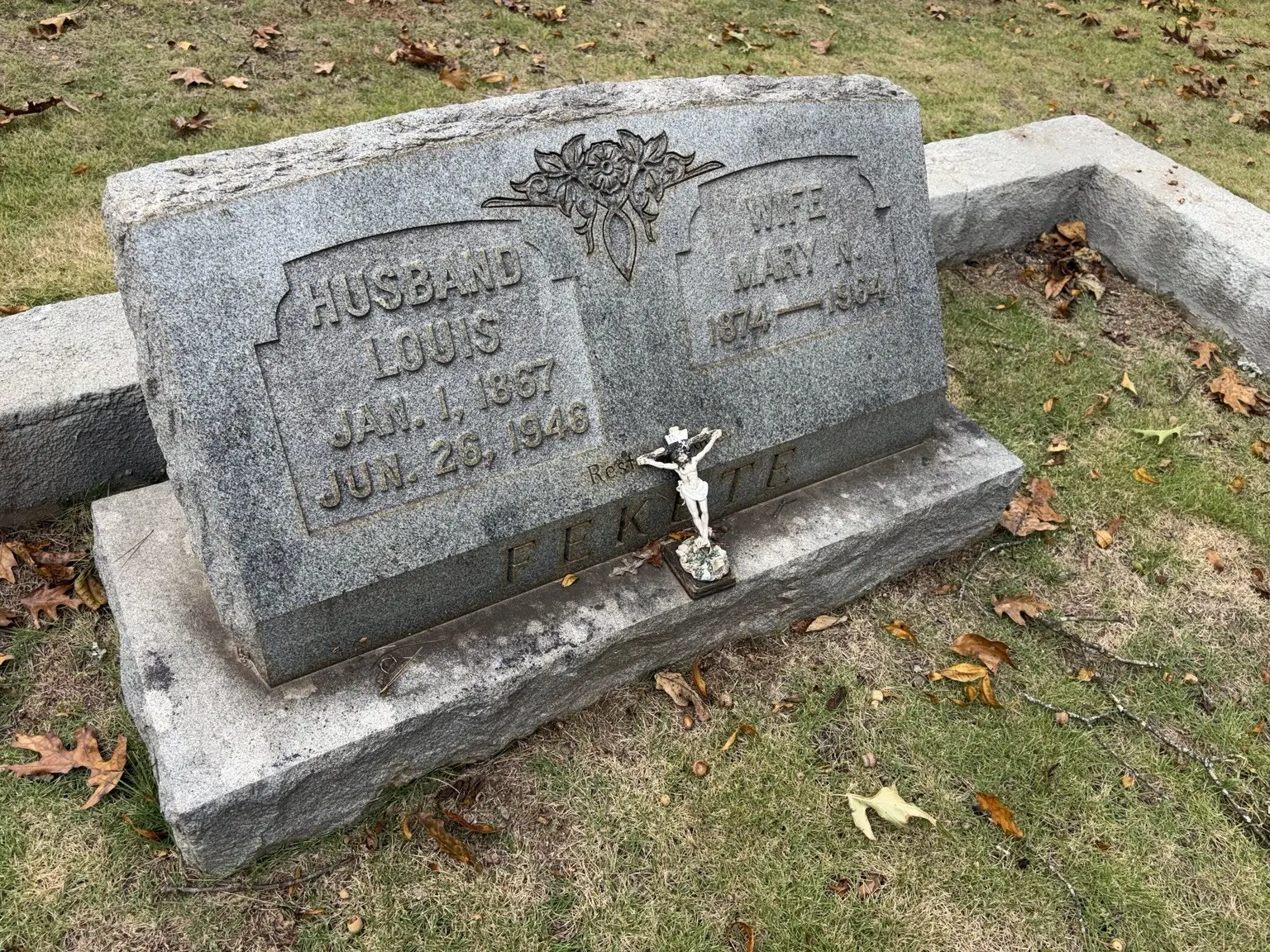
Back in the cemetery, the Fekete monument carries that longer timespan in plain numbers. Louis died in 1946. Mary died in 1964. Their stone cannot settle the history of the whole village. It does make a one-year ending impossible to accept without asking more.
A business can fail while a family continues. A settlement can shrink while its church connections endure. People can move away and still belong to a place through the dead they leave there and the memories they take with them.
Someone had to care for what remained
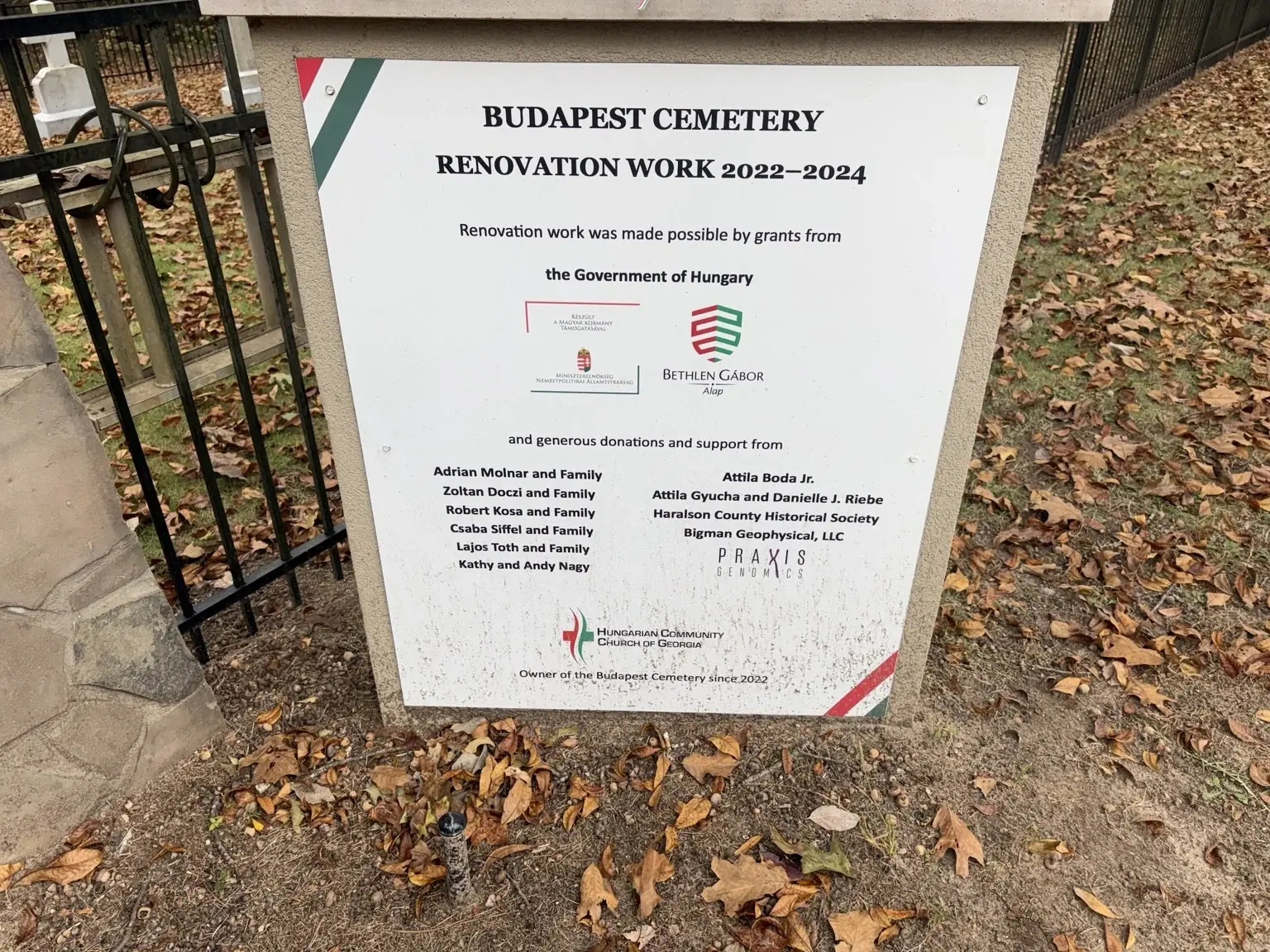
The cemetery in these photographs has been cared for. The fence, entrance, signs, and restored markers represent work done by people who decided the place was worth keeping.
The renovation plaque dates that effort to 2022–2024. It identifies the Hungarian Community Church of Georgia as the cemetery’s owner since 2022, credits support from the Government of Hungary, and names families, researchers, local historians, businesses, and other contributors. The nearby kiosk also thanks the local community for caring for the cemetery over the years.1
That last acknowledgment matters. The recent restoration belongs to a longer history of people paying attention.
Some of the work reached below what a visitor could see. A November 2022 announcement for archaeologist Danielle Riebe’s lecture described ground-penetrating radar being used at Budapest Cemetery to locate unmarked or formerly marked graves, with markers being placed at those locations.23
That does not mean every person’s name has been recovered. It means the effort to preserve the cemetery included looking for people whose places were no longer plainly marked. The list of known names on the kiosk should be read as exactly that: known names, not necessarily everyone buried within the ground.
There is a difference between knowing that a cemetery exists and accepting responsibility for it. Fences need attention. Water moves soil. Stones lose lettering, break, or disappear. Records get separated from families. Every generation has an opportunity to preserve what the next one will otherwise have to search for.
The restored cemetery reopened on June 1, 2024. In his Hungarian-language account of the ceremony, Varga Tamás describes the ribbon being cut and children entering first with baskets of flowers. They placed a flower on every gravestone.24
I was not there for that ceremony. I came later, alone, and photographed the place those people had helped preserve. But that recorded scene is a fitting one to hold beside the older story: children coming through the gate to remember families whose own children had once begun their lives in Budapest.
The questions that brought me into the research are still worth asking. What was promised? What was earned? What disappointed them? What made one family stay, another leave, and another return?
We cannot answer every one. We can do better than reducing all those lives to a vanished vineyard.
We can remember the skill that brought people here, the homes they tried to establish, the children born here, and the work their descendants went on to do. We can distinguish an old newspaper report from a family recollection without dismissing either. We can leave room for the names not yet recovered.
Budapest is still written over the gate. The people buried beneath it were part of this county. Taking time to learn their names is one way of caring for the place we call home.
Sources and further reading
Research notes
This account combines Daniel’s solo visit and photographs, contemporary newspapers and promotional publications, later local and church histories, and attributed family recollections. No historical dialogue, private thoughts, or unrecorded travel scenes have been invented. The exact founding chronology, household land terms, and complete migration routes remain open. A promising census spelling match was excluded because the identity is not yet established.
Present-day photographs are Daniel Moss’s. The two reproduced newspaper details date from 1895 and 1920 and are public-domain material digitized by Georgia Historic Newspapers, Digital Library of Georgia. The photographic views retain their original content; display copies have been resized for this edition.
- The place and its inscriptions. Daniel Moss’s photographs of Budapest Cemetery, the 1988 Georgia historic marker, the May 2024 list of known graves, and the 2022–2024 renovation plaque. Names and dates described from these photographs are distinguished from independently verified vital records. Read source
- A community with several backgrounds. Budapest Cemetery organization, “Budapest, Georgia—History,” “Nitra—History,” and “Tokai—History.” Later community histories; consulted for settlement identities and geography. Detailed founding dates and town boundaries differ among accounts. Read source
- Recruitment and the ten-acre account. Peggy Kimball, “Prelude to the Haralson County Wine Boom,” Haralson County Historical Society. Retrospective account: ten-acre arrangements and the offer of a home, horse and buggy to the priest. No original settlement contract inspected. Read source
- Building a town, spring 1895. The Banner-Messenger, May 16, 1895, p. 5; Waco correspondence dated May 8. Original scan checked. Read source
- Houses planned; winery work interrupted. The Banner-Messenger, July 11, 1895, p. 5. Separate Waco and Tallapoosa notices. Original scans checked; the additional houses were reported as plans, not completed construction. Read source
- The wider fruit-growing sales pitch. Southern Homestead and Fruit Growing Company, Prospectus, catalogued 1895, Digital Library of Georgia, gb5193. Original price and projection pages checked. A different company’s offer—not an established contract for Budapest families. Read source
- Tallapoosa’s business setting. North Tallapoosa Residential Historic District, National Register nomination, 2003, historical narrative. Later researched synthesis linking Spencer, development companies and fruit-growing ventures. Read source
- Gold property beside the Cross mine. Columbus Enquirer-Sun, October 16, 1887, p. 2, “Rich in Resources.” Original scan checked: 400 acres adjoining the Holland or Cross mines. A reported company holding, not a deed or a demonstrated vineyard parcel. Read source
- Cross, Camille and Royal. Yeates, McCallie and King, A Preliminary Report on a Part of the Gold Deposits of Georgia (1896), pp. 250–252. Geological history connecting the Cross lease, Camille company and Royal name. Read source
- The Rados’ New York chapter. Joe Conley, “Ignatz and Julia Ann (Poor) Rado,” Haralson GAGenWeb biography. Contributed family account, not an original recruitment letter or employment record. The priest’s surname appears in several spellings across sources. Read source
- Rado family chronology. Joe Conley-contributed entries in Haralson GAGenWeb’s obituary compilation, including Ignatz, Albert, Pauline, Margaret, William and Julia Rado. Original newspaper citations are absent for these entries; dates vary in parallel versions. Exact arrival days are omitted from the story. Read source
- Wine from the priest’s vineyard. The Sunny South, February 11, 1899, p. 3, “The Great South.” Original notice checked. A reported favorable appraisal, not an independently recovered award or proof of profit. Read source
- Vineyard practice in 1899. The Sunny South, May 20, 1899, p. 3, “In the Grape Country.” Original page and colony passage checked. Contemporary promotional journalism, not a census. Its regional grape-variety and shipping descriptions are not assigned to individual Budapest farms. Read source
- A Budapest restaurant. Griffin Daily News and Sun, December 21, 1906, p. 2, “Man Seriously Shot.” Original scan checked. The restaurant is described as operated by Woehl and his wife; another report differs on names and outcome. The disputed incident is not reconstructed here. Read source
- Georgia’s prohibition timeline. Kaylynn Washnock, “Prohibition in Georgia,” New Georgia Encyclopedia. For the January 1, 1908 effective date, see also the contemporary Catholic Encyclopedia entry “Georgia” (1909). State prohibition preceded national prohibition. Read source
- What a 1908 publication said. Tallapoosa, Georgia: Its Past, Present and Future (1908), printed p. 25. Original page checked. Promotional booklet; describes grapes, some tobacco and interference with wine production under state prohibition. Its “Bohemian Colony” heading is the publisher’s label. Read source
- A stop in Budapest in 1913. Jesse Travis, “Tells of Mr. Long’s Annual Camp,” Carroll Free Press, August 7, 1913, p. 3. Original scan checked. Describes a trip beginning May 12 and a tobacco purchase in “Budhapest”; does not identify its seller or prove local cultivation. Read source
- The return through Bremen. Joe Conley, “The Istvanko / Estavanko / Estvanko Family,” Haralson GAGenWeb. Attributed family recollection of widowhood, remarriage, rail arrival, wagons and rebuilding a house. Not independently corroborated; the page contains errors elsewhere, including its claim about the cemetery’s first burial. Read source
- Sixty acres for sale, 1920. Carroll Free Press, November 23, 1920, p. 1. Original advertisement checked: 60 acres, three or four dwellings, three barns, wells and running water; S. G. Rado contact. A completed sale and the advertiser’s full identity are not established. Read source
- Betty’s life after Budapest. “Elizabeth A. Conley, 84, Enjoyed Crocheting and Quilting,” LorainCounty.com, March 21, 2017. Published family obituary placing her birth in Budapest in 1932 and move to Lorain in 1936; also identifies her parents and later teaching. Read source
- Catholic continuity. Teresa M. Pirch, “Carrollton Commemorates A 20-Year Journey Of Faith,” Georgia Bulletin, April 22, 1982, p. 2. Retrospective parish account; original page checked. Used for later parish continuity and the reported transfer of Stations of the Cross, not its disputed early dates. Read source
- A recipe remembered. Jane F. Garvey, “Celebrating a culinary heritage,” Georgia Magazine, October 2019, pp. 38–40, especially p. 39. Credits a cheese-filled palacsinta recipe to Pauline Estavanko Rado and references The Southern Roots of Budapest (2012). Recipe not reproduced. Read source
- Finding burial locations. Prehistoric Interactions on the Plain Project, November 7, 2022 lecture announcement, “The Hungarian Connection.” Describes ground-penetrating radar work and markers at unmarked or formerly marked grave locations. Does not establish that every burial was identified by name. Read source
- The children with flowers. Varga Tamás, “Újra látogatható a felújított Budapest temető,” Kőrösi Csoma Sándor Program. Hungarian-language account of the June 1, 2024 reopening; paraphrased in English. Daniel did not witness that ceremony. Read source
Read another local story
 The city Tallapoosa was supposed to becomePublic-domain 1891 newspaper. Morrow County Museum / University of Oregon.
 Royal-Vindicator: the machinery behind Haralson's goldPublic-domain original publication; Georgia Geological Survey / Digital Library of Georgia.
 The many lives of Tallapoosa’s grand hotelPublic-domain U.S. publication, 1908. Library of Congress copy / Internet Archive.
Share a photo, memory or landmark
Daniel reviews contributions before anything appears publicly.
Know someone who would enjoy this? Pass it along.