HARALSON COUNTY · PROMISES, VINEYARDS & FAMILY LIFE
The city Tallapoosa was supposed to become
A promise sold across the country, an industrial dream that failed, and the vineyard families who belong in the story.
The story in 30 seconds
- Tallapoosa’s promoters sold an industrial future to investors far beyond Georgia. [1]
- Its financial trouble began before the national Panic of 1893; factory records tell a different story from the promises. [3]
- Vineyard families helped build another livelihood. County grape figures show its scale, while family photographs preserve some of the people behind it. [4] [5]
Dates at a glance
- 1887Ralph Spencer helps launch Tallapoosa’s development boom. [2]
- 1891–1892Industrial expansion and financial trouble overlap; the bank suspends in May 1892. [3]
- 1893Company assets are auctioned in April; a fruit-growing and winery association is chartered in October. [3]
- 1900The historical society reports more than 665,000 grapevines in Haralson’s agricultural census. This is a county figure. [4]
- January 1, 1908The preservation history places the local winery shutdown under state prohibition at this date. [3]
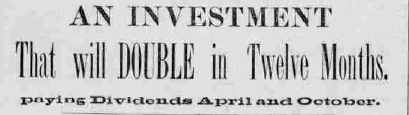
On February 19, 1891, a newspaper reader in Heppner, Oregon, could buy into the future of Tallapoosa, Georgia. The offer occupied a prominent place on the front page of the Weekly Heppner Gazette. Above the company officers and property descriptions stood a promise: an investment "That will DOUBLE in Twelve Months." [1]
In this story
A promise reaches Oregon
The distance matters. Tallapoosa was being offered to people who might never have seen its streets. A town in West Georgia had become something that could travel across the country on a sheet of newsprint, inviting a stranger to imagine what it might become.
The Georgia-Alabama Investment and Development Company offered shares at $3.33 1/3 each. It named Benjamin F. Butler as president and former United States treasurer James W. Hyatt as treasurer. Its property list included city lots, mineral land, an iron furnace and glass works. Small investors were welcome: shareholders around the country could encourage migration to Tallapoosa. [1]
That last detail reveals the ambition behind the sale. An investor could also become a recruiter. Money, new residents and new businesses were supposed to reinforce one another. The company was selling participation in a growing city, with a financial return attached.
A future that could be advertised
Tallapoosa already had a history before the promoters arrived. The Georgia Historical Society dates its incorporation to December 20, 1860. Ralph L. Spencer, a developer from Connecticut, helped launch its development boom in 1887. Mineral resources and productive land supplied the ingredients for a much larger vision. [2]
The Oregon advertisement made that vision sound unusually complete. It presented schools, churches, waterworks, electric lights, a hotel and manufacturing interests as reasons to invest. Those were the company's representations to buyers, not an independent audit of the town. [1]
Read as a sales pitch, the inventory is revealing. A factory could promise wages. Houses could promise a settled population. Churches and schools could suggest that families would stay. Each item helped make the next seem plausible. The attraction was the possibility of arriving early, before other people recognized the opportunity.
There was real construction behind the excitement. The National Register history of North Tallapoosa records an iron furnace and glass works operating in 1891, alongside other factories operating or being built. It also records the financial trouble: a dividend announced that autumn went unpaid; the Merchants' & Miners' Bank suspended in May 1892; C. A. Norton became the development company's receiver on June 6. Its assets were auctioned on April 20, 1893. [3]
Those dates change the way the collapse should be told. Tallapoosa's financial unraveling was already under way in 1891 and 1892. A story that attributes everything to the national panic of 1893 misses trouble that preceded it. The promises and the difficulties overlapped.
For someone looking backward, the auction supplies an obvious ending. For a town, it does not. Selling a company's property does not dispose of the needs of everyone who lives around it. A business failure can close one route to a livelihood while leaving people searching for another.
The next future grew on vines
The change appears in the county's industrial and agricultural record. The Haralson County Historical Society reports that the 1895 Sanborn maps marked at least ten Tallapoosa manufacturing establishments as idle or vacant. Its account of the 1900 agricultural census records more than 665,000 grapevines and about 1.59 million pounds of grapes in Haralson County. Those are county figures, but they show the scale that grape growing reached. [4]
A second vision for the area was taking shape. The National Register history dates the Georgia Fruit Growing and Winery Association's charter to October 1893. [3] The work behind that new enterprise brought immigrant families into a story too often told mainly through the names of businessmen.
Peggy Kimball's local history describes Spencer recruiting people with grape-growing knowledge, including Hungarian families then working in Pennsylvania coal mines. She records the involvement of a Catholic priest, Father Janishek, and describes ten-acre family allotments, with part of the land already planted. Her account also connects the nearby community of Nitra with Slovak settlers. [5]
Budapest, Nitra and Tokaj put names associated with Europe onto the landscape of Haralson County. [2] The move was a practical undertaking as well as an expression of hope. Grapes required cultivation; a settlement required homes, supplies and people willing to make a life there. A promoter could arrange a venture. Its future still depended on the people doing the work.
The historical society's family photographs help restore some of those people to view. One caption identifies Pauline and Catherine "Kate" Estavanko working in a vineyard. Another identifies Jacob, Joseph and Mary Estavanko in a family photograph dated 1896-1898. [5] These names deserve space beside Spencer's. They bring the account closer to the households whose labor made the venture possible.
What outlasted the promises
Georgia enacted statewide prohibition in 1907, years before national prohibition. [6] The North Tallapoosa history places the local wineries' shutdown under the law at January 1, 1908. It also notes disappointing vineyard returns for many absentee owners before that deadline. [3] The ending therefore involved both the economics of the venture and a change in the law.
The Budapest cemetery's present custodians describe the community's subsequent dispersal. Their account also brings the story into our own time: the Hungarian Community Church of Georgia acquired the cemetery in 2022 and reports completing its renovation in 2024. [7]
That is a different kind of undertaking from the one advertised in Oregon. The attraction now is the value of remembering who was here. Names that once belonged to a living neighborhood have become the reason to care for a place.
Tallapoosa itself continued beyond the failure of its development company. An early twentieth-century Georgia history acknowledged the real-estate collapse while describing subsequent growth. [8] Its survival prevents the boom from becoming the whole explanation of the town.
The distant investor encountered a promise printed above a list of assets. The vineyard families encountered land that had to be worked. Reading their histories together gives Tallapoosa's boom years their human scale: a succession of plans for prosperity, and people who had to build their lives amid the results.
Where the record remains open
This story brings existing scholarship and checked records together; it does not claim these histories were previously unknown. Original Haralson court files could clarify individual responsibility and investor losses. Recruitment advertisements, deeds and family records could clarify the vineyard settlements’ arrival dates and numbers. No criminal verdict, complete investor-loss total or single arrival date is asserted here.
Sources and further reading
- The Weekly Heppner Gazette, February 19, 1891, p. 1
Public-domain advertisement; original scan visually inspected. Headline excerpt reproduced from Morrow County Museum / University of Oregon. The advertisement documents promises, not their fulfillment. - Georgia Historical Society, "Marker Monday: Historic Tallapoosa"
Published July 6, 2020. Used for the earlier town, Spencer and community names. Its 1888 recruitment date differs from accounts emphasizing the 1890s; invitation and arrival counts remain distinct. - North Tallapoosa Residential Historic District nomination
Historical context compiled by Dan Latham; see printed pp. 18-23. The financial chronology is verified at this secondary-source level; underlying litigation files were not examined. - Haralson County Historical Society, "Haralson County 1881-1900"
Used for its reading of the 1895 industrial maps and 1900 agricultural census. Original map sheets and census tables were not inspected. Figures refer to the county, not the city or one immigrant settlement. - Peggy Kimball, "Prelude to the Haralson County Wine Boom"
Local history dated November 2004, with Estavanko photographs added in 2006 courtesy of Joseph Conley. Used for recruitment, allotments, Nitra and family-photo identifications. Captions were read; family identities were not independently genealogically verified. - New Georgia Encyclopedia, "Prohibition in Georgia"
Used for the statewide law's passage in 1907. The local industry's January 1908 chronology comes from T3. - Budapest Cemetery, "History"
The cemetery project's account of community dispersal and its own acquisition and restoration work. The 2022 and 2024 dates are attributed to this organization; no site visit was made. - Georgia's Landmarks, Memorials and Legends, vol. II, p. 794
Early twentieth-century retrospective, read in online transcription. Its observation of later growth helps distinguish failure of the development venture from disappearance of the town.
Know someone who would enjoy this? Pass it along.