CARROLL COUNTY · CANNING CLUBS, 1918–1920
A Garden Plot, a Record Book and a Chance at School
In spring 1918, canning-club girls and mothers at Bowdon Junction gathered to see an iceless refrigerator and a fireless cooker demonstrated. Their club offered a place to learn useful household skills. Carroll County’s records connect that practical work with scholarships—and, in one member’s own letter, a journey to Athens. [1] [2] [3] [7] [8]
In this story
Girls and mothers learning together
The club’s report appeared in the Carroll Free Press on May 9, 1918. Mrs. V. D. Whatley had given the demonstrations at a Friday afternoon meeting. The report specifically included mothers among the audience. A lesson organized for the girls could bring another generation into the room. [1]
The device names need a little explanation. A USDA leaflet from 1917 described an iceless refrigerator as a screened wooden cupboard covered with wet fabric. Evaporation cooled its contents, with damp weather making it less effective. Another contemporary leaflet explained a fireless cooker: it retained heat after food had first been heated on a stove. These documents explain the kinds of equipment being taught, although the club report does not identify Whatley’s particular models. [5] [6]
The short local notice does not tell us how many households adopted either device. It does show people coming together to learn ways of handling ordinary kitchen work. Whatley appears again in the county fair records as the home demonstration agent. [1] [2]
The work behind the jars
At the county’s A. & M. School Fair, the club exhibits came with requirements that reached back into the garden. Rules printed October 17 said each contestant must have cultivated one-tenth of an acre under the agent’s direction. Alongside the exhibit, she had to submit a record book and a history of her work. [2]
The categories ranged from sewing to tomatoes, fruit, garden produce and peppers. Two advertised Atlanta business-college scholarships rewarded ability in managing club work and well-kept records. The applicants were expected to finish seventh grade in May 1919. The judges were being asked to consider the work and its documentation as well as the finished exhibit. [2]
Those rules describe an offer. The later prize list lets us take the next step and see whom the newspaper actually named as winners. It also widens the story beyond the Bowdon Junction meeting: these are county fair awards, and the list does not identify the recipients’ individual clubs. [2] [3]
Names beside scholarships
On December 5, the Free Press published the premiums awarded through the A. & M. Fair. Under scholarships, Eva Jones received the Asa G. Candler Scholarship, valued at $150 and described as one year’s expense at the A. M. College. Clevie Nixon was listed for a $60 Atlanta Business College scholarship; Winnie Holmes for $50 at Southern College; and Jewell Nixon for a $50 Athens short course. [3]
The list makes the opportunity concrete: four names, four awards and different kinds of further study. It does not establish that the recipients enrolled, completed the courses or received the listed sums in cash. Their later school records would tell the next part. [3]
One smaller prize deserves a pause. Beneath the heading for best sewing by a club boy, the paper named Roy Simpkins, with a dollar from Citizens Bank. The fair rules had offered such a prize; the December list now supplies its winner. Even a column headed for the girls’ canning club could include a boy’s sewing work. [2] [3]
The news she read first
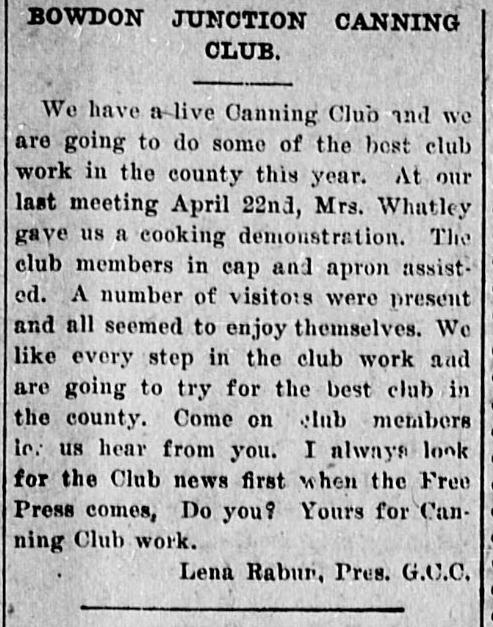
The following spring, Bowdon Junction’s club reported again. Lena Raburn’s notice, printed May 8, 1919, described an April 22 cooking demonstration by Mrs. Whatley. Members in caps and aprons assisted, and visitors attended. Raburn wanted the club to do well and urged other members to send news of their own work. [4]
Then she addressed the reader directly: “I always look for the Club news first when the Free Press comes, Do you?” [4]
That question gives the club a voice beyond the fair’s lists. Here was a member interested in what other clubs were doing and eager to have her own group heard. Other letters would take the conversation beyond Bowdon Junction.
A later award, and a journey
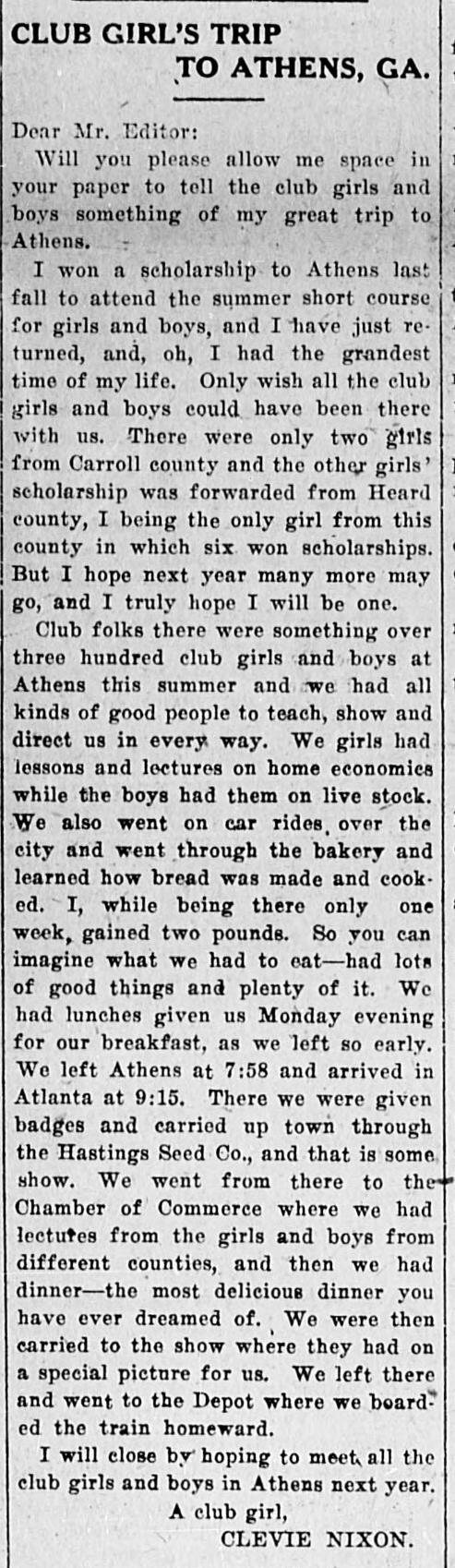
One later scholarship can now be followed beyond the prize list. On October 23, 1919, the paper named Clevie Nixon as a winner of a scholarship to Athens. In a letter published August 17, 1920, Nixon said she had won an Athens scholarship the previous fall and had just returned from the summer short course. Destination and timing connect the award with her account of attending. This was a later opportunity, separate from her still-untraced 1918 Atlanta Business College award. [7] [8]
Nixon described a week of lessons, visits and travel. Girls studied home economics while boys had livestock lessons. The group visited a bakery to learn how bread was made. On the journey home, an Atlanta stop included Hastings Seed Company, the Chamber of Commerce, a meal and a picture show before the train home. “I had the grandest time of my life,” she wrote. [8]
She also wished that more of Carroll’s scholarship winners had gone. Her letter does not explain why others stayed away. It does make the opportunity personal: a girl whose name had appeared beside an award was now telling other members what she had learned and hoping to return. [8]
A meeting despite the rain
Learning continued close to home, too. A report signed Winnie Holmes, corresponding secretary of the Striplings Girls Club, describes its August 20, 1920 meeting. Rain and bad roads made the teacher, Mr. Boyd, doubt that Mrs. Whatley would come. The girls kept preparing. Whatley arrived, and the meeting included a demonstration of pine-needle baskets and sandwich trays for Christmas gifts. [9]
Afterward, the teacher’s desk became a table for the picnic lunch the girls had provided. Holmes said most of the club had attended the A. & M. short course and were still talking about its lessons. She wrote that she had been a club member for four years and thanked Whatley for her help. The report does not individually confirm Holmes’s attendance at that course or show that her 1918 Southern College award was used. [9]
These members left more than a list of prizes. Their own reports tell us what they looked forward to: a visit from their teacher, work worth showing, a trip beyond the county and news from other clubs. Saving those words gives the names beside the awards something of their voices back.
Explore the original records
Open these records at the archive or family website for a closer look.
- Read Clevie Nixon’s complete 1920 newspaper letter
Original column from the August 17 issue, p. 4, including her signature. Public domain in the United States by publication age. Credit: The Semi-Weekly Carroll Free Press / Georgia Historic Newspapers, Digital Library of Georgia. It is a printed letter, not a surviving handwritten manuscript.
Sources and further reading
Research notes
Seven original newspaper pages and the opening text of two contemporary USDA leaflets were inspected for this article. The 1919 Athens award and Clevie Nixon’s 1920 letter now connect one scholarship with a first-person attendance account. The four separate 1918 award outcomes remain unresolved. Winnie Holmes’s collective report of club attendance does not individually establish her enrollment. Demonstrations do not prove household adoption. The items do not establish countywide membership, participants’ race or racial admission policy. The 1918 Bowdon Junction report conflicts internally about Lena’s office and varies her surname; the 1919 signature supplies the spelling used here. No full biography or family relationship is built from matching names alone. The newspaper reports are complementary kinds of evidence from one publisher.
- The Carroll Free Press, May 9, 1918, p. 3
“Bowdon Junction Canning Club,” column 3. Original inspected. Reports demonstrations for girls and mothers, without a venue, attendance count or exact equipment plan. The officer list and signature disagree about Lena’s office, so no 1918 office is assigned here. - The Carroll Free Press, October 17, 1918, p. 5
A. & M. School Fair premium list, right column. Original inspected: one-tenth-acre requirement, record book, work history, two business-college scholarship offers and expected seventh-grade completion. Offered prizes are distinct from the later awards. Inconsistent fair-opening text is not used to establish the fair’s actual operating dates. - The Carroll Free Press, December 5, 1918, p. 11
“Premiums Awarded Through the A. & M. Fair to the Girls Canning Club.” Original inspected. Four scholarship names and values; Roy Simpkins’s sewing prize. The list says Southern College where the earlier offer says Southern Business College. Awards do not establish payment, attendance or completion. Recipients are not assigned to Bowdon Junction or made relatives on the strength of matching surnames. - Lena Raburn, Bowdon Junction Canning Club report, The Carroll Free Press, May 8, 1919, p. 9
Original report and signature inspected. Reports April 22 demonstration, members assisting, visitors and interest in club news. Signature identifies Raburn as president in this 1919 report; her 1918 office remains disputed within that earlier item. - Madge J. Reese, The Iceless Refrigerator, USDA, May 1, 1917
Original unnumbered text page, PDF image 3, inspected. Contemporary explanation of evaporative cooling and reduced effectiveness in damp air. This design is context, not an identified plan used at Bowdon Junction; the historical leaflet is not current food-storage guidance. - M. E. Creswell and O. Powell, How to Build and Use a Fireless Cooker, USDA, 1916
Form 776, revised January 25, 1916. Original opening page, PDF image 3, inspected; the principle is retaining heat after initial heating. The National Agricultural Library identifies the authors and publication in its historical fireless-cooker collection. No exact Bowdon Junction model established; historical context, not present-day cooking instructions. - The Semi-Weekly Carroll Free Press, October 23, 1919, p. 1
“Premiums Awarded the Girls’ Club at the Carroll County Fair,” column 4. Original inspected. Names Clevie Nixon for an Athens scholarship, alongside awards to Ruby Strickland, Winnie Holmes and Eva M. Jones. This is a 1919 list, distinct from the 1918 awards. Its four named recipients are not assumed to exhaust the county’s scholarships. - Clevie Nixon, “Club Girl’s Trip to Athens, Ga.,” The Semi-Weekly Carroll Free Press, August 17, 1920, p. 4
Complete original letter and signature inspected. States she won the Athens scholarship the previous fall, stayed one week and had just returned. Its destination, timing and county-club context corroborate the October 1919 award. This is her attendance account, not a degree or registrar’s roll. Her discussion of six scholarships and two Carroll girls (one using an award forwarded from Heard) is not converted into a complete attendance count or a cause for others’ absence. The letter does not resolve her 1918 Atlanta award. - Winnie Holmes, “Striplings Chapel Club,” The Semi-Weekly Carroll Free Press, August 26, 1920, p. 7
Complete original report inspected. Describes the August 20 meeting, rainy roads, baskets, lunch, four years of membership and most club members attending the A. & M. short course. The collective attendance statement is not an individual enrollment record for Holmes. No use of her 1918 Southern College or 1919 Athens scholarship proved. Prospective sewing-machine prize and next meeting remain plans.
Read another local story
 Biscuits, pies and the people who fed West GeorgiaPublic domain. Published in New York in 1898; Library of Congress explicitly permits free use and reuse. Credit: Library of Congress / Internet Archive.
 When the Lights Reached the FarmsPublic domain. Library of Congress, Prints & Photographs Division, Farm Security Administration/Office of War Information collection.
 A school map from 1918. A different view of home.Georgia school survey · 1918
Share a photo, memory or landmark
Daniel reviews contributions before anything appears publicly.
Know someone who would enjoy this? Pass it along.