CARROLLTON · THE WORK BEFORE THE FIRE
When Carrollton’s Firemen Had to Pull the Wagon
Before Carrollton could fight a fire, somebody had to get the equipment there. In 1907, that could mean men pulling the hose reels and ladder wagon themselves. The town’s changing equipment tells a practical story about the work before the fire: training horses, maintaining wagons and learning to operate motor trucks, including one built by the firemen themselves. [1] [6] [7] [9]
In this story
The run before the fire
The Carroll Free Press put the problem plainly on September 26, 1907. In an unsigned editorial headed “What About It?”, it asked whether Carrollton needed horses and a wagon for its fire department. On runs toward the town limits, the writer said, men hauling the equipment arrived exhausted. There were not enough available men to pull both hose reels and the hook-and-ladder wagon efficiently. [1]
The appeal praised the firefighters’ willingness, then questioned how much strength the town was asking them to spend before the firefighting began. It urged residents to investigate possible insurance savings, too. That was an argument for making a purchase, not evidence of money already saved. [1]
The purchase followed. On August 20, 1908, the paper reported that a new hose wagon and two horses had arrived. Council members appointed to make the purchase had secured the outfit for about $1,000. An expert horseman identified as Mr. Dunbar had been engaged to train the animals; they were expected to be ready for service shortly. [6]
Arrival and readiness were separate steps. The department’s later official history dates the first horse team’s deployment to September 1, 1908. The August newspaper explains the preparation leading toward service, although it does not independently establish that exact starting day. [5] [6]
The new outfit still left a gap. After a Bradley warehouse fire in October 1908, the Free Press praised the response but said the firefighters had too few ladders to scale the building. The old hand hook-and-ladder truck was still available. Dunbar offered his own horse to pull it, free, if the city supplied shafts and harness. The paper urged the city to act; it does not establish that the offer was taken up. [10]
A wagon worth meeting at the depot
People changed along with the equipment. On October 19, 1911, the Free Press reported that the city council had elected James S. Dempsey of Rome to head the department after Mr. Vance’s death. It described Dempsey as a firefighter with seventeen years of experience and said he would move his family to Carrollton. [2]
Then came an arrival important enough for an escort. The April 11, 1912 paper reported that a new wagon purchased by department members had arrived the previous week. The mayor, councilmen, police, Carrollton band and firefighters accompanied it from the depot to the firehouse. [3]
The wagon was considerably lighter than the old one. The newspaper expected it to reach fires faster and make the pulling easier for the horses. It did not name the maker, give a price or explain how members raised the money. This was a later purchase, distinct from the outfit reported arriving in 1908. [3] [6]
Barney, Raleigh and the alarm
A report dated September 16, 1912, printed three days later, puts names to the horses: Barney and Raleigh. Foreman Jim Dempsey submitted it for the year ending September 1. The printed approval names Grady Cole as chief and S. J. Cole as secretary and treasurer—useful distinctions when an earlier newspaper had simply called Dempsey the department’s head. [4]
The horses appear among an inventory of hose, ladders, protective clothing and other equipment. The expenditure list describes an alarm system with ten street boxes and six and a half miles of wire, installed and guaranteed by the Gamewell Fire Alarm Company. Getting word to the station was part of getting help to the fire. [4]

Keeping the equipment ready
The report complicates an easy story of steady improvement. Dempsey said the wagon then in use was in bad condition and recommended an overhaul. Another wagon, owned by the department individually, stood in reserve and could serve during the repairs. The members’ April purchase offers a possible connection, but neither record explicitly says that new wagon became this reserve. [4]
The report’s closing line also reaches beyond the station. It says Mandeville Mills employees handled fires there with the department’s assistance. Workers responding at their own workplace belonged to the town’s protection story, too. The report does not name them. [4]
A motor truck on approval
Another arrival brought another need for training. On January 27, 1916, the Free Press reported that Carrollton was trying a truck built by Yancey Motor Fire Apparatus Company of Rome. The city’s contract depended on the machine meeting the manufacturer’s specifications. It carried a thirty-gallon chemical tank alongside the regular equipment. Company mechanic T. D. Harris was to stay until Dempsey and Assistant Foreman New knew how to operate it. [7]
The reported price was about $3,000. The account described a $750 trade allowance for two horses, the big wagon and equipment, leaving about $2,250 to pay. A third horse and wagon equipment were to remain available for emergencies. These were the reported terms while the truck was still on approval. [7]
The change reached beyond the station. A February report describes a demonstration at four o’clock on the preceding Wednesday, with the alarm sounded from box No. 36 on Dixie Street. The hour was chosen especially for schoolchildren. Dempsey explained the dangers around a fire run, including horses frightened by the truck and automobiles following it at speed. New equipment required the town to learn new habits. [8]
By April, the city’s published accounts add firmer evidence. In his April 1 report to the mayor and council, Dempsey described the automobile apparatus as purchased by the city and in service. Clerk J. L. Thomasson’s report for the quarter ending March 31 separately listed $500 under “Fire Truck.” These are an official purchase acknowledgment and a reported truck expenditure. They do not yet explain the full payment schedule, identify the payee or supply the final acceptance vote. [11] [12]
A truck the members built
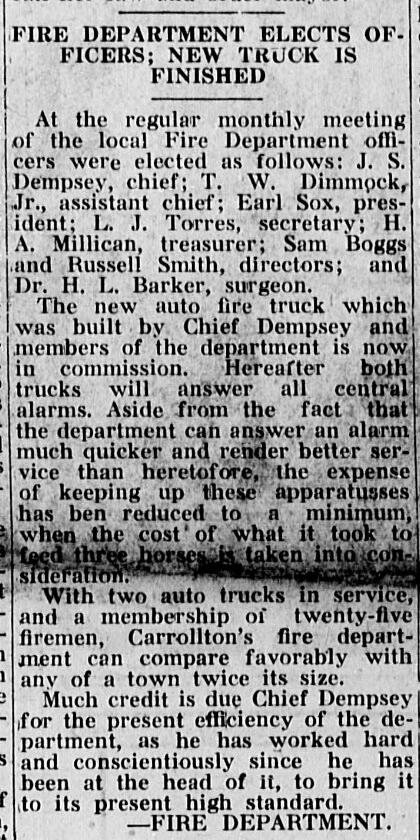
By August, the department’s members had taken on another kind of work. A notice signed by the Fire Department said that a new motor truck built by Chief Dempsey and the members was now in commission. It described two trucks in service and twenty-five firemen; both trucks were to answer central alarms. [9]
The report does not name a chassis or explain the construction. We cannot yet say which members did which jobs, what materials they used or how the truck was financed. It does establish how the department described its own contribution: the men had helped build the equipment they would take to a fire. [9]
Nine years earlier, the newspaper had asked how much strength the men could spare after hauling the equipment themselves. The later records bring horses, a trainer, mechanics and the members’ own building work into view. Getting help to a fire depended on people preparing and caring for the means of reaching it.
Sources and further reading
Research notes
Eleven contemporary newspaper pages were inspected for this article: an editorial, news accounts and reproduced department reports from one newspaper. The 1908 arrival and October ladder problem are documented; Dunbar’s horse offer is not proof of a completed conversion. September 1 deployment still comes from a later history. April 1916 official reports now acknowledge an apparatus purchase and record a $500 truck disbursement, advancing the January trial account. The original acceptance vote, payment voucher and full settlement remain unexamined. Other unknowns include horse identities across years, the 1912 wagon’s maker and funding, its possible identity with the reserve, and the members’ truck construction and financing. No chassis or conversion of the 1912 wagon is inferred. An undated carriage photograph remains unsuitable as an identified fire-department scene.
- The Carroll Free Press, September 26, 1907, p. 4
“What About It?”, second column. Original page and printed date inspected. Unsigned editorial advocating horses and a wagon; its exhaustion and staffing statements remain attributed. The fire mentioned as occurring Tuesday evening is not independently identified here. - The Carroll Free Press, October 19, 1911, p. 1
“Change in Fire Department.” Original page inspected. Reports James S. Dempsey’s election, experience and intended family move. Its word “head” is not substituted for the formal roles in the 1912 report. - The Carroll Free Press, April 11, 1912, p. 1
“New Wagon for Fire Department.” Original page inspected. Members’ purchase, arrival in the preceding week, civic escort and lighter weight. Faster response and easier work for the horses are the newspaper’s expected benefits, not timed performance results. - The Carroll Free Press, September 19, 1912, p. 8
“Report of Fire Department,” dated September 16 and covering the year ending September 1, 1912. Complete original report inspected, including signatures, inventory, expenditures, repair recommendation and final statement about Mandeville Mills. Inventory valuations are not purchase prices. Forecast insurance savings and claimed property saved are not independently verified outcomes. - Carrollton Fire Department, Our History
Department’s retrospective history dates deployment of the first horse team and wagon to September 1, 1908. The contemporary August 20 arrival and training report is now inspected; the exact service date and original council purchase voucher remain unverified. Its broad motorization summary is read alongside the more specific January and August 1916 reports. - The Carroll Free Press, August 20, 1908, p. 1
“New Fire Wagon and Horses Arrived,” column 4. Original image and masthead inspected. About $1,000 is the reported combined cost of wagon and pair of horses. No exact arrival day, vendor, Dunbar first name or horse names; this pair is not proved to be Barney and Raleigh in the 1912 inventory. - The Carroll Free Press, January 27, 1916, p. 1
“Motor Fire Truck Here on Approval,” column 4. Original inspected: approximately $3,000, $750 allowance, about $2,250 balance. The contract is conditional. This is a chemical-tank apparatus, not the more expensive pumping equipment discussed separately. Two horses traded and a third retained are the contemporary account’s terms; no later horse identities, final payment or independently measured insurance savings established. - The Carroll Free Press, February 10, 1916, p. 1
“Carrollton Fire Department Gives Demonstration,” column 3. Original image reads box No. 36, not the OCR’s 30. Establishes Dixie Street, not an exact corner or a complete alarm map. Demonstration reported as the preceding Wednesday; account of instructions is historical. - The Carroll Free Press, August 10, 1916, p. 1
“Fire Department Elects Officers; New Truck Is Finished,” column 5, signed Fire Department. Original inspected. Reports a truck built by Dempsey and members, two trucks in service, twenty-five members and plans for both to answer central alarms. No chassis, workshop, individual builders, cost or financing identified. This does not establish that the 1912 wagon was converted, nor independently settle the January contract’s final acceptance. - The Carroll Free Press, October 22, 1908, p. 1
“Big Fire in Warehouse,” column 1. Complete original and masthead inspected. The ladder shortage and Dunbar’s conditional offer concern the old hand hook-and-ladder truck. No completed conversion, later reserve-wagon identity or exact horse identity established. The Bradley warehouse was cotton storage, not a mill. - J. L. Thomasson, City Clerk’s quarterly report, The Carroll Free Press, April 6, 1916, p. 1
“Municipal Reports for Past Three Months,” column 5. Report dated March 31, for the quarter ending that day. Original inspected: Fire Truck $500.00 is a separate disbursement line from Fire Department $91.00. This is not an identified down payment or full purchase price; no payee, voucher or complete payment schedule supplied. - Jas. S. Dempsey, Fire Chief’s quarterly report, The Carroll Free Press, April 6, 1916, p. 7
Column 4; dated April 1 and submitted for the quarter ending March 31. Original inspected. Explicitly acknowledges the city’s automobile-apparatus purchase and reports its service. Linking it with the January truck is a chronological interpretation, not a serial-number match; manufacturer not repeated. Eleven alarms and “nine out of ten” fires are not silently reconciled into a performance statistic.
Read another local story
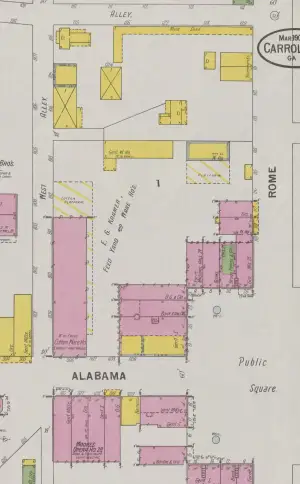 The Insurance Man Who Left Us a TownPublic-domain U.S. map, March 1900. Sanborn-Perris Map Company; University of Georgia Libraries Map Collection, presented by the Digital Library of Georgia. Cropped from sheet 3; no map content altered.
 The Mail Had to Get ThroughNo Copyright—United States. United States Post Office Department; University of Georgia Libraries, Map and Government Information Library. Reduced facsimile; no route alterations.
- The Socks Carrollton Made—and the Jobs Behind Them
Share a photo, memory or landmark
Daniel reviews contributions before anything appears publicly.
Know someone who would enjoy this? Pass it along.