PASSENGER JOURNEYS · WORK · A CHANGING JUNCTION
Changing trains at Bremen: how West Georgia reached Atlanta
A trip from Carrollton to Atlanta once began with a question that a modern road map does not answer: where would you change trains?
In this story
Two ways to reach Atlanta
The September 4, 1919, Carroll Free Press printed a notice headed “Schedule Between Carrollton and Atlanta.” It advertised connections through Bremen and the Southern Railroad, and through Newnan and the Atlanta & West Point. Carrollton belonged to a network; the connecting town could matter as much as the starting station. [1]
For the northern connection, Bremen was where the journey toward Atlanta changed railroads. The newspaper paired a Carrollton–Bremen leg with a Bremen–Atlanta leg and also printed return connections. These were instructions offered to readers at the time, rather than memories written after the service disappeared. [1]
The Newnan alternative matters, too. It keeps us from reducing Carrollton’s passenger history to one familiar route. The notice preserves a choice of connections, although it does not tell us why any particular traveler chose one. The trips described here are historical connections, not present-day train itineraries.
Before a journey, someone had to build the line
A short item in the June 8, 1888, Carroll Free Press puts two people into the construction story. J. A. Huggins and J. R. Chambers had a contract supplying cross-ties for the new railroad near Bremen. The paper explained their absence from Carrollton’s streets by saying how closely the work had occupied them. [2]
The same issue reported track laying advancing from Bremen toward Carrollton and a bridge across the Tallapoosa nearing completion. Those are glimpses of work underway. A newspaper’s expected completion date is not, by itself, proof of the day a line opened. [2]
That issue also reprinted a Haralson Banner item mentioning an unnamed Black employee of the C. R. & C. Construction Company. The item noticed him through an anecdote instead of recording his name or describing his work. It leaves a small but important trace of Black labor in this local construction history. His particular job, wages and family remain unidentified in that notice. [2]
The passengers who asked for more
Tracks did not settle whether a community had enough passenger service. In 1908, Buchanan residents and other patrons between Bremen and Cedartown petitioned Georgia’s Railroad Commission for additional trains. After hearings, the commission agreed that the existing service was insufficient. [3]
On August 27, 1908, it ordered Central of Georgia trains Nos. 5 and 6, then operating between Griffin and Bremen, to continue to Cedartown. The railway could seek to reverse the extension if a six-month trial showed a loss. When its general manager requested discontinuance on January 9, 1909, the commission declined because the required trial was incomplete. [3]
The case does not tell the line’s whole subsequent history. It does show neighbors organizing around a practical need and persuading a public body to act. Railway history includes people asking a company to serve their town better—not only companies deciding where to lay track.
A connected region, a divided passenger system
Railway travel operated within enforced racial segregation. The Railroad Commission’s report for 1919 reproduced Georgia requirements for separate cars or compartments for Black and white passengers, with conductors assigning passengers and penalties for refusing those assignments. [4]
The legal language promised equal accommodation while requiring separation. It is evidence of the rules governing the system, not proof that the experience or treatment of passengers was equal. Nor does a statewide rule reveal the exact floor plan of a particular Bremen or Carrollton depot.
These records complicate a pleasant picture of a day on the train. Connections opened possibilities, but the people using them did not all travel on equal terms. Remembering both belongs in the history of the junction.
Look again at the railway town
The old maps add another layer. On Carrollton’s March 1900 Sanborn sheet, a freight house, tracks, cotton warehouses and mill buildings appear in separate panels. Passenger travel sat beside the movement of goods and the work of a town. The map records buildings and labels; it cannot supply the voices of everyone who worked there. [5]
A junction is more than two lines crossing. It is a connection someone depended on, a workplace, and a service people could challenge. When you look at Bremen again, ask not only when the trains came, but what people could do with them—and what stood in their way.

Explore the original records
Open these records at the archive or family website for a closer look.
- Explore the railroad map and eight places today
Continue town by town, with public destinations, original maps and the distinction between surviving depots and replicas.
- Enlarge the full Carrollton map sheet
Full-resolution reproduction of the March 1900 record.
Sources and further reading
Research notes
The newspaper route headings and construction prose were checked in indexed archive text. The scan viewer required access verification, so the 1919 departure times, fares and connection durations have not been transcribed. OCR can misread timetable columns. The undated five-in-the-morning/eight-at-night journey in a later local historical account has not been assigned to 1919. The commission reports are original public records; their statewide racial rules do not establish every local depot’s arrangement.
- Carroll Free Press, September 4, 1919, image 2
Advertised Carrollton–Atlanta connections through Bremen and Newnan. Exact clock times omitted pending visual verification. - Carroll Free Press, June 8, 1888, image 3
Cross-tie contractors, railway construction progress and an unnamed Black construction-company employee; indexed prose, with scan verification still outstanding. - Railroad Commission of Georgia, thirty-sixth report, 1908; published May 1, 1909
File 8225, printed pp. 142–143. Buchanan and other Bremen–Cedartown patrons’ petition; extension order and incomplete trial. - Railroad Commission of Georgia, forty-seventh report, 1919; transmitted April 1, 1920
Printed pp. 9–10 and 23–24 reproduce requirements for racially segregated cars or compartments and their enforcement. - Sanborn fire insurance map, Carrollton, March 1900, sheet 4
Library of Congress. Visually inspected; different panels show the freight house, tracks, mills and warehouses.
Read another local story
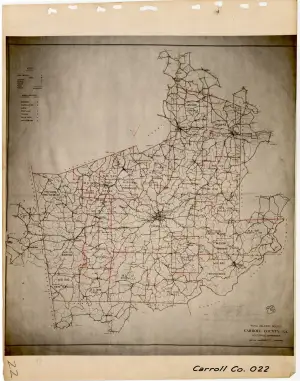 The Mail Had to Get ThroughNo Copyright—United States. United States Post Office Department; University of Georgia Libraries, Map and Government Information Library. Reduced facsimile; no route alterations.
 The tracks that built West GeorgiaCram, 1883 · Library of Congress · public domain
- Bremen hiding in plain sight
Share a photo, memory or landmark
Daniel reviews contributions before anything appears publicly.
Know someone who would enjoy this? Pass it along.