Draketown · Haralson County history
The monument on Eaves Drive
Alice Stewart, a deadly moonshine conflict in 1924, and the white memorial that keeps her name in Draketown’s landscape.
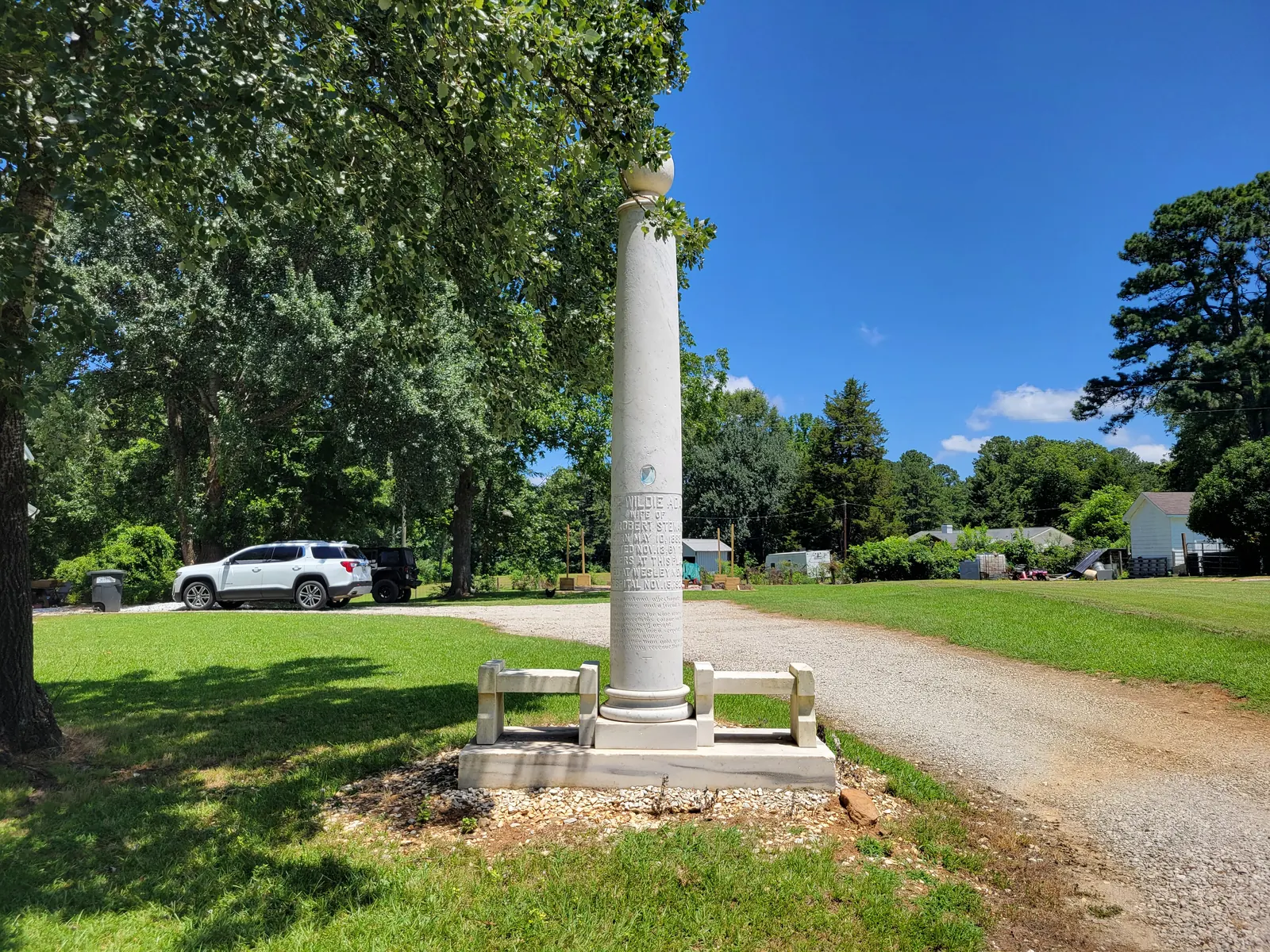
A white column stands beside Eaves Drive in Draketown, close to the everyday life of homes, trees and a gravel drive. Its inscription names Alice Wildie Adams Stewart. A photograph taken in July 2025 shows how quietly this memorial occupies the landscape, although the story behind it once reached newspaper readers far beyond Haralson County. [1] [2]

In this story
Start with the person remembered
Alice was the wife of Methodist preacher Robert Stewart. The inscription records the attack on November 13, 1924, and her death at Wesley Memorial Hospital two days later. It also remembers her place in a family and among friends. Those personal details deserve room beside the better-known story of a preacher’s confrontation with moonshiners. [1] [2]
A family photograph reproduced by researcher Cynthia Jennings shows Robert with their two daughters in the Atlanta Constitution of November 16, 1924. That image gives the monument a different scale: a household had lost a wife and mother. [5]
Why moonshine mattered here
Georgia’s liquor conflict was already old when the Stewarts lived in Draketown. The state legislature passed a statewide prohibition law in 1907, well before national Prohibition took effect in January 1920. By 1924, the demand for liquor continued under both state and federal restrictions. [4]
Making liquor also belonged to a much older farm economy. Historian Bruce E. Stewart explains that farmers across Georgia turned surplus crops into spirits to earn cash. Moonshining extended beyond the northern mountains into other parts of the state. That wider history helps explain why a story about stills and bootlegging belongs in West Georgia’s history, too. [3]
Robert Stewart took an active part in destroying stills, earning the nickname “The Raiding Parson.” Ken Denney’s later newspaper account describes men coming to the parsonage on November 13 to seize him. Alice intervened with a pistol and was shot. She died on November 15. [2]
The memorial and the Klan’s involvement
The monument was unveiled in 1925. A photograph caption published by the Dallas New Era gives May 31 as the ceremony date; a later newspaper account says June. The sources agree on the year, while the precise date needs confirmation from contemporary coverage. [2] [6]
Jennings’s account describes the Ku Klux Klan helping raise money for the monument and robed members attending its unveiling. That involvement by a white supremacist organization belongs in the memorial’s history. It does not, by itself, establish who killed Alice or what any individual knew. [5]
A memorial preserves a name, but its dedication also tells us something about the people who shaped the public remembrance. Reading those two histories together leaves room to honor Alice while examining the organization that helped commemorate her.
Then the story became a movie
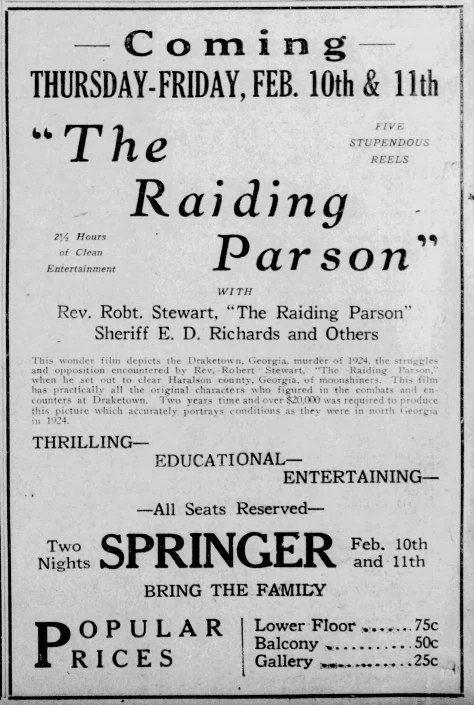
One of the most unexpected surviving items is a Columbus Ledger advertisement dated February 6, 1927, reproduced by Jennings. It promotes The Raiding Parson at the Springer for February 10 and 11. The bill names Rev. Robert Stewart and Sheriff E. D. Richards, advertises five reels, and lists tickets from 25 to 75 cents. [5]
The advertisement claims that many participants in the original events appear in the picture. It also claims a production cost above $20,000. These are the promoter’s claims; the clipping cannot establish the film’s accuracy, cast or actual budget. What it does show is that, within a few years, the Draketown story was being sold to a theater audience. [5]
We have examined the reproduced advertisement, not a surviving print of the film. Finding a print, production record or contemporary review would add a remarkable next chapter to this research.
A story carried through families
Elaine Bolden Bailey and Patricia Lamar Mullinax later researched the story for Draketown Tragedy. Bailey described interviews with Alice’s granddaughters and access to family photographs. She also explained that some names were changed, making the book a fictionalized treatment grounded in historical research. Her published account says no one was convicted of Alice’s murder. [6]
This article draws on the authors’ published explanation and later reporting; it does not claim a review of the complete book or original trial file. Court records and contemporary newspapers would be needed to examine the proceedings in detail. A remembered family story, a monument inscription and a court judgment each answer different questions.
For neighbors who know the column but have never learned the name, Alice is a good place to begin. Dated photographs, old newspaper clippings and family documents could help fill the gaps. The monument stands beside residential property, and this research has not established public visitor access. Please respect the nearby homes. [1]
The dates at a glance
- 1907Georgia passes its statewide prohibition law. [4]
- November 13–15, 1924Alice Stewart is shot and dies two days later. [1]
- 1925The monument is unveiled; later sources differ on the ceremony date. [2] [6]
- February 1927A newspaper advertisement promotes The Raiding Parson at the Springer. [5]
- July 2, 2025John Phelan photographs the surviving memorial. [1]
Sources and further reading
- John Phelan, Alice Wildie Adams Stewart memorial, Draketown GA
Photograph dated July 2, 2025. The image and visible inscription were examined. Photograph reused under CC BY 4.0, with attribution and a license link in its caption. - Ken Denney, “Murder in Draketown,” Times-Georgian, January 11, 2020
Reprinted by Lillium Press alongside earlier reporting. A retrospective account, used for the attack, Eaves Drive location and memorial history. - Bruce E. Stewart, “Moonshine,” New Georgia Encyclopedia
Statewide agricultural and economic context; not evidence of any particular Draketown resident’s conduct. - Kaylynn Washnock, “Prohibition in Georgia,” New Georgia Encyclopedia
State prohibition legislation and the chronology of national Prohibition. - Cynthia L. Jennings, “The Draketown Tragedy—Draketown, Georgia,” February 5, 2023
Includes the family photograph and a reproduced Columbus Ledger advertisement identified as February 6, 1927. The clipping was inspected; the complete newspaper issue and film were not. The author’s speculation about responsibility for the killing is not treated here as established fact. - Elaine Bailey, “Moonshine and Murder Featured in Local Authors’ New Book,” Dallas New Era
Author’s explanation of research, changed names and reported trial outcome; photograph caption dates the unveiling May 31, 1925. Text was available through the search index; the direct page intermittently failed. The article is also reprinted by Lillium Press above.