FAITH CLOSE TO HOME · BIRMINGHAM, ALABAMA
The Christmas bomb that did not stop Fred Shuttlesworth
On Christmas night in 1956, a bomb exploded at the home of Rev. Fred Shuttlesworth, pastor of Bethel Baptist Church. The parsonage was destroyed. Shuttlesworth emerged unharmed. The next day, he continued with a planned challenge to racial segregation on the city’s buses. [1] [2]
In this story
A congregation in Collegeville
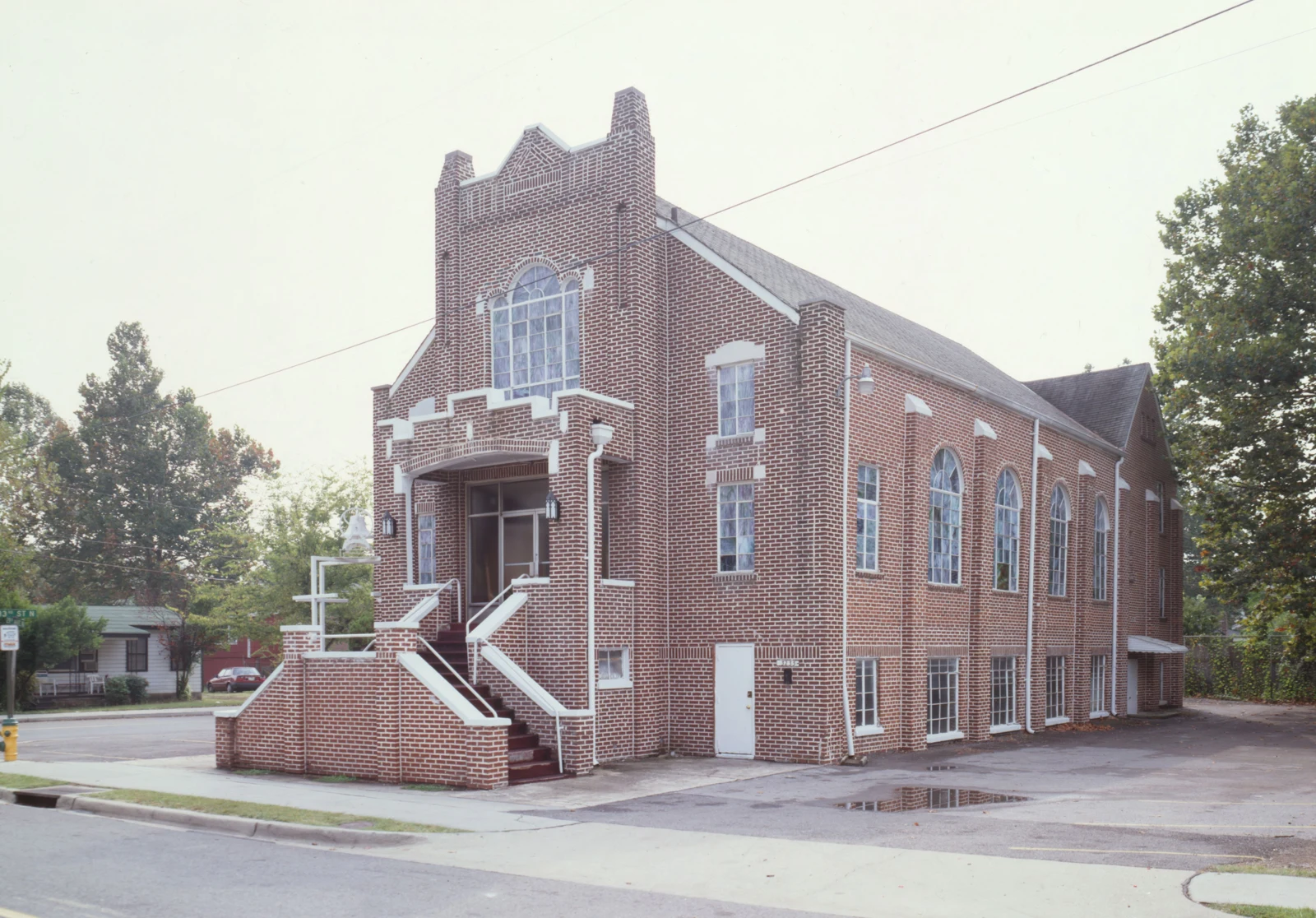
Bethel stood in a Black working-class neighborhood near Birmingham’s mines and industrial plants. Its brick church building dated to 1926. Shuttlesworth became its pastor in 1953, and the congregation would become a central meeting place for the Alabama Christian Movement for Human Rights. The setting matters: this work grew among families with jobs, homes, and daily responsibilities in the city whose laws they were challenging. [5]
In 1956, Alabama moved to prevent the NAACP from operating in the state. Shuttlesworth and fellow organizers established the ACMHR to continue the struggle. Churches provided places to meet, raise funds, pray, sing, and organize. Faith was part of the work’s shared life, while legal challenges and direct action gave that conviction practical expression. [1] [4]
After the Supreme Court upheld the ruling against bus segregation in Montgomery, Birmingham activists planned their own test of segregated seating. They chose December 26. The bomb struck the night before. [2]

His account of the blast
Nearly three decades later, Shuttlesworth described that night in an interview for Eyes on the Prize. He remembered lying in bed near the explosion and the wall and floor giving way. His recollection included dust, falling material, and the startling fact that he was still alive on his mattress. This is his later eyewitness account, preserved in an archival interview. [3]
He also described a conviction that God was with him and a profound change in his relationship to fear. In his telling, the attempt to kill him strengthened his resolve. We can report that testimony honestly while keeping it distinct from the independently documented bombing and survival. [3]
December 26
The planned action went ahead. Black passengers took seats in sections Birmingham reserved for white riders. Twenty-one participants were arrested and convicted. The ACMHR pursued a federal lawsuit against the segregation requirement. The effort involved many people accepting risk together; Shuttlesworth was leading a movement whose participants had their own families and livelihoods to consider. [2] [4]
The attack did not end the congregation’s work. Bethel repaired its sanctuary and built another parsonage. The church and Shuttlesworth continued through further threats and attacks. Their organizing helped create the foundations for the larger Birmingham campaign of 1963 and the pressure for national civil-rights legislation that followed. [5]
There is a useful lesson in the distance between the explosion and those later achievements. A moment of survival did not remove the work ahead. The people involved still needed places to meet, resources, legal effort, and the willingness to return after intimidation. The history asks us to notice that sustained labor alongside the remarkable night. [4] [5]
Remembering the man and the people beside him
“Be not overcome of evil, but overcome evil with good” (Romans 12:21, KJV). Paul’s instruction belongs to a passage that forbids personal vengeance and commands care even for an enemy. [6]
The original Bethel church is preserved as a historic site, with a marker recalling the bombing. Its surviving buildings bring the story into a real Birmingham neighborhood. They help visitors remember that the movement was carried by congregations and households as well as the leaders whose names became familiar. [1]
For a Christian reader, the account raises a searching question: what does love of neighbor require when doing right is costly? No act of courage earns salvation; our acceptance before God rests in Christ and His grace. Yet grace calls people into costly obedience. We can give thanks for Shuttlesworth’s preservation, face the evil done against him truthfully, and consider how to serve our own neighbors with courage and without personal vengeance. [6] [7]
Sources and further reading
- National Park Service — The Historic Bethel Baptist Church
Church history and the preserved site. - Stanford King Institute — Shuttlesworth, Fred Lee
Chronology of the bombing and bus action. - American Archive of Public Broadcasting — Interview with Reverend Fred Shuttlesworth, November 7, 1985
Shuttlesworth’s recorded recollections for Eyes on the Prize. - Encyclopedia of Alabama — Alabama Christian Movement for Human Rights
Organizing, strategies and collective action. - Library of Congress — Bethel Baptist Church, Historic American Buildings Survey AL-977
Historic building and neighborhood documentation. - Romans 12:17–21, King James Version
Christian reflection. - Ephesians 2:8–10, King James Version
Christian reflection.
Read another local story
 The Villa Rica boy behind “Precious Lord”Smithsonian NMAAHC · Open Access (CC0).
 The Cartersville preacher behind the RymanPublished in 1907; public domain in the United States.
- Faith close to home
Share a photo, memory or landmark
Daniel reviews contributions before anything appears publicly.
Know someone who would enjoy this? Pass it along.