HARALSON COUNTY · REPAIR WORK AND INVENTION
A Tallapoosa Idea for Changing the Mop
A mop has to hold its cleaning material firmly, then let it go when someone needs to change it. In Tallapoosa, George Washington Kemp put that ordinary problem into a patent drawing: two metal bars, guiding stems and a pair of wing nuts. His small improvement gives us a reason to look closer at the town’s repair trades and the people behind them. [1]
In this story
Two bars and a pair of wing nuts
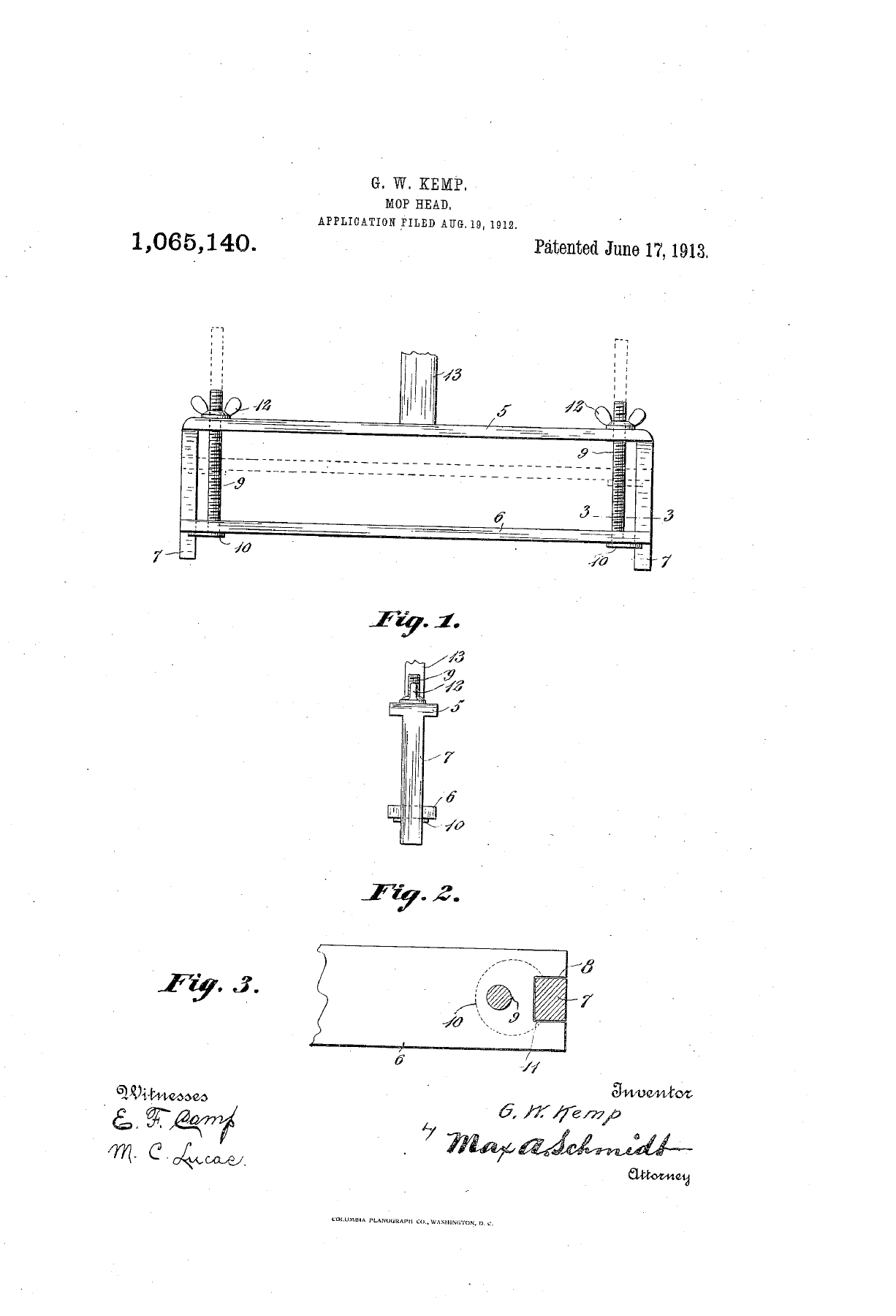
Kemp applied for his mop-head patent on August 19, 1912. It was issued on June 17, 1913, and identified his home as Tallapoosa in Haralson County. His claim concerned the arrangement of the head’s parts. The mop itself was already a familiar tool. [1]
In his drawing, one metal bar stays fixed while another slides toward it, guided by stems at the ends. Tightening the wing nuts brings the bars together around the cleaning material. Loosening them opens the clamp. The bolt heads have notches that fit against the guides, keeping the bolts from turning while the nuts are tightened. It is a design built around holding, guiding and releasing. [1]
A name in the repair trades
Years before the patent, a carriage-and-wagon directory placed G. W. Kemp among Tallapoosa’s repairers. The 1903 volume lists him with the abbreviation “rep,” which its own key defines as repairer. Young & Co.’s 1909–10 directory is more specific: G. W. Kemp, blacksmith. [2] [3]
The federal census adds a fuller name. In 1910, Tallapoosa’s George W. Kemp was recorded as a sixty-year-old blacksmith working on his own account. The matching name and town, alongside the repair-trade records, strongly suggest that this was the patent holder. None of the outside records explicitly identifies him by his patent, so that personal connection remains an inference. [4]
A household across twenty years
The original census pages let us follow that blacksmith’s household further. In June 1900, George Kemp was fifty and living in Tallapoosa with his wife, daughters Carrie V., Carole and Maggie C., and son Spencer. His occupation was already blacksmith. An index misreads the boy’s name as “Sawser”; the handwritten page reads Spencer. [5]
Ten years later, George was listed as widowed. Maggie and Spencer remained in his household, and Spencer worked as a clerk in a general store. Those repeated names, the town, the occupation and the ages make the connection between the two census households especially strong. The records give us people and work, without telling us who first thought of the mop or who might have helped develop it. [4] [5]
In January 1920, the census again recorded George W. Kemp in Tallapoosa. He was seventy, with Louisa listed as his wife, and still described as a blacksmith working in his own shop. The sequence places a repair trade across two decades of the town’s life. It does not turn the intervening patent into proof of a new factory or a successful product. [6]
Following the idea beyond the drawing
Two witnesses signed the patent specification: L. J. Pounds and T. W. Wright. The earlier business directory lists an L. J. Pounds in Tallapoosa’s hardware trade. That is a lead worth following, but a witness and a matching business name do not establish that anyone stocked or sold Kemp’s invention. [1] [3]
No advertisement, production record, customer account or surviving mop has yet been securely connected to this patent. Its promises of strength and easy use remain Kemp’s claims. What survives is more modest, and still worth seeing: a local resident working through the small connections that make an everyday tool useful. The repair directories and census pages give that drawing a setting in a town where people earned their living making things work. [1]
Sources and further reading
Research notes
The 1900 and 1920 original census pages are new evidence in this pass. The patent, 1903 repairer directory, 1909–10 business directory and 1910 census were already inspected in earlier Dig research; this is their first standalone Kemp story. The census households match strongly across names, ages, birthplace, trade and town. Identifying that blacksmith with the full-name inventor remains an inference, not an explicit documentary link. No domestic inspiration, family participation, retailer, manufacturer, sales or surviving product has been established. A Pennsylvania George W. Kemp’s gate patent is excluded. The original 1900 son’s name is Spencer, not the index transcription “Sawser.”
- George Washington Kemp, U.S. Patent 1,065,140, Mop-head, June 17, 1913
Both original patent pages inspected. Filed August 19, 1912; full name, Tallapoosa and Haralson County supplied. The design and intended benefits are not evidence of manufacture, sales, tested durability or use. Text witnesses L. J. Pounds and T. W. Wright. Original PDF: https://patentimages.storage.googleapis.com/3a/b9/a8/08f4269ea629d9/US1065140.pdf. - American Carriage and Wagon and Accessory Trades Directory, 1903, pp. 73 and 99
Original title, copyright, explanatory key and listing inspected. Price & Lee, 15th edition; 1903 title date and 1902 copyright. Printed p. 99 lists Kemp G. W. (rep) under Tallapoosa; p. 73 defines rep as repairer. No full name, address or mop business. Exact listing image: https://archive.org/download/americancarriage1903newh/page/n106.jpg. - Young & Co.’s business and professional directory, 1909–10, p. 600, Tallapoosa
Original listing inspected in the earlier Dig research and rechecked. Lists Kemp G W, blacksmith, and Pounds L J, hardware. Initials and town support an identity lead, not a proven patent or retail relationship. - 1910 U.S. census, Tallapoosa city, Haralson County, ED 86, sheet 6B, lines 69–71
Original federal schedule inspected. National Archives T624, roll 188; page dated April 21–22. George W. Kemp, 60, widowed, blacksmith, own account; daughter Maggie, 23, and son Spencer, 21, general-store clerk. Digitized copy via Internet Archive / Allen County Public Library Genealogy Center. Original image: https://archive.org/download/13thcensus1910po188unit/page/n881.jpg. - 1900 U.S. census, Tallapoosa, Haralson County, ED 61, sheet 5B, lines 76–81
Newly inspected original federal schedule, June 8, 1900; National Archives T623, roll 203. George Kemp, 50, blacksmith; wife’s name appears as Elizie A.; daughters Carrie V., Carole and Maggie C.; son Spencer. The original resolves the index’s “Sawser” transcription. Household matching is supported by names, ages, town and trade; no patent is named. Original image: https://archive.org/download/12thcensusofpopu203unit/page/n447.jpg. - 1920 U.S. census, Tallapoosa city, Haralson County, ED 119, sheet 12A, lines 16–17
Newly inspected original federal schedule, January 15, 1920, stamped folio 140; National Archives T625, roll 261. George W. Kemp, 70, Alabama-born, blacksmith, own shop, own account; Louisa, wife, 47. No factory, mop production or marriage circumstances established. Original image: https://archive.org/download/14thcensusofpopu261unit/page/n282.jpg.
Read another local story
- From Artificial Limbs to Well Tops: A Tallapoosa Inventor
 When Tallapoosa dreamed of becoming an industrial cityPublic-domain 1895 map; UGA Libraries / Digital Library of Georgia.
 Southwire: How Carrollton learned to make wireU.S. patent drawing; no copyright notice in original scan. Reproduced under USPTO patent-publication guidance (source 9).
Share a photo, memory or landmark
Daniel reviews contributions before anything appears publicly.
Know someone who would enjoy this? Pass it along.