HARALSON COUNTY · INVENTION AND A WORKING LIFE · 1864–1920
From Artificial Limbs to Well Tops: A Tallapoosa Inventor
The lining inside an artificial limb is a small part with a very personal job. William H. Kimball of Tallapoosa patented an improvement to it in 1901. His later drawings addressed fence posts and household wells. Following those designs now brings us into family, military and census records that help identify the man behind them. [1] [2] [4] [8] [9] [10]
In this story
A life behind the drawings
A family history published in 1908 names William H. Kimball and his wife, Leora Hickox, and places their family in Tallapoosa that May. It describes him as a merchant and manufacturer who had largely retired. It also records an earlier life in the Union Army’s 47th Ohio Infantry and the loss of his right leg during the Atlanta campaign. [8]
That military account has independent support. Ohio’s official roster lists William H. Kimball as a first lieutenant, wounded near Atlanta on August 4, 1864, with a leg amputated. The roster gives his discharge as November 1, 1864; the family history gives November 4. The difference remains in the source notes rather than being silently harmonized. [8] [9]
The 1910 Tallapoosa census records William H. and Leora C. Kimball, both sixty-six and born in Michigan, with forty-six years of marriage reported. These names, ages and place support the family history’s identification. Together they strongly point to the veteran as the local inventor, although the biographical records do not mention his patent number. [8] [10]
An injury gives the artificial-limb drawing a possible personal context. It does not tell us that Kimball wore his own design, tested it on himself or invented it because of his wartime experience. No located account makes those claims.
Inside the socket
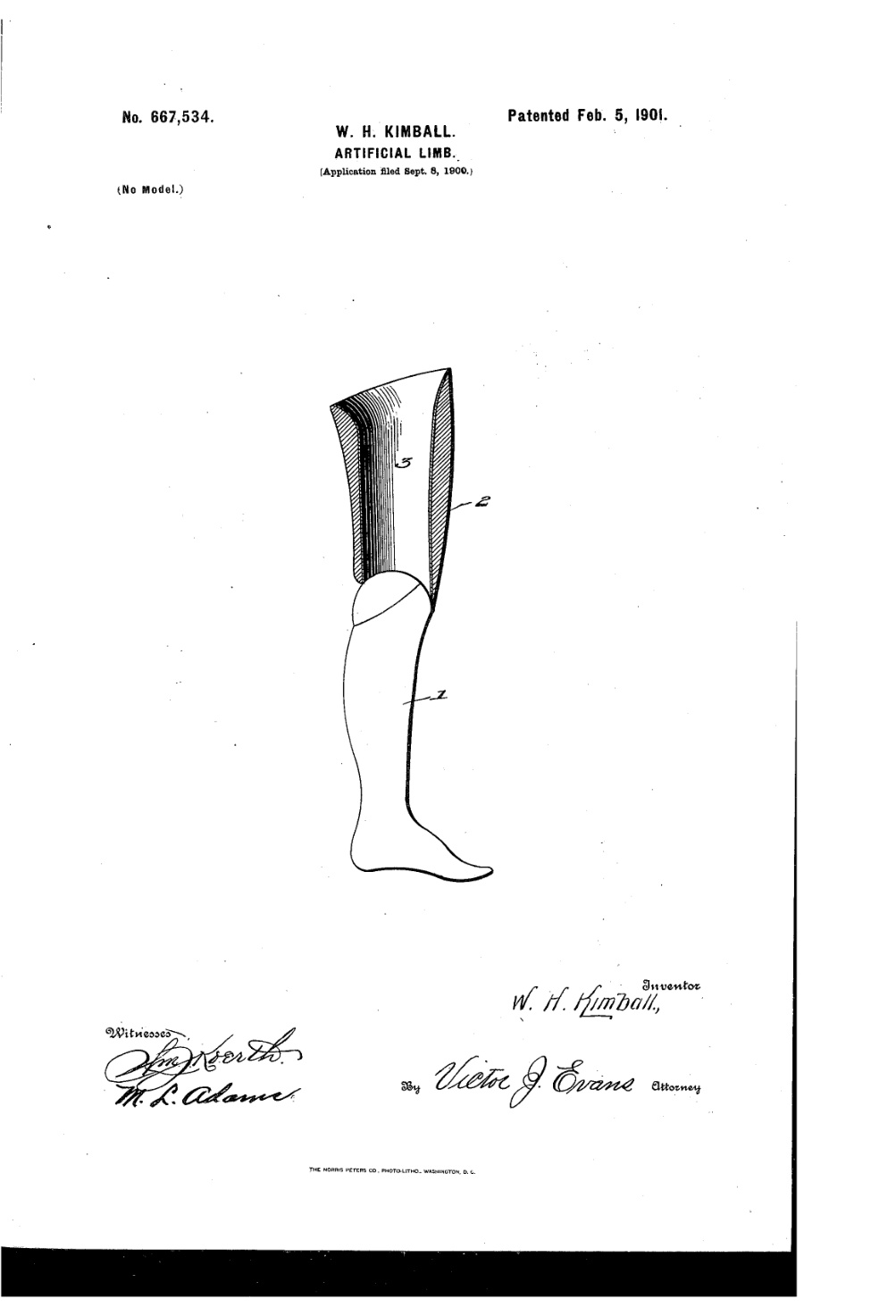
Kimball’s first patent in this story was issued on February 5, 1901, after an application the previous September. Its subject was the socket where an artificial limb met its wearer. He described perspiration being absorbed into that socket and proposed a thin metal lining to provide a nonporous surface. Tin foil or aluminium, attached with an adhesive, were among the materials he named. [1]
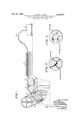
The drawing shows an artificial leg with part of the upper socket cut away. The small number 3 points to the lining that was the heart of his proposal. Kimball said the improvement could apply to arms as well as legs and to different makes of artificial limb. His claim concerned that lining, rather than the invention of artificial limbs as a whole. [1]
The document supplies a design and its intended purpose, not an account of a wearer’s experience. No identified user, trial or manufacturer of this lining has been found. The wartime records deepen the human question without answering whether the improvement worked as Kimball hoped.
A post with less material
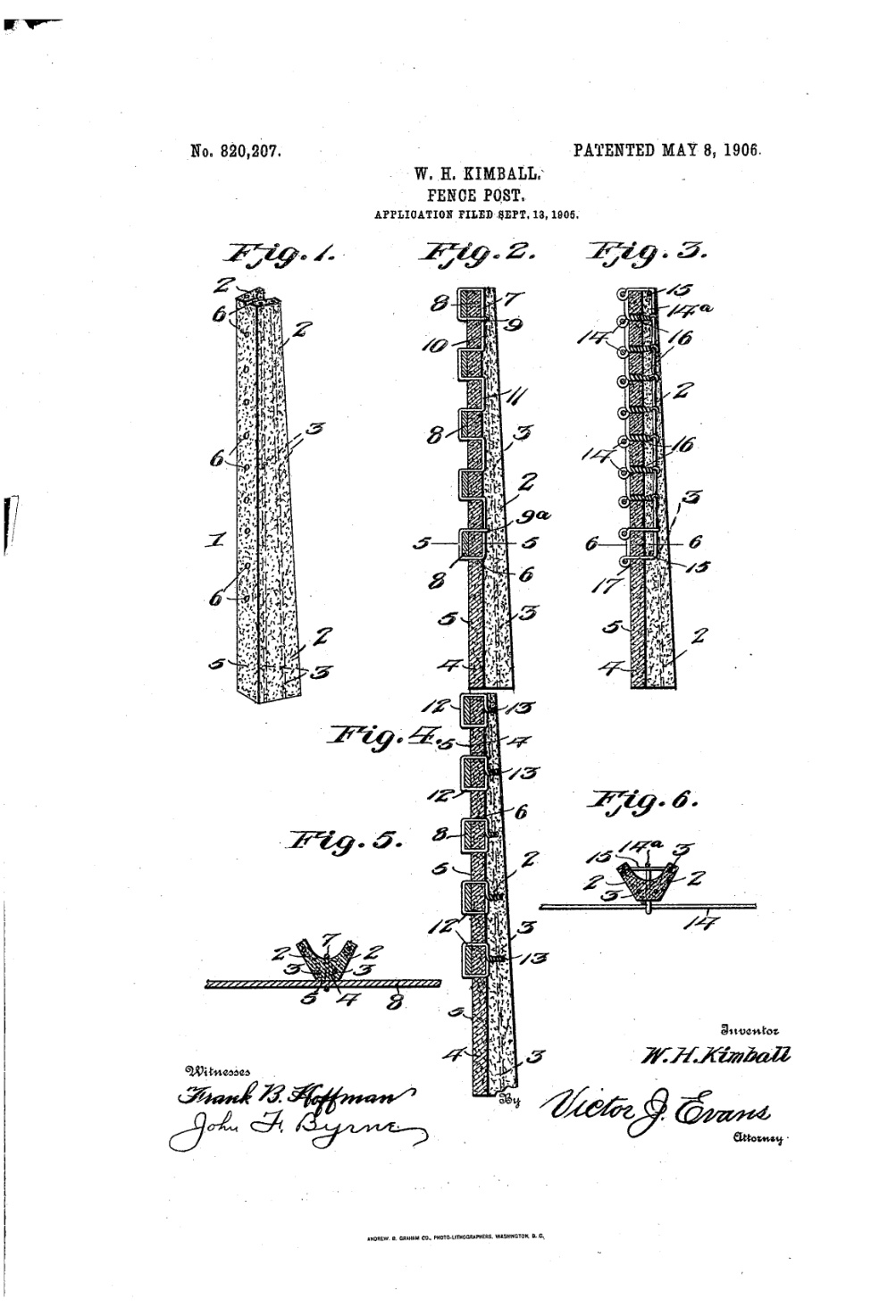
Five years later, on May 8, 1906, Kimball received a fence-post patent. He described a molded post of cement or similar material, wider at the base and tapering upward, with a U-shaped cross section. Wires embedded lengthwise in its sides were intended to reinforce it. His aim was strength with economical use of material and a low manufacturing cost. [2]
The six figures explain more than the post’s outline. They show ways of fastening wooden rails or fence wire to it, and cross sections reveal the hollowed shape. Kimball also addressed a practical manufacturing problem: keeping the sides from collapsing as the post came out of its mold. Those details preserve the work he was thinking through, even though no surviving post or production record has yet been identified. [2]
The heading adds another Tallapoosa name. Kimball assigned one-half of the patent to William C. Kimball. The original scan clearly supplies the middle initial C; one machine transcription reads it as O. The 1908 family history names a son William C., making a family partnership a possibility. But its birth year and birthplace do not align with a later Tallapoosa census entry for William C. The assignee’s relationship is still unresolved. [2] [8] [12]
Above the well
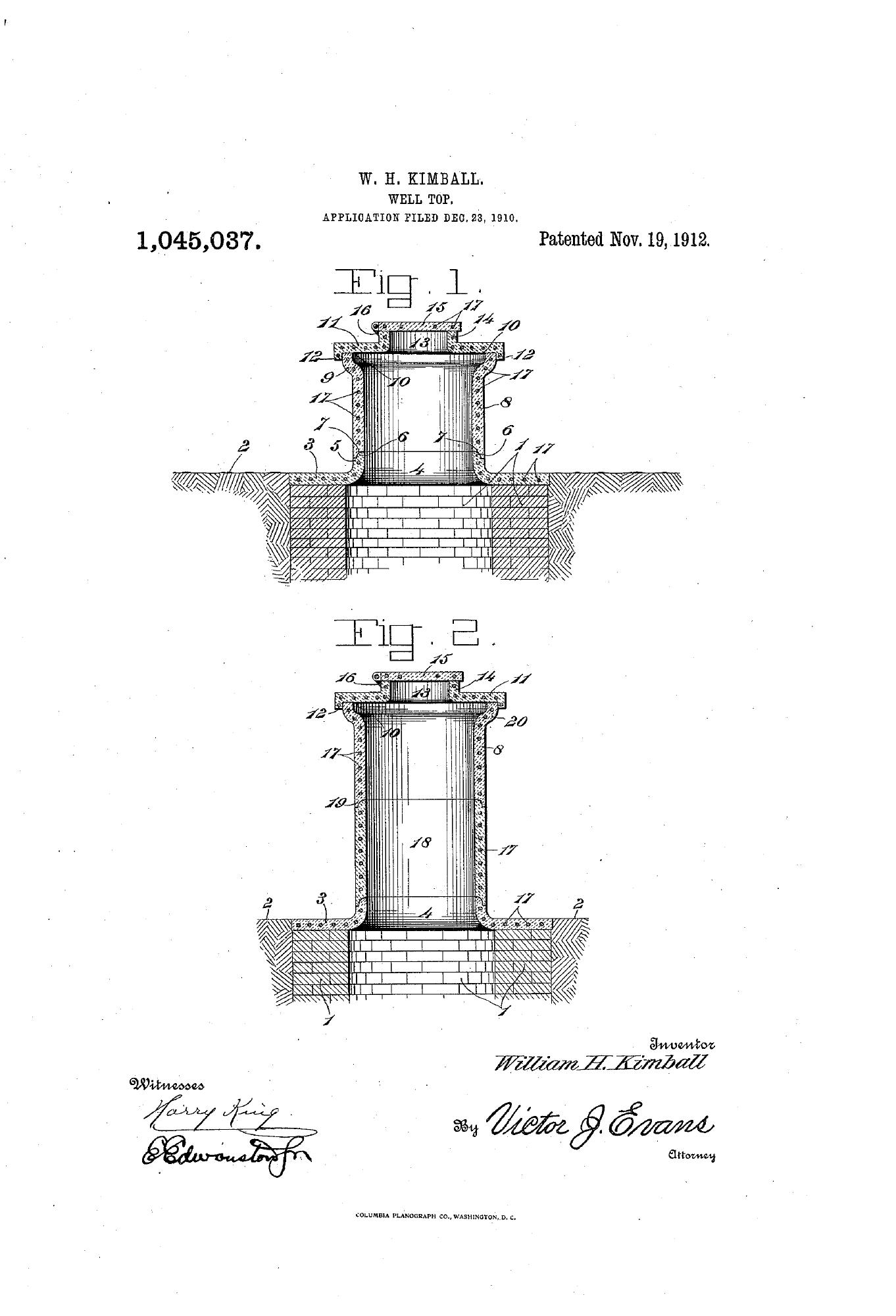
Kimball filed his well-top application on December 23, 1910, and received the patent on November 19, 1912. He proposed replacing the wooden structure commonly used above a walled well with one preferably made of cement and strengthened by embedded reinforcement. Its broad circular base would overlap the well walls, an arrangement intended to keep water from running back into the well. [4]
At the top, a covered opening left room for the bucket. In the second drawing, the body could be assembled from sections joined by tongues and grooves. Kimball even described extending it to a building’s first or second floor. The drawing preserves an adaptable design; it does not identify a house where it was installed or establish its performance. [4]
Four days after the patent was issued, the Augusta Herald included W. H. Kimball of Tallapoosa and his well top in a list of patents to Georgians. The notice brought the invention into a newspaper, but said nothing about sales. [7]
A business name emerges
Seven years later, a civic contribution left a more useful business clue. On October 17, 1919, the Atlanta Georgian reported a $25 advance contribution to the Roosevelt memorial fund from W. H. Kimball, identifying him as president of the Acme Well Top Company of Tallapoosa. A brief notice about a memorial campaign had preserved a company title. [5]
Acme’s name can now be followed one year earlier than before, into Georgia’s industry roster for 1915, published in 1916. The company also appears in the reports for 1916 and 1917. In the last of these, W. H. Kimball has a separate entry in the same broad brick-and-tile industry category. These are listings, not production accounts. [3] [6] [11]
Another census entry strengthens the business trail. In February 1920, William H. Kimball and Leora were still in Tallapoosa, both listed as seventy-six. His occupation was now manufacturer, with concrete work entered as the industry. Unlike the 1910 entry describing him as retired, this record places him in manufacturing; it names no company or particular product. [10] [12]
The matching name, town and material make the Acme connection more persuasive. No located company paper or surviving object explicitly connects its output to patent 1,045,037, however. We can now follow a household as well as three designs: a lining close to the body, a fence post standing in the ground and a cover over the household well. A dated bill, catalogue or well top with a reliable history could tell us what people actually bought and used.
Sources and further reading
Research notes
Original patent, newspaper, industry-list, family-history, military-roster and census pages were inspected. New this pass: the 1908 family compilation, official Ohio roster, 1910 and 1920 Kimball households, and the Acme listing in the report for 1915. Matching name, wife, ages and town strongly link the Tallapoosa resident to the veteran; no source explicitly names the patent in that biography. The official roster’s November 1, 1864 discharge differs from the genealogy’s November 4. No personal motive, use or testing of the artificial-limb lining is inferred from the injury. The genealogy’s William C. details conflict with the separate 1920 household, leaving the patent assignee’s relationship unresolved. The 1920 manufacturer/concrete entry strengthens the Acme lead without proving company identity or production of a particular patent. Incorporation, sales, customers, surviving products and an authenticated portrait remain open.
- William H. Kimball, U.S. Patent 667,534, Artificial Limb, February 5, 1901
Both original patent pages inspected. Filed September 8, 1900; specification identifies Tallapoosa, Haralson County. Drawing and claim concern a metal socket lining. The stated aims are not evidence of medical results, manufacture or sales. Original PDF: patentimages.storage.googleapis.com/41/56/f3/57ef4a99f06b29/US667534.pdf. - William H. Kimball, U.S. Patent 820,207, Fence-Post, May 8, 1906
All three original pages inspected. Filed September 13, 1905. The original heading assigns one-half to William C. Kimball of the same city; C is not the O in one transcription. The period word “plastic” means moldable here: cement is the specified example, not modern synthetic plastic. Intended strength and economy are not measured results. Original PDF: patentimages.storage.googleapis.com/37/d3/e9/5f7a545bd8ca2d/US820207.pdf. - Georgia Department of Commerce and Labor, Sixth Annual Report, for 1917, published 1918, pp. 59–60
Title page and printed pp. 59–60 visually inspected: bound PDF pages 107, 167 and 168. Category is Brick, Tile and Terra Cotta. Acme Well Top Co., Tallapoosa appears on p. 59; Kimball, W. H., Tallapoosa on p. 60. These are separate entries, not an explicit legal relationship. The Acme entry gains new relevance from the 1919 newspaper identification; this is the same report already examined in the previous pass. - William H. Kimball, U.S. Patent 1,045,037, Well-top, November 19, 1912
Both original pages inspected. Filed December 23, 1910; full name and Tallapoosa, Haralson County specified. Cement, embedded reinforcement, bucket opening, pivoted cover and sectional version are proposed arrangements. No installation, tested water quality, durability or manufacture established. “Plastic” means moldable material here. Original PDF: https://patentimages.storage.googleapis.com/9c/0e/f8/8a0f6aebf4ed91/US1045037.pdf. - The Atlanta Georgian, October 17, 1919, edition 6, p. 9, “Memorial Drive Heads Named”
Original page and column 2 inspected. Final paragraph identifies W. H. Kimball as president of Acme Well Top Company of Tallapoosa and reports his $25 advance contribution. Initials, place and product field support a possible inventor-company connection; full-name identification and manufacture of the patent are not established. The unrelated portrait above the article is not Kimball. - Georgia Department of Commerce and Labor, Fifth Annual Report, for 1916, published 1917, p. 60
Original title and listing inspected at bound PDF pages 5 and 66. Acme Well Top Co., Tallapoosa is under Brick, Tile, Terra Cotta, Sewer Pipe and Lime. Roster presence does not establish exact products, executives or continuous production. This bound object also contains the later report cited in source 3. - The Augusta Herald, November 23, 1912, p. 8, “Patents to Georgians”
Original page and column 3 notice inspected. The list, supplied by patent attorneys Davis & Davis, includes W. H. Kimball, Tallapoosa, well top. Repeated notices are not independent evidence of production or use. - William Franklin and Charles Edwin McMillan, McMillan Genealogy & History, 1908, pp. 154–155
Original pages visually inspected via the Library of Congress digitized copy at Internet Archive, mcmillangenealog00mcmi, download images n205 and n206. Names William H. Kimball and Leora Hickox, their Michigan origins, 47th Ohio service, right-leg loss, Tallapoosa family address in May 1908 and son William C. This is a near-contemporary family compilation, not an inspected service or birth certificate. Its November 4 discharge differs from the official roster’s November 1. Its William C. birth year and birthplace conflict with details in the 1920 neighboring household; do not treat the patent assignee’s kinship as proved. - Official Roster of the Soldiers of the State of Ohio, vol. IV, 1887, p. 403, 47th Ohio Infantry, Company D
Original printed p. 403 inspected at https://archive.org/download/ohiowarroster04howerich/page/n416.jpg. William H. Kimball, first lieutenant; transfer from Company I September 14, 1863; discharged November 1, 1864 for wounds received August 4 near Atlanta; leg amputated. Roster confirms military injury independently of the family history, but does not name Tallapoosa or a patent. The genealogy supplies the right-leg detail; the roster says leg. - 1910 U.S. census, Tallapoosa city, Haralson County, ED 86, sheet 19B, lines 67–68
Original federal schedule visually inspected, page dated May 9–10, 1910; National Archives T624, roll 188. William H. and Leora C. Kimball, both 66, Michigan-born, 46 years married; William’s occupation Retired. Same name, wife, age and town support the genealogy match. The right-hand veteran columns are not used. Original image: https://archive.org/download/13thcensus1910po188unit/page/n907.jpg. - Georgia Department of Commerce and Labor, Fourth Annual Report, for 1915, published 1916, p. 59
Original report and printed p. 59 inspected. Acme Well Top Co., Tallapoosa is listed under Brick, Tile, Terra Cotta, Sewer Pipe and Lime. Extends the previously inspected 1916–1917 listings backward by one report year; does not establish incorporation date, an exact product, output or sales. - 1920 U.S. census, Tallapoosa town, Haralson County, ED 204, sheet 9B, lines 57–61
Original federal schedule visually inspected, February 5, 1920; National Archives T625, roll 261. Lines 60–61: William H. and Leora C., both 76; his occupation Manufacturer, industry beginning “Concrete Art…” (ending abbreviated/uncertain), own account. No company or particular product named. Separate preceding household lists William C., 42, Michigan-born, accountant, with wife Lillian E. and son Charles S. The separate households establish proximity in enumeration, not kinship; their details conflict with the 1908 genealogy’s William C., born 1887 in Minnesota and unmarried in May 1908. Original image: https://archive.org/download/14thcensusofpopu261unit/page/n307.jpg.
Read another local story
- A Tallapoosa Idea for Changing the Mop
 When Tallapoosa dreamed of becoming an industrial cityPublic-domain 1895 map; UGA Libraries / Digital Library of Georgia.
 Southwire: How Carrollton learned to make wireU.S. patent drawing; no copyright notice in original scan. Reproduced under USPTO patent-publication guidance (source 9).
Share a photo, memory or landmark
Daniel reviews contributions before anything appears publicly.
Know someone who would enjoy this? Pass it along.