FAITH CLOSE TO HOME · NEAR PIEDMONT, ALABAMA
After the tornado, Goshen kept gathering
On March 27, 1994, people gathered for Palm Sunday at Goshen United Methodist Church near Piedmont, Alabama. Children were taking part in a musical program. Among them was sixteen-year-old Christa Neyman, who later remembered the electricity flickering, urgent instructions to get down, and then the sight of a building with its roof gone. Her memories would remain vivid twenty years afterward. [2]
In this story
11:39 on Palm Sunday
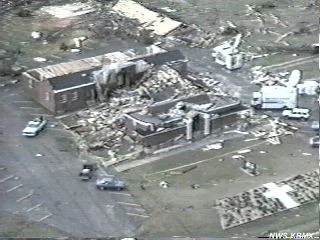
The National Weather Service places the strike at 11:39 a.m. Central Standard Time. The tornado had begun near Ragland, crossed Neely Henry Lake, and moved northeast toward the Goshen community. At the church, twenty people died and about ninety were injured. Those are settled facts beneath the photographs of wreckage: a congregation had lost people it knew and loved. [1]
One of the children who died was Hannah Clem, the four-year-old daughter of Goshen’s pastor, Kelly Clem. [4] Her father, Dale, was also a minister. Years later, he would remember an energetic little girl who found her way into mischief. That ordinary description matters. Before Hannah became a name in an account of a disaster, she was a daughter whose family knew her laughter and personality. [5]
An official investigation found that a tornado warning had been issued about twelve minutes before the church was struck, but the congregation had no NOAA Weather Radio or other way to receive it. The findings became part of a larger examination of warning delivery. Preserving this detail gives the history a practical consequence: communities need warnings to reach the people gathered inside their buildings. [6]
The next Sunday came
One week later, about two hundred people gathered for Easter worship in the ruined church’s parking lot. [3]
A year later, Goshen still worshiped in borrowed space at a Masonic lodge. Twenty candles were lit as the dead were remembered. Kelly Clem invited another minister to preach, acknowledging that she needed care too. Work had begun toward a new church building. [4]
There is something worth lingering over in that admission. A grieving leader should not have to become an emblem of strength for everyone else. The people who pray with others also need someone to sit beside them. Christian care becomes more honest when it allows that need to be spoken.
Memory became service
In a 2005 interview, Dale Clem spoke about resurrection while remembering his daughter and the family’s long journey afterward. He had written about that experience in Winds of Fury, Circles of Grace. Eleven years had passed, and the conversation still held both loss and renewed purpose. His account gives us a father’s testimony over time; it does not give outsiders permission to explain why his child died. [5]
Then another terrible tornado outbreak struck Alabama on April 27, 2011. The North Alabama Conference subsequently reported that members of Goshen were taking part in daily volunteer efforts for those affected. People whose own congregation had suffered were now helping other survivors. That later chapter deserves a place beside the famous images from 1994. [7]
At the twentieth anniversary, Neyman described what surviving had taught her: to cherish family and friends and to value the people around her. Her emphasis was on love expressed in ordinary relationships. This is a quieter part of the story, but it brings the history within reach of anyone who has another opportunity to care for a neighbor. [2]
What hope can honestly say
“Jesus wept” (John 11:35, KJV). The same chapter records His promise of resurrection and His sorrow beside grieving people. Hope and tears belong together. [8]
We should leave room for what remains unanswered. Survival is not a measure of somebody’s faith, and the people who died must never become props in an uplifting ending. Christian hope rests in Jesus Christ, who died and rose again. His promise of life is the ground beneath the believer’s grief, even when the grief remains heavy. [8] [9]
For readers in west Georgia and eastern Alabama, Goshen offers a nearby history to remember with care. We can honor that witness by listening patiently to grieving people, receiving help when we need it, and staying long enough to do the ordinary work of love.
Sources and further reading
- National Weather Service Birmingham — Palm Sunday Tornadoes 1994 Storm Data
Official storm record; injury totals differ slightly between NWS accounts. - WBRC — 20th anniversary of Palm Sunday tornado (2014)
Christa Neyman’s recollections. - The Washington Post — A Celebration of Life (April 4, 1994)
- Associated Press / SFGATE — A Day of Not Forgetting (April 10, 1995)
First-anniversary reporting. - WAFF — Remembrance and Resurrection: 11 Years After Palm Sunday Tornado (2005)
Dale Clem’s account of grief and faith. - National Weather Service — Southeastern United States Palm Sunday Tornado Outbreak of March 27, 1994
Warning delivery and official findings. - North Alabama Conference — Goshen tornado survivors give aid (May 6, 2011)
Goshen members helping after the 2011 tornadoes. - John 11:25–35, King James Version
Christian reflection. - 1 Corinthians 15:3–4, King James Version
Christian reflection.
Read another local story
 The unarmed medic who kept going backU.S. Army · Public domain.
 Sentenced to four years for refusing to leaveNational Archives · Public domain.
- Faith close to home
Share a photo, memory or landmark
Daniel reviews contributions before anything appears publicly.
Know someone who would enjoy this? Pass it along.