FAITH CLOSE TO HOME · NEW ECHOTA & NEAR ROME, GEORGIA
Sentenced to four years for refusing to leave
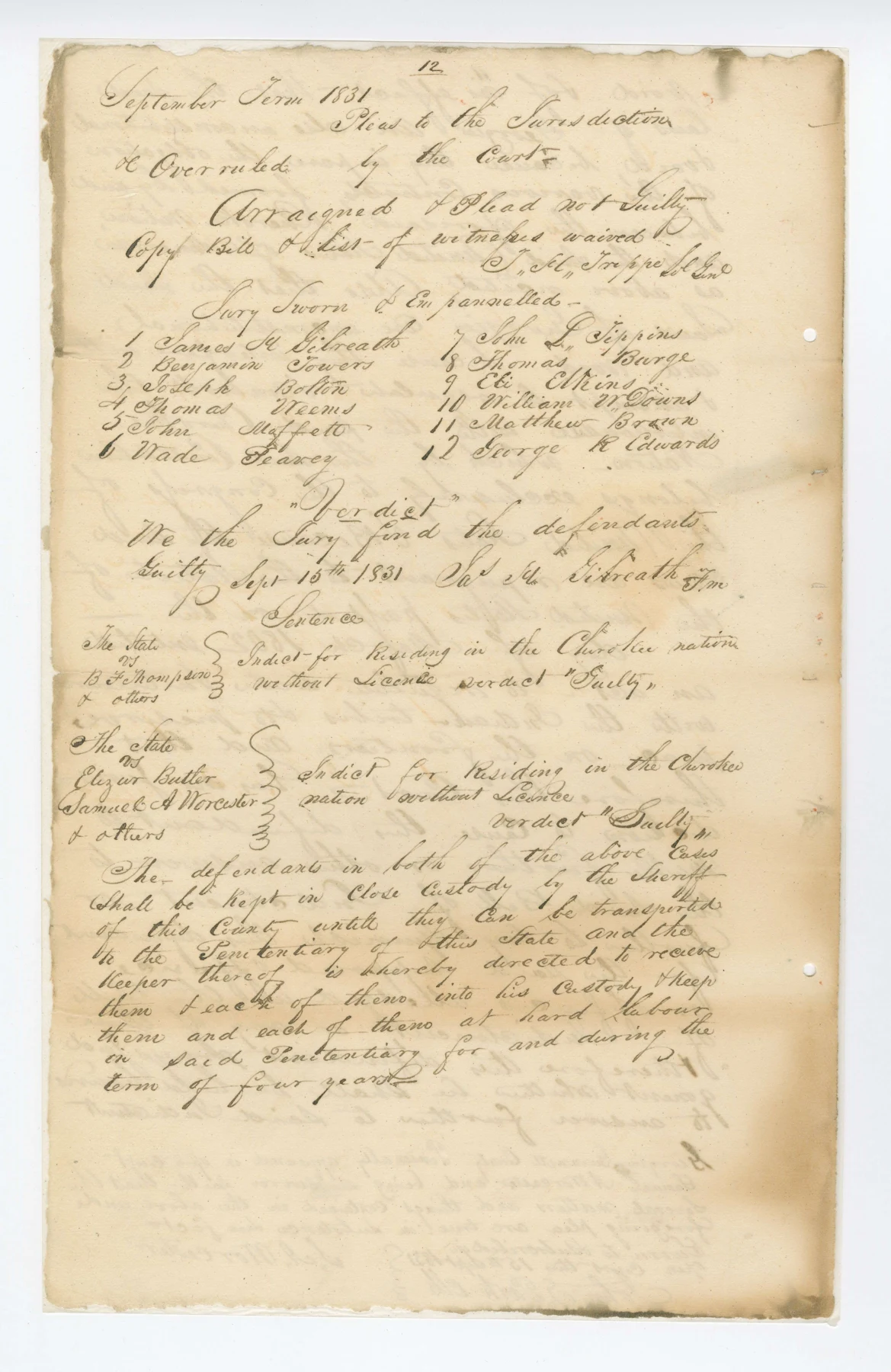
The surviving indictment makes the charge plain. Samuel Worcester, Elizur Butler, and other white residents were accused of living within the Cherokee Nation without a Georgia license and without taking the required oath to the state's laws. The document names residence itself as the offense. These men already had Cherokee permission to be there. The question was whether Georgia could impose its authority over that nation. [1]
In this story
Whose permission mattered?
Worcester had come to New Echota in 1827. There he worked with Cherokee editor Elias Boudinot on translating Scripture and other material into Cherokee. Butler, a physician as well as a missionary, had been assigned to Haweis near Rome. Their work belonged to an existing Cherokee community with its own leaders, language, and political decisions. [2]
A letter that makes the danger personal
On May 16, 1831, Governor George Gilmer wrote Worcester a warning: comply with Georgia's requirements or leave. The governor also told him he had lost his position as postmaster at New Echota, removing the protection Worcester had previously claimed through that federal role. This was a written threat from the highest office in the state. [3]
Butler's own account brings the pressure closer to the family doorstep. In a statement dated June 20, he described Colonel Sanford threatening to put the missionaries and their belongings out of their homes. Butler said he and Worcester intended to stay until forced away, unless their mission board advised otherwise. He considered where his family could find shelter and the long journey he might face under arrest. These are Butler's recollections of the encounter, preserved in his letter—not a modern reconstruction of the conversation. [4]
The gold charge beside the missionaries
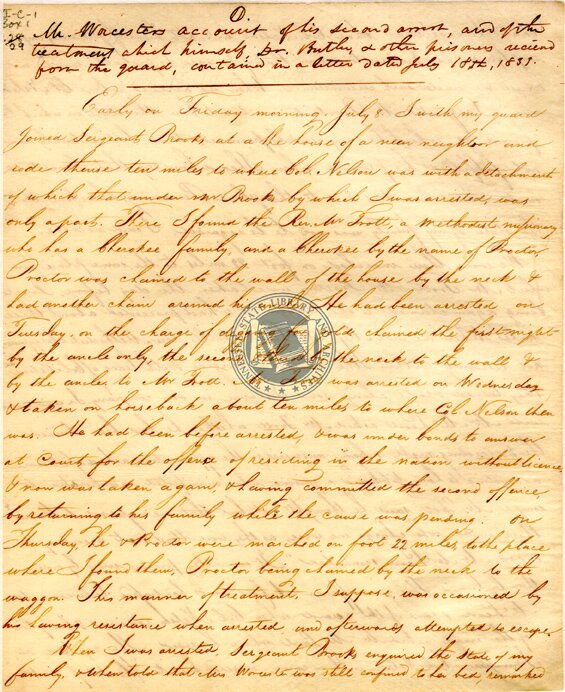
A July 1831 account carries the story from those warnings onto the road. Worcester described finding a Cherokee prisoner named Proctor chained by the neck and ankle. According to Worcester, Proctor had been arrested on a charge of digging for gold. His presence connects the missionaries’ legal struggle to the pressure on Cherokee people and their resources. [10]
The account records exhausting marches and harsh treatment, but Worcester did not describe every guard alike. Some were kind; four soldiers walked several miles so prisoners could ride. Keeping that detail beside the cruelty lets the surviving account retain its own distinctions. [10]
The words a guard could not take away
Worcester also recorded a moment of faith under pressure. Sergeant Brooks, he wrote, mocked the prisoners with Jesus’ words about the Father’s care for His little flock, from Luke 12:32. Worcester said the taunting manner did not keep him from finding consolation in the words. [10]
On July 16, the prisoners asked permission for Worcester and fellow missionary John Trott to hold a meeting for any guards and neighbors who wished to attend. The account reproduces Colonel Nelson’s refusal, which questioned their honesty and said his purpose was to restrain their teaching. [10]
Cherokee help at the jail
The account’s later entries name William Rogers, a Cherokee agent for the nation, who came with a man named Thompson bringing a writ of habeas corpus. Cherokee help was immediate and practical, as well as part of the larger legal campaign. [10]
At Lawrenceville, Worcester reported, all the prisoners eventually secured bail except the Cherokee prisoner, who could not then find someone to stand as his security. Men traveling together could reach very different doors out of custody. [10]
The sentence survives on paper
On September 15, 1831, the court found the defendants guilty. The sentence directed that they be taken to the state penitentiary and held at hard labor for four years. A scan of the handwritten record survives in the National Archives. It turns an often abbreviated history lesson into something concrete: named people, a date, a guilty verdict, and years of punishment for remaining where Georgia said they could not live. [5]
The Cherokee Phoenix reported the convictions in its September 24 issue. The newspaper also recalled the missionaries' public opposition to Cherokee removal. Reading that paper beside the court record matters. The people whose homeland was at stake had a newspaper and a voice of their own. They were participants in this struggle, not merely the setting for a white missionary's bravery. [6]
A small wooden box offers another surviving trace. The Georgia Historical Society attributes it to Worcester and Butler’s work in the Milledgeville penitentiary; its labels identify the makers and the years 1831–32. The institution also describes its hinges, lock and key. What the men intended to keep inside it is not established by those labels. [11]
A victory that did not open the prison doors
Lawyers hired by the Cherokee Nation carried the missionaries' case to the United States Supreme Court. In 1832, Worcester v. Georgia rejected the state's asserted authority within Cherokee territory. Georgia nevertheless continued to hold the men. A favorable judgment had not made the state obey. [2]
Their release came in January 1833, after they instructed their lawyers to stop seeking further proceedings. Their letters, published by the Cherokee Phoenix, expressly maintained that their cause was just and that the Court’s judgment entitled them to release. The newspaper’s editorial insisted that freeing the missionaries did not weaken the decision concerning Cherokee rights. [12]
Governor Wilson Lumpkin presented the release as Georgia’s generosity. His January 14 proclamation defended the state, blamed the missionaries and remitted the remaining sentences. Freedom had come without an admission that the imprisonment was wrong. They had been sentenced to four years; they did not serve the whole term. [7]
The larger tragedy also remained. The ruling did not prevent the Cherokee people's forced removal in 1838. An honest ending must leave that grief in view. [2]
Courage without a polished legend
The missionaries' own legal defense used the period's paternalistic language about the supposed improvement of Native people. Their resistance to Georgia deserves attention, and their assumptions still deserve examination. Their court filing helps us see both. Historical courage does not require us to pretend that the people who showed it understood every question rightly. [8]
For a Christian reader, the account raises a searching question about the cost of loving a neighbor when powerful people want that neighbor displaced. Faithfulness cannot be measured only by whether the immediate outcome looks successful. Our confidence rests in Christ's death and resurrection; courage and mercy are responses to His grace, never payment for salvation.
A place to keep learning
At New Echota State Historic Site near Calhoun, visitors can encounter Worcester's home alongside the Council House, print shop, and other original or reconstructed buildings. Seeing the missionary's home within the wider Cherokee capital helps restore the story's proper scale: one household's decision inside a nation's struggle for its homeland. Check the official site before planning a visit. [9]
Explore the original records
Open these records at the archive or family website for a closer look.
- Read Worcester’s July account
The surviving manuscript includes Proctor, the refused worship request and Cherokee agent William Rogers.
- See the prison-made box in the Society’s collection
Institutional description and photograph of the box attributed to Worcester and Butler.
Sources and further reading
Research notes
The July manuscript preserves Worcester’s account, including passages based on what others told him. Proctor’s full identity and eventual fate remain unresolved. The account has later entries and an inconsistent date heading; no precise correction is assumed. January 1833 newspaper material is paraphrased from Western Carolina University’s transcription. The prison box is described through the Georgia Historical Society’s catalog account; its contents and purpose are not established.
- Indictment for Samuel Worcester, Elizur Butler, and Other Defendants — National Archives / DocsTeach
The charge against the missionaries. - Tim Alan Garrison, Worcester v. Georgia — New Georgia Encyclopedia
Mission locations, Cherokee legal action and later events. - Governor George R. Gilmer to Samuel A. Worcester, May 16, 1831 — Digital Library of Georgia
The governor’s warning to Worcester. - Elizur Butler's statement about Colonel Sanford, June 20, 1831 — Digital Library of Georgia
Butler’s firsthand account of threats and family concerns. - Guilty Verdict and Sentencing, September 15, 1831 — National Archives / DocsTeach
Original verdict and sentence. - Cherokee Phoenix, September 24, 1831, volume 4, number 13 — Western Carolina University
Contemporary Cherokee newspaper coverage. - Governor Wilson Lumpkin's release proclamation, January 14, 1833 — Digital Library of Georgia
Proclamation remitting the remaining sentences. - Butler and Worcester's response to their indictment — National Archives / DocsTeach
The missionaries’ jurisdictional defense. - New Echota State Historic Site — Georgia Department of Natural Resources
Official visitor information. - Samuel Worcester’s account of his second arrest, July 1831 — Tennessee State Library and Archives / Digital Library of Georgia
Surviving manuscript of the July 18 account and subsequent entries. Pages 1, 3, 6, 8–10 inspected for Proctor, Scripture, guards, worship, William Rogers and bail. Incidents remain attributed to Worcester. - Prison-made wooden box, 1831–32 — Georgia Historical Society
Institutional attribution and description of the labels, hinges, lock and key; modern photograph linked, not reproduced. - Cherokee Phoenix, January 26, 1833, page 3, column 2 onward — Western Carolina University
Editorial and missionaries’ January correspondence. Paraphrased from the institutional transcription; the newspaper page image was not inspected.
Read another local story
 The Christmas bomb that did not stop Fred ShuttlesworthJet Lowe / Historic American Buildings Survey, Library of Congress · Public domain.
 The Villa Rica boy behind “Precious Lord”Smithsonian NMAAHC · Open Access (CC0).
- Faith close to home
Share a photo, memory or landmark
Daniel reviews contributions before anything appears publicly.
Know someone who would enjoy this? Pass it along.