OUR CHANGING COUNTY · BREMEN & BUCHANAN
Haralson is growing. Are its towns growing with it?
The county’s population is rising, but growth has not followed one pattern. Most recent growth is outside incorporated towns. Buchanan’s latest estimate still sits below its 2010 count.
New neighbors, busy roads and familiar factory buildings raise questions that deserve more than an impression. Where is the population growing? Is Buchanan gaining households? How much of the old employment economy remains? We connected the county population study with a closer examination of Bremen and Buchanan.
Open the full study: seven charts, data tables and 25 source notes. The report can be printed or saved from your browser.
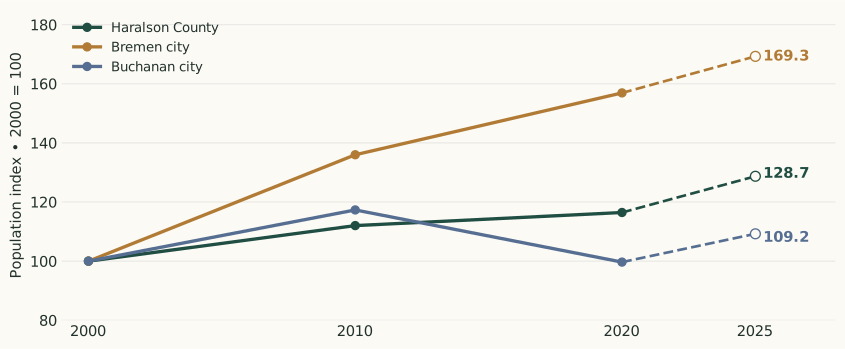
The county grew faster than Bremen after 2020
The Census Bureau’s July 2025 estimates put Haralson County at 33,066 residents, Bremen at 7,751 and Buchanan at 1,028. Against the adjusted April 2020 population bases in that same estimate release, the increases are 10.5%, 7.5% and 10.4%, respectively. These are estimates, not a new head count. [1]
| Year | Haralson County | Bremen | Buchanan |
|---|---|---|---|
| 1980 | 18,422 | 3,966 | 1,019 |
| 1990 | 21,966 | 4,356 | 1,009 |
| 2000 | 25,690 | 4,579 | 941 |
| 2010 | 28,780 | 6,227 | 1,104 |
| 2020 | 29,919 | 7,185 | 938 |
| 2025 estimate | 33,066 | 7,751 | 1,028 |
Most recent growth is outside the towns
Haralson’s estimated gain from its adjusted 2020 base is 3,138 residents. Of that net increase, 2,486—79.2%—is in the unincorporated county balance. The Haralson portion of Bremen adds 537, Buchanan 97, Waco 73 and the Haralson portion of Temple 16. Tallapoosa’s estimate falls by 71. Those components sum to the county increase. [1]
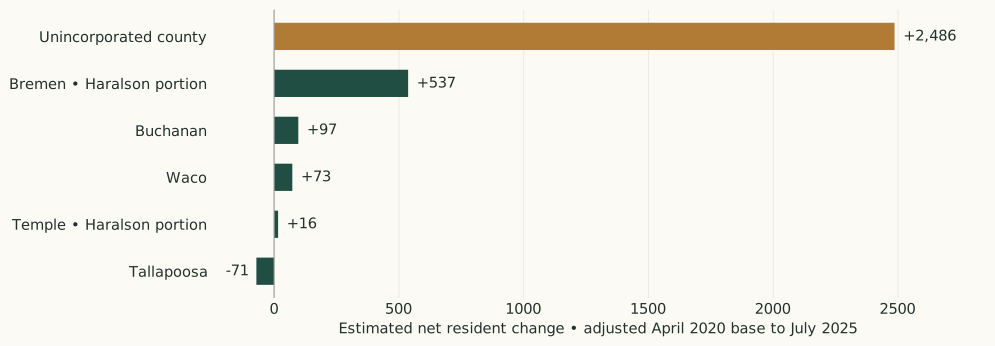
That is a reason to examine county roads, water service, housing approvals and emergency coverage alongside city budgets. It does not establish how many newcomers moved here, how many houses were built, or which employer caused growth. Population change is not the same measure as migration or construction.
Buchanan’s recovery is uneven
Buchanan’s census population fell from 1,104 in 2010 to 938 in 2020, a 15.0% decline. Its 2025 estimate of 1,028 is still 6.9% below the 2010 count. The latest annual estimate rises by 80 residents, from 948 in 2024; a small population makes a modest numerical change look large as a percentage. [1] [2]
The housing evidence complicates a simple abandonment story. Buchanan had 405 housing units in 2010 and 399 in 2020: six fewer units, a 1.5% decrease. The 2010 census also recorded 203 residents in institutional group quarters. Until we reconcile the matching 2020 group-quarters count, boundaries, occupancy and household size, we cannot assign the population decline to one cause. [2]
The factory remains part of the explanation—not the whole explanation
Buchanan’s Arrow shirt factory opened in 1947 under Cluett, Peabody & Co. Corporate history describes local financing of the factory building and a lease to the company. The University of West Georgia’s Textile Trail identifies the former Cluett Building at 155 Van Wert Street. That connects an identifiable industrial site to a town’s investment in manufacturing employment. It does not establish company scrip, compulsory company housing or exclusionary zoning; we found no verified local evidence of those practices. [4] [5]
A contemporary federal record exposes a more precise labor issue. The November 25, 1950 Federal Register lists a learner-certificate authorization for Buchanan shirt production covering November 9, 1950 through November 8, 1951, with a 10% normal-turnover allowance. This authorized subminimum learner wages under the applicable rules. The notice does not tell us how many workers were actually paid those rates. Payroll and certificate case records are needed to measure the effect on wages. [6]
The shutdown date remains unresolved. Local histories place the closure in the early 1990s, while a secondary WARN index lists a Buchanan Cluett, Peabody event involving 317 employees on April 21, 2000. We have not inspected the original notice or established that both accounts describe the same plant event. The full report identifies the needed Georgia Department of Labor WARN notice, 1988–2001 county tax records and company plant records. Neither an exact liquidation year nor a peak output figure is established. [4] [7]
What deserves the next round of work?
The county’s 2022–2026 joint comprehensive plan identifies Buchanan’s needs for jobs, housing choices and water and sewer capacity. Listed infrastructure projects are planning commitments, not proof that construction was funded or completed. Matching those plans to permits, budgets and completed work would show whether public capacity is keeping pace with population change. [8]
For the industrial history, the next useful work is original records and dated site documentation: factory deeds and leases, tax assessments, payroll or union records, and photographs matched to addresses. A surviving building proves less than a production ledger. This first edition separates what the records establish from what still needs an answer.
Sources and full research
Read, print or save the complete population and industrial-history study, including seven charts, Buchanan employment and housing details, source links, downloadable data and the archive request list. This is document research; current building conditions have not been field-verified.
- U.S. Census Bureau, Vintage 2025 Georgia population estimates (CSV). County, whole-city and county-portion records; adjusted April 2020 bases and July annual estimates.
- Census historical tables: 2000 Georgia population and housing counts; 2010 Georgia population and housing characteristics; 2020 Georgia incorporated-place counts.
- Atlanta Regional Commission, Buchanan profile. ACS 2020–2024 estimates and margins of error.
- University of West Georgia, Buchanan Textile Trail. Later historical account and site identification.
- PVH, Arrow Enterprise documentary history. Corporate account; promotional context must be considered.
- Federal Register, November 25, 1950, pages 8091–8092. Learner-certificate authorizations.
- WARNTracker, Cluett, Peabody & Co., April 21, 2000. Secondary index; original notice not yet verified.
- Haralson County joint comprehensive plan, 2022–2026. Buchanan needs and work program, printed pages 108–114.