Haralson County · Vineyards & immigrant lives
Nitra: The Vineyard Village Planned Beside a Georgia Creek
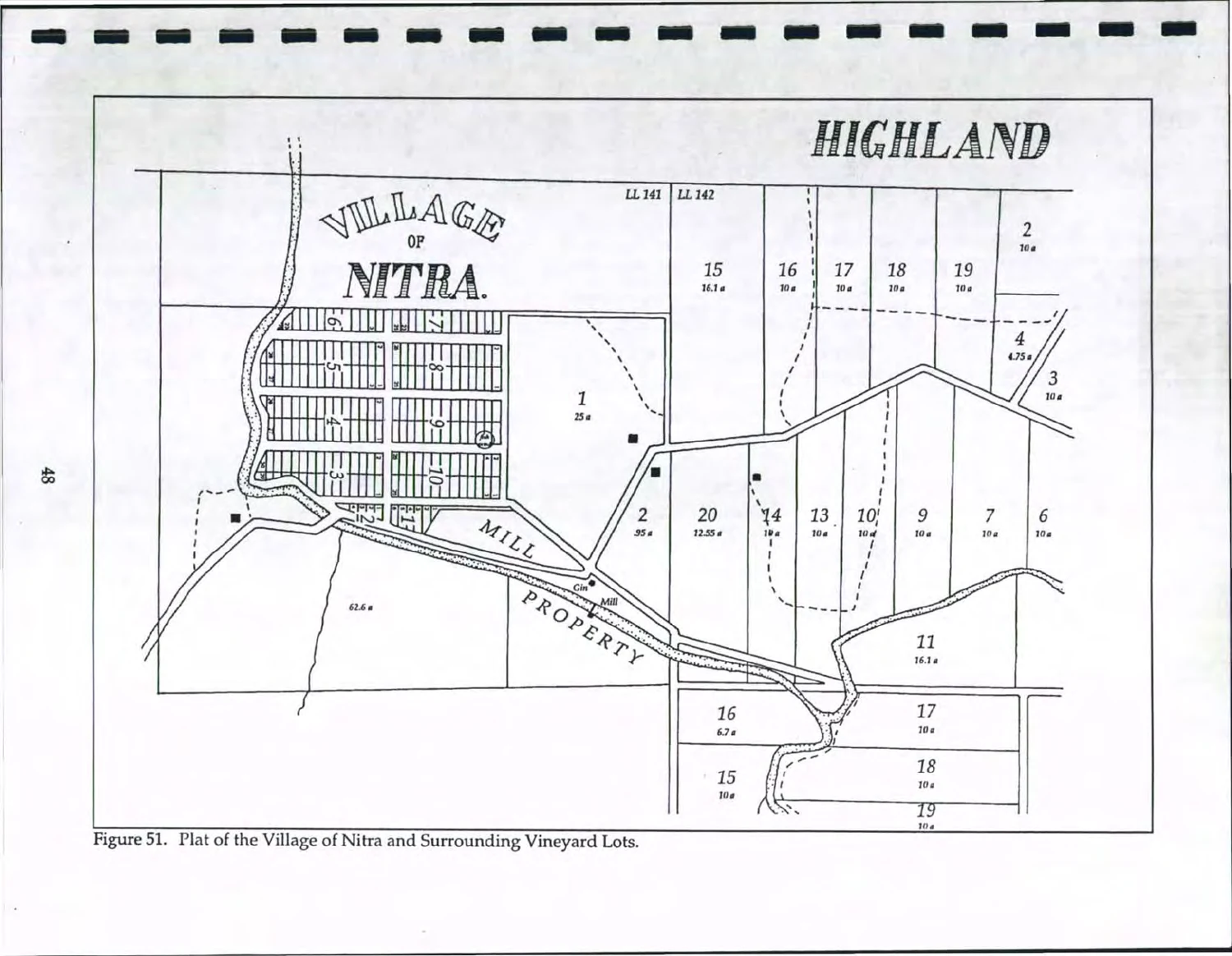
The map gives the vanished village a shape. Small lots line a grid of streets beside a winding creek. Beyond them lie larger parcels, many marked ten acres. Across the drawing are the words "Village of Nitra." Farther downstream, another label reads "Mill Property." [1]
It is a plan for a place where people expected to build lives: homes close together, agricultural land around them, and a creek running through the settlement. In the 1890s, Slovak immigrants helped turn that plan into a community in Haralson County. Nitra belonged to the same grape-growing movement as nearby Budapest, but it had a name, a layout, and a history of its own. [1] [2]
The surviving record lets us see some of its beginnings with unusual clarity. We can name a buyer, trace a purchase, look at the town plan, and read an account of the settlement while its buildings were still going up.
Buying a place in the new village
According to the 1997 historic-resources survey, the Highland Colony of Fruit Growers purchased three land lots in 1894 and divided them into town lots measuring 150 by 50 feet, surrounded by vineyard parcels of roughly ten acres. The investigators traced the development through county deeds and a plat recorded in Plat Book 1, page 65. [1]
Their first recorded sale was to Joseph Oleksa in October 1894: ten acres of lot number 2 for $360. The report counted approximately 80 sales in the development during 1894-1896, with only another 14 recorded through 1899. Those figures count transactions, not families or occupied houses, but they show an early burst of activity followed by a slower pace. [1]
The wider project was associated with promoter Ralph L. Spencer and Father Francis Janushek, whose surname appears in several spellings. The survey describes efforts to bring immigrants from Pennsylvania coal-mining communities into grape growing in Georgia. Budapest was associated with Hungarian settlers; Nitra with Slovak settlers. Their neighboring histories should not be collapsed into one town. [1]
News from a community taking shape
Historian Robert M. Zecker found Nitra in the Slovak immigrant press. In his book Race and America's Immigrant Press, he reproduces an April 1895 account reporting more than 50 families, 15 completed buildings, and three more under construction. The writer also described a church community served by the priest. These are the figures of a contemporary correspondent, preserved in Zecker's account, rather than an independently verified census. [2]
Zecker also reproduces a September 1894 report in Slovak v Amerike celebrating the vineyard settlement. Its closing wish makes the ambitions behind the map personal: "May God grant that Nitra in America may bloom!" [2]
That hope is the heart of this story. Nitra was more than a developer's subdivision. People were putting up buildings, establishing a religious community, and trying to make a home in a new landscape.
The house above the village
Overlooking the settlement stood the building later known as the Priest's House. The 1997 survey dated it to about 1894 and reasoned that it existed before October of that year because it appeared on the development plat. Its precise construction date remains approximate. [1]
The researchers documented a two-story Queen Anne house with a three-story corner turret, a wraparound porch, decorative woodwork, and paired entrance doors. A photograph in the report shows the turret rising above the porch and surrounding trees. Those details describe the house when it was surveyed in the 1990s; they are not a claim about its condition today. [1]
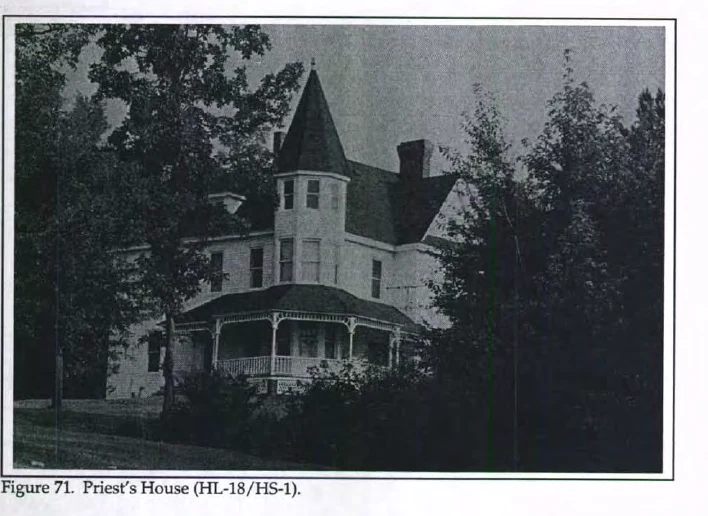
The survey also described a cellar beneath the house and another dug into the hillside, identifying both with wine storage. It recorded a church site across from the house and recollections of other buildings on the slopes around the village. Together, the plan, photograph, and property history give the settlement more substance than a name on an old map. [1]
The priest's own movements complicate any picture of an unchanging village. The report traces land transactions describing him in New Jersey by 1900 and Pittsburgh in 1908. It also records transfers involving Josephine and Stephen Somogyi. These details suggest connections reaching well beyond Haralson County, although the deeds themselves still need to be inspected before drawing a fuller biography. [1]
A decline already underway
Nitra's ending is often folded into the story of prohibition. The dates deserve closer attention. The survey found indications of decline by 1905, before Georgia's statewide prohibition took effect on January 1, 1908. The law was enacted in 1907. [1] [3]
For a venture organized around wine grapes, the prohibition of alcohol manufacture and sale was an obvious obstacle. But the earlier slowing of sales and the changing ownership described in the survey mean that prohibition cannot responsibly be presented as the sole explanation for Nitra's disappearance. The evidence reviewed does not establish one departure date or one reason shared by every household.
As parcels changed hands, land once divided for a village became part of larger holdings. The survey describes J. W. Key gradually assembling the estate around the house. It attributes a 1906 purchase of the house to family recollection, while noting that the researchers did not locate that deed. Later acquisitions brought his holding to approximately 90 acres. [1]
By the time of the 1990s research, Hoke Smith recalled removing several older buildings and had farmed ground where the town had been. The Priest's House remained, while much of the village had become a place remembered through its land and scattered traces. [1]
Reading the village back into the landscape
The survey was undertaken for a proposed reservoir. Its authors warned that the projected water could cover the village site and alter the house's setting and access. Those were anticipated effects of a proposal, not a description of Nitra being drowned by a completed lake. [1]
The documents assembled for that project now offer a way to recover the village's story. A plat preserves its planned streets. Deed summaries identify people who invested in it. A newspaper account carries the hope of a community still being built. A photograph records the house above it.
Nitra did not become the lasting vineyard village its settlers hoped for. Yet the hope itself has survived: a new home, land to work, neighbors close by, and a place in America that might bloom.
Sources and research notes
- Ellen B. Ehrenhard and Jeffrey L. Holland, Historic Resources Survey and Assessment of the Proposed West Georgia Reservoir, Haralson County, Georgia (1997), Georgia Archaeological Site File AR_04122. Printed pp. 4–6, 45, 48, 74–79 (PDF pp. 11–13, 52, 55, 81–86). Figure 51 is the village plat; Figure 71 records the house. Deed details are attributed to the survey: the original courthouse records have not been independently inspected for this article. The reported 1906 house purchase comes from family recollection; the survey did not locate that deed.
- Robert M. Zecker, Race and America’s Immigrant Press: How the Slovaks Were Taught to Think Like White People (Bloomsbury Academic, 2013), p. 19, referring to notes 28–29. Read the book. The 1894–1895 newspaper accounts are used through Zecker’s reproduction; original newspaper pages were not inspected. Family and building counts are contemporary reports, not a verified census.
- Acts and Resolutions of the General Assembly of the State of Georgia, 1907, vol. 1, pp. 81–82, Act No. 23. Read the Georgia acts. The prohibition law took effect January 1, 1908, correcting the survey’s reference to 1909.
The house’s present condition and visitor access have not been established. This article does not establish public access to private property. The survey assessed National Register eligibility; that is not evidence of formal listing. A reported count of 60 buildings has been omitted because the survey cautions that it may describe Budapest instead of Nitra.
Research was supported in part by the University of Georgia and Georgia Archaeological Site File. Historical illustrations reproduced from the supplied survey; no claim of UGA endorsement of this article is intended.
Written for Moss & Sons · November 4, 2026.
Read another local story
 Budapest, among the treesPhotograph by Daniel Moss.
 The city Tallapoosa was supposed to becomePublic-domain 1891 newspaper. Morrow County Museum / University of Oregon.
 The Lake Haralson County Never GotUSGS · 1975 aerial photograph
Share a photo, memory or landmark
Daniel reviews contributions before anything appears publicly.
Know someone who would enjoy this? Pass it along.