Budapest, families & Prohibition
To Protect the Home
In 1908, a booklet promoting Tallapoosa paused among its descriptions of farms and businesses to mention the grape growers at Budapest, an immigrant farming community east of town in Haralson County. State prohibition laws, it reported, had seriously interfered with their wine production. Yet the same passage described vineyards, crops and residents still making their lives there. [1]
In this story
A law reaches the vineyards
That small paragraph keeps two things in view: a livelihood had been hurt, and a community had not simply disappeared.
Georgia’s law had been approved on August 6, 1907, and took effect the following January. It prohibited the manufacture and sale of intoxicating drinks, alongside other specified activities, with limited exceptions. This was the state’s own legislation, years before national Prohibition began. [2]
To understand why people supported such a measure, we have to look beyond the vineyard. Some families saw alcohol as a threat to the money, safety and stability of home. Others depended on a lawful wine economy that the new law disrupted. Those concerns could exist at the same time.
Women making themselves heard
The Woman’s Christian Temperance Union helped turn household concerns into public campaigns. Its Georgia history, published in 1914, remembers petitions, conventions, teaching campaigns and repeated efforts to influence legislators. The book celebrates the movement, so it must be read as an advocate’s account rather than an impartial verdict on its results. [3]
The same history records a Black temperance union in Tallapoosa, associating its formation with work by Mrs. Mary Walton. That brief entry is not enough to reconstruct her life, but it shows that local temperance activity extended beyond the white leaders most often remembered. [3]
Women also disagreed over how much political power they should seek. The Georgia organization’s 1893 convention retained its national affiliation while declaring women’s suffrage unsuitable for its cause in Georgia. The national organization’s support for voting rights did not mean every state branch shared that position. [3]
The movement’s moral language also coexisted with racial injustice. Ida B. Wells challenged Frances Willard over racist statements Willard had made in Atlanta and pressed her to support the campaign against lynching. The Willard museum’s documentary project examines that failure of leadership. [4] Concern for some homes did not guarantee equal protection for every family.
A supporter changes her mind
In June 1928, Pauline Morton Sabin explained her reversal in an essay for The Outlook, “I Change My Mind on Prohibition.” She had supported the policy. Now she worried about what habitual lawbreaking was teaching children. [5]
Her examples included young people who recognized the Eighteenth Amendment chiefly as something adults disregarded. In her telling, the law meant to improve conduct was damaging respect for law itself.
Sabin’s testimony came from her own experience and the examples brought to her attention. It was not a survey of every American household. But it gave repeal an argument that was itself concerned with upbringing and public responsibility.
Another woman sees something worth keeping
Earlier that same year, Jane Addams had offered a different account. A newspaper report of her February address to the Chicago Woman’s Club described improvements she had observed around Hull-House, the social settlement she helped establish. [6]
Families, she said, had gained comforts unavailable to them in the saloon era. Yet she cautioned against assigning all improvement to one cause: wartime prosperity was difficult to separate from the effects of prohibition. She also acknowledged deterioration as bootlegging developed. [6]
That qualification matters. Addams defended the policy while recognizing both competing explanations and enforcement failures. Her account and Sabin’s were not a recorded face-to-face debate. Read together, however, they reveal different experiences behind women’s disagreement.
One feared what children learned when adults openly evaded the law. The other feared losing gains she believed working families had made.
Back to the vineyards
Neither woman’s experience alone explains what happened near Tallapoosa. The Budapest paragraph brings the question back to particular households whose work was tied to grapes and wine.
The 1908 booklet was trying to attract favorable attention to the area. It was not a family census or an economic investigation. Even so, its acknowledgment of disruption is valuable contemporary evidence. Its description of an inhabited farming community also cautions against the familiar picture of a place vanishing overnight. [1]
The history asks us to hold motives and consequences together. We can take seriously the families who wanted relief from drinking’s harms, the women who challenged a law they believed was doing damage, and the growers whose livelihoods suffered. Understanding their disagreement begins with listening carefully to what each source can actually tell us.
Sources and research notes
Historical advocacy and contemporary reporting are attributed to their authors. Neither account establishes effects on every household. The 1908 promotional booklet documents disruption and continuing residents, not a complete explanation of Budapest’s later history.
- Read the original booklet
Tallapoosa, Georgia: Its Past, Present and Future (1908), section headed “Bohemian Colony,” PDF p. 33. The period heading is not used here to assign a single ethnicity to all residents. - Read the law
Georgia General Assembly, Acts and Resolutions (1907), Act No. 23, pp. 81–84, approved August 6, 1907. - Read the organizational history
Lula Barnes Ansley, History of the Georgia Woman’s Christian Temperance Union (1914), especially p. 138 and pp. 141–147. - Read the documentary exhibit
Frances Willard House Museum and Archives, Truth-Telling: Frances Willard and Ida B. Wells. - Read the historical magazine scan
Pauline Morton Sabin, “I Change My Mind on Prohibition,” The Outlook, June 13, 1928, p. 254. - Read the report and transcription
“What Prohibition Has Done for Chicago,” February 1, 1928, as reported in the Chicago Tribune, February 2, p. 2; Jane Addams Digital Edition.
Read another local story
 Budapest, among the treesPhotograph by Daniel Moss.
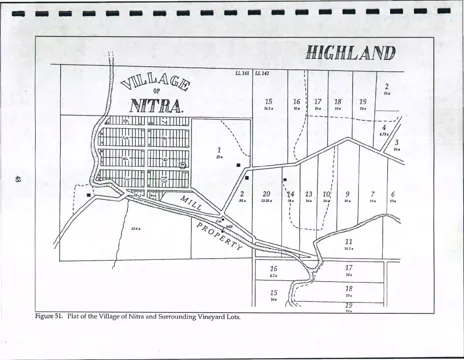 Nitra: The Vineyard Village Planned Beside a Georgia CreekHistoric Nitra plat, Figure 51 in the 1997 survey; UGA / Georgia Archaeological Site File, AR_04122.
What story should we tell next?
Is there a person, place or piece of local history you’d like to see on Moss & Sons? Perhaps your family has photographs, letters, an old business record—or a memory you’d like to share.
You don’t need to have the whole story. Tell us what you know, and we can start there. Daniel reviews contributions and confirms permission before anything is published.
Know someone who would enjoy this? Pass it along.