WACO · HARALSON COUNTY
The Springs Waco Hoped Would Change Its Future
In July 1889, a visitor to Waco, in Georgia’s Haralson County, spent the night at the Suggs House. The next morning, Judge Trammell had something he wanted the visitor to see.
About three-quarters of a mile from town, water came up from thirty-odd outlets in a basin almost surrounded by hills. That was the visitor’s count, published a few days later in the Haralson Banner. The account called them the Trammell Springs. [N03]
Within months the same paper was talking about a large hotel and summer cottages. Years later, a state geologist would describe a much smaller improvement at the springs: a little pavilion. Between those two accounts is the story of what Waco hoped the water might do for the town. [N05, B01]
A street from the depot
In April 1889, the Banner reported that Waco’s council had ordered a street opened from the depot to the springs. People were raising subscriptions for it, and the proposed width was 60 feet. By the end of May, the paper credited Judge Trammell with completing a street to the springs and reported that he was trying to arrange an excursion over it. [N01, N02]
The Georgia Pacific Railroad already brought business to Waco. Local freights met there, and their crews could get dinner at the Commercial Hotel. We have one especially clear connection between lodging and the springs: the July visitor stayed with Mr. and Mrs. G. L. Suggs, then went out with Trammell the next morning. Whether the Suggs House and Commercial Hotel were the same establishment remains open. [N02, N03]
The visitor credited Trammell with finding the springs by chance and imagined what they might be worth with some improvements and advertising. The same column repeated claims about relief from eye troubles. That mix of firsthand observation and salesmanship would become a feature of the springs’ newspaper coverage. [N03]
A hotel on paper
In January 1890, the Haralson Banner announced plans for a stock company to improve the springs. A large hotel and summer cottages were to follow. The clipping records what people intended to build. A charter, construction record or opening notice would tell us how far they got. [N05]
The following summer, the Banner-Messenger reported that Dr. J. C. Edmondson had bought the springs and was improving them. The deed has yet to turn up in this research. A week after the purchase notice, the Waco correspondent credited Edmondson and James Beall with opening an avenue from Bowdon Street to the springs and mentioned people strolling along it. [N06, N07]
In September 1891, the correspondent who signed as “Uncle Calhoun” credited the two men with naming the attraction Eureca Springs of Georgia. In a column otherwise full of ordinary town news, he made sweeping claims about the water, said visitors came from across the country, and urged people to see the springs for themselves. Those claims tell us how Waco promoted the place. The cure and attendance claims remain unverified. Near the end of the same column, he was still calling for a new hotel. [N08]
A place to spend a Saturday
A short dispatch from June 1895 gives us a different reason to go. Waco’s Sunday schools had spent Saturday at “Mineral springs,” and Rev. A. J. Coalson gave a little speech in the afternoon. The notice gives no route or tract, though the local spring group is the likely destination. Whatever became of the hotel plans, that report gives us a glimpse of how Waco families used the springs. [N09]
Iron Spring and Eye Spring
In 1913, Georgia state geologist S. W. McCallie published his description of Waco’s springs. He put the group in a hollow below a crescent-shaped bluff, on less than an acre. More than 40 outlets were reported, all with small flows. His report names two sampled outlets: Iron Spring and Eye Spring. The latter name came from the belief that its water helped inflamed eyes. McCallie traced the supposed medicinal use to 1886. That date comes from his later account, and the chemical analyses establish neither a health benefit nor present-day drinking-water safety. [B01, pp. 164–165]
By the time of McCallie’s account, the only improvement he described at the springs was a small pavilion. Anyone needing a bed could find accommodations in town. The report leaves us with a modest description of a place Waco had once promoted far beyond Haralson County. [B01, p. 164; N08]
Following the springs today
These were Waco’s springs, a separate place from the historic hotel and spring grounds in Tallapoosa.
The exact modern location, surviving structures and public access are unverified. The 1913 report gives both a land lot and a direction from Waco, but those clues still need to be reconciled with deeds and plats. For now, readers can see the historical records themselves, including the Georgia Archives photograph of Waco depot workers, circa 1913. [B01, P01]
Does your family remember Waco’s springs?
We’re looking for a dated photo, a family letter, or a firsthand memory of the springs, the pavilion, or a picnic there. Tell us what you remember, about when it happened, and whether you saw it yourself or heard it from someone else. If you have a photograph, tell us who took it or how it came to you, and whether we may share it. Please keep any private property details out of public comments.
Sources behind the story
Newspaper “image” numbers refer to the archive’s digitized page sequence. The newspaper reports preserve contemporary observations and proposals; the 1913 geological report supplies the later description.
- B01: S. W. McCallie, A Preliminary Report on the Mineral Springs of Georgia, Geological Survey of Georgia, Bulletin No. 20 (Atlanta: Chas. P. Byrd, State Printer, 1913), pp. 164–165. Catalog and text; state PDF. In the DLG PDF, printed p. 164 is PDF page 185; printed p. 165 is PDF page 187.
- N01: Haralson Banner, April 20, 1889, image 5, “Waco Items,” col. 1. Page.
- N02: Haralson Banner, May 31, 1889, image 4, “Waco Items,” col. 3. Page.
- N03: Haralson Banner, July 12, 1889, image 4, “A Thriving Town,” col. 2. Page.
- N05: Haralson Banner, January 10, 1890, image 4, “Waco Paragraphs,” col. 4. Page.
- N06: Banner-Messenger, July 23, 1891, image 1, purchase notice col. 4; J. C. Edmondson identification col. 2. Page.
- N07: Banner-Messenger, July 30, 1891, image 4, “Waco Items,” col. 3. Page.
- N08: Banner-Messenger, September 3, 1891, image 5, “Waco News,” cols. 1–2, signed “Uncle Calhoun.” Page.
- N09: Banner-Messenger, June 20, 1895, image 5, “Waco,” col. 1, dispatch dated June 18. Page.
- P01: Georgia Archives, Vanishing Georgia, hrl005, Waco railroad workers and depot, circa 1913. Catalog.
Read another local story
 Tallapoosa’s hotel above the quiet springsRemastered from a print supplied by Jackie Jones’s family. Colors and fine details interpreted; original artist/date unconfirmed.
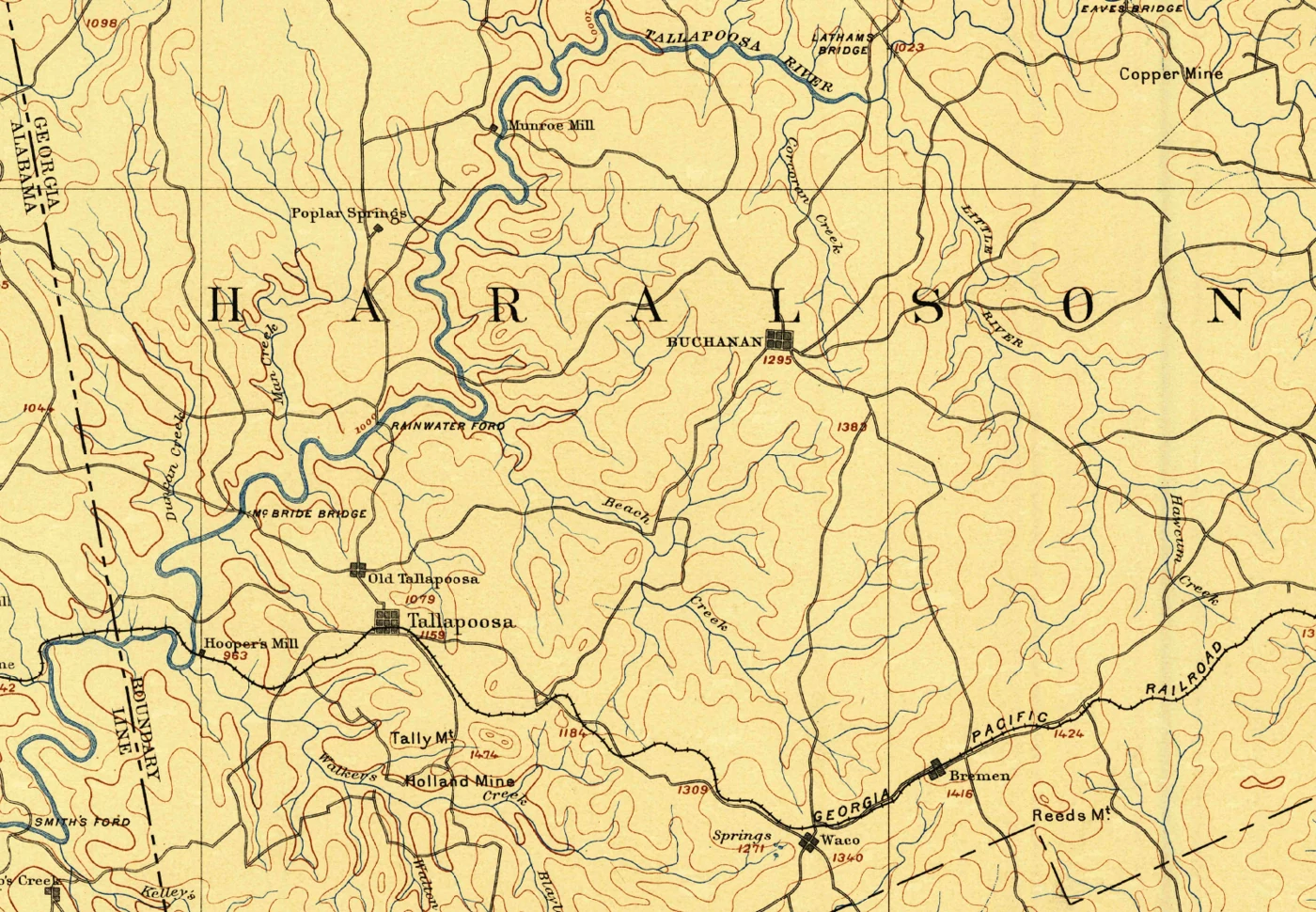 Before the Highway: How People Reached TallapoosaUSGS Tallapoosa sheet, 1889; public-domain federal map. Detail from original.
What story should we tell next?
Is there a person, place or piece of local history you’d like to see on Moss & Sons? Perhaps your family has photographs, letters, an old business record—or a memory you’d like to share.
You don’t need to have the whole story. Tell us what you know, and we can start there. Daniel reviews contributions and confirms permission before anything is published.
Know someone who would enjoy this? Pass it along.