A tool and the work underground
When the Blast Didn’t Fire
The metal bar in the photograph is easy to pass over. It is slender, bowed through much of its length, and sharply bent near one end. At the other is a small, flattened spoon. Beside the larger machinery associated with a gold mine, it might seem a minor piece of equipment. Mine operations chief Mike Musselwhite’s explanation during our visit to Royal–Vindicator near Tallapoosa, Georgia gave it a different importance. As I understood his account, the blunt end was used to push explosive material into place. The spoon end served to recover material after a charge failed to fire. [6]
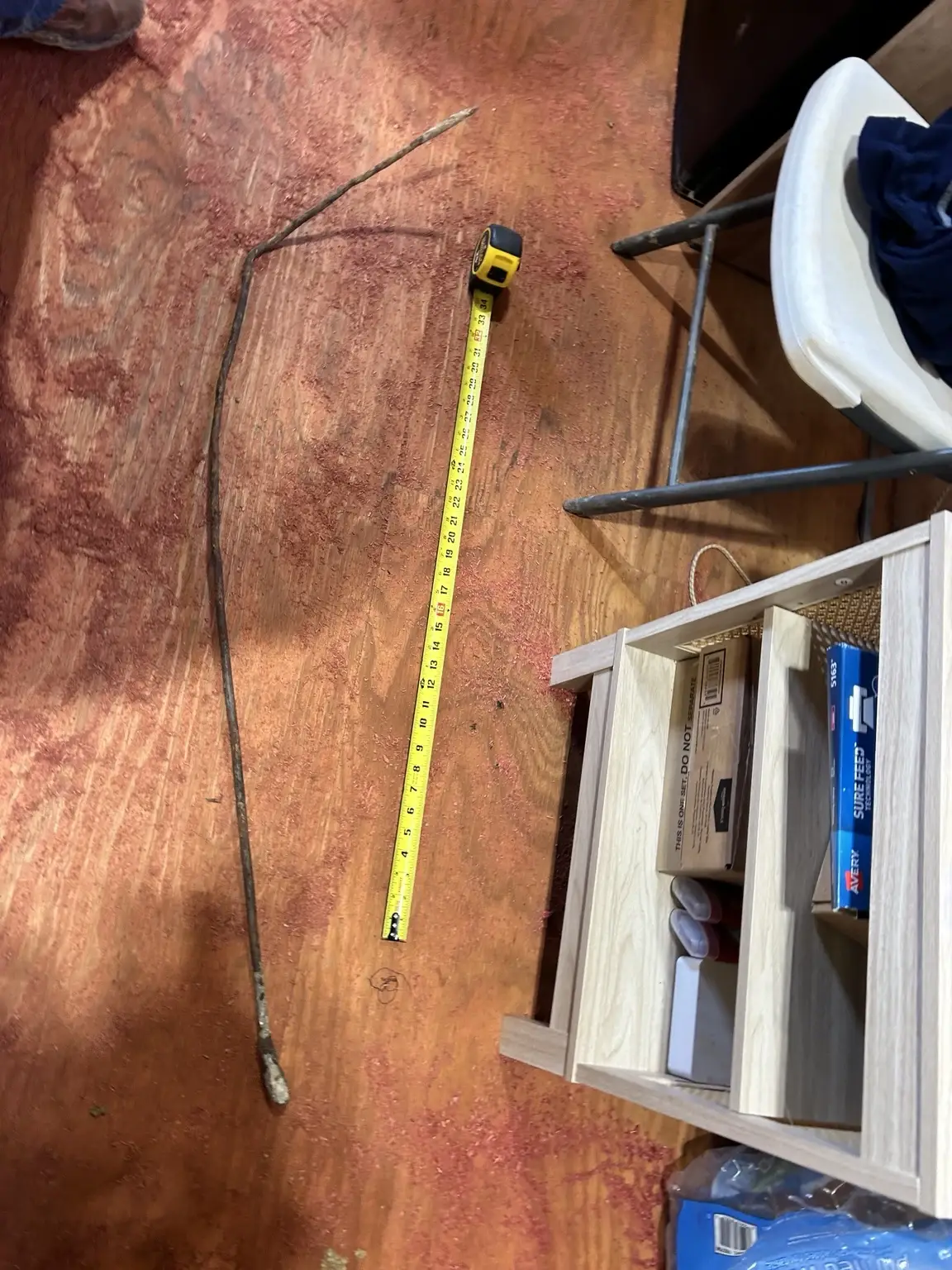
A charge that failed to fire as intended was called a misfire. It could leave dangerous material in the ground where the crew still had work to do.
The person responsible needed to understand what had happened and what it meant for the crew. The spoon-ended bar points toward that less visible part of mining: the judgment needed when the work did not go as expected.
In this story
Before the rock reached the mill
A gold mine’s mill could only process material that miners had first freed from the ground. Underground work therefore required people who understood both the rock they were following and the equipment used to break it. Drilling and blasting belonged to that work, before the hauling and processing most easily pictured in accounts of industrial mining.
We have a specific glimpse of that activity at Royal. In June 1897, mining writer W. M. Brewer reported that the mills were stopped while underground development continued. Two air drills were in use in passages at the 105-foot level. He called those passages drifts: workings driven roughly horizontally through the ground. His report also described a cage being installed to hoist ore cars. [1]
Brewer’s report gives us a glimpse of work continuing below ground even while the mill stood idle. It records no misfire. The tools, the rock and the passage itself still demanded knowledge that a photograph of the machinery cannot fully show.
The skill behind the job
A federal description of mining occupations published in 1918 spells out the breadth of that knowledge. Its entry for a metal miner expected knowledge of hand and machine drills, explosives, ore, and the timbering used to support underground workings. Experience underground mattered because the job brought those responsibilities together. [2]
The same publication described a metal-mine shift boss as responsible for the safety of the crew as well as production. The work depended on people recognizing conditions, making decisions and looking after others while the mine continued to operate.
These national descriptions come from a later year and do not establish Royal’s staffing. They show how broadly the trade understood a miner’s responsibilities: recognizing the ground, using the equipment and helping keep the workings safe belonged together.
A familiar tool, an unfinished identification
The spoon-shaped end has historical comparisons. A Forest Service account of hand drilling describes miners’ spoons as long rods with flattened, curved scoops and associates them with clearing drilling debris and recovering material after misfires. Its description of the opposite end differs from Mike’s account of this example. [3]
There is nineteenth-century evidence, too. In 1895, Nathan E. Varney received a patent for a “Miners’ Spooning-Tool.” His description included recovery after a misfire among its purposes. The patent’s distinctive spiral attachment is absent from our photographed bar, so it is a comparison—not an identification of the same design. [4]
These sources support the broader tool family and the historical recovery function Mike described. They do not establish when this bar was made, whether its bend was intentional, or where it was used. Those questions remain part of the object’s story.
What a failed blast could leave behind
Period records make clear why explosives knowledge carried such weight. The introduction to a 1915 Bureau of Mines bulletin reported more than 130 deaths and 250 serious injuries from explosives in American metal mines and quarries during 1913. It also recognized harm from fumes and gases. [5]
Those figures cover the country and several kinds of work. They are not Royal casualties, and they are not a count of misfire accidents alone. They show the wider human cost surrounding the work that this modest tool brings to mind.
The small scoop is a reminder that mining equipment had to serve the interruptions as well as the planned work. A failed blast could leave the rock in place and the crew facing a hazard that had not gone away.
We do not know whose hands held this bar. Mike’s explanation and the historical comparisons give us a reason to look beyond its size. Before gold-bearing rock could leave the mine, people had to understand the ground and the work well enough to help bring their crew through it.
Sources and research notes
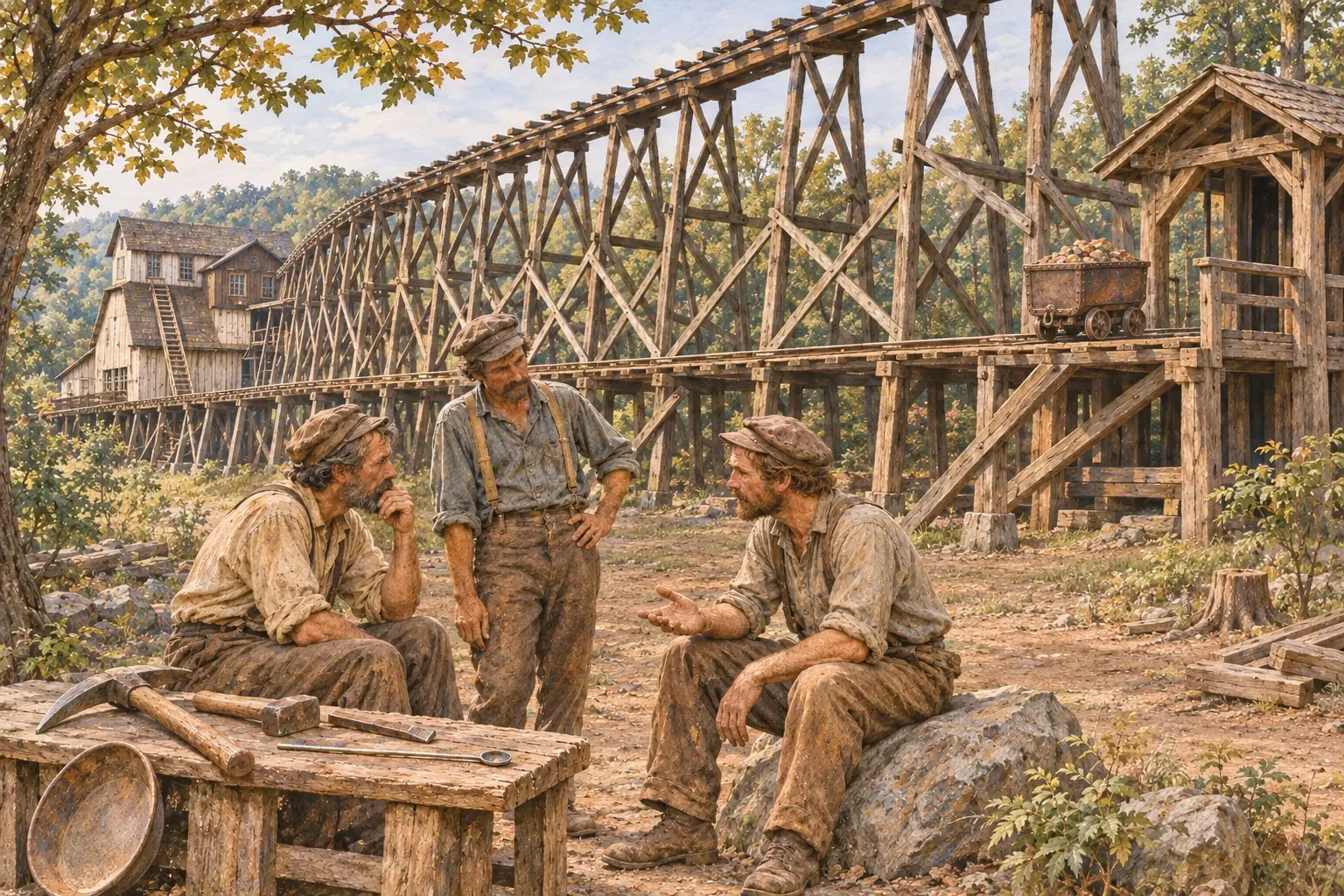
Mike’s explanation is attributed to Daniel’s recollection. No specific Royal misfire incident or exact identification of this bar was established. The illustration depicts a general historical scene. This is an account of historical work, not present-day explosives-handling guidance.
- W. M. Brewer, Engineering and Mining Journal (1897)
W. M. Brewer, “New Work in the Villa Rica District, Georgia,” The Engineering and Mining Journal, June 26, 1897, p. 665. The Royal passage was checked in the issue’s digitized text; the original page was not freshly inspected for this draft. - Descriptions of Occupations: Mines and Mining (1918)
Descriptions of Occupations: Mines and Mining, U.S. Department of Labor, 1918, pp. 27 and 32. National descriptions of metal miners and shift bosses, not local employment records. - Forest Service: historical miners’ spoons
USDA Forest Service, Hand Drilling and Breaking Rock for Wilderness Trail Maintenance, printed p. 11. Historical tool description; its pictured trail-work tools are not Royal artifacts. For a further shape comparison, see the Western Museum of Mining & Industry’s illustrated glossary, p. 30, “Powder Spoon.” - Nathan E. Varney, Miners’ Spooning-Tool patent (1895)
Nathan E. Varney, U.S. Patent 540,201, “Miners’ Spooning-Tool,” May 28, 1895. A related tool with a different attachment; it does not date or identify the photographed object. - Bureau of Mines Bulletin 80 (1915)
Charles E. Munroe and Clarence Hall, A Primer on Explosives for Metal Miners and Quarrymen, Bureau of Mines Bulletin 80, 1915. Figures from the introduction reproduced by OneTunnel; the full bulletin was not reviewed. - Daniel Moss’s visit photograph and recollection
Daniel’s photograph of the metal bar and his corrected account of Mike’s explanation: the blunt end placed explosive material, and the spoon end recovered material after a misfire. Paraphrased, not a verbatim recording. The wooden object photographed separately is not this tool.
Read another local story
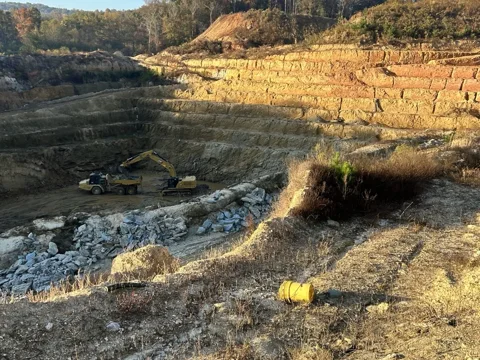 The Gold You Never SeePhotograph © Daniel Moss / Moss & Sons.
 Royal-Vindicator: the machinery behind Haralson's goldPublic-domain original publication; Georgia Geological Survey / Digital Library of Georgia.
What story should we tell next?
Is there a person, place or piece of local history you’d like to see on Moss & Sons? Perhaps your family has photographs, letters, an old business record—or a memory you’d like to share.
You don’t need to have the whole story. Tell us what you know, and we can start there. Daniel reviews contributions and confirms permission before anything is published.
Know someone who would enjoy this? Pass it along.