PAULDING & POLK COUNTIES · LOCAL HISTORY
When Van Wert lost the county seat and Dallas gained one
In 1870, Van Wert still measured its town limits five hundred yards in every direction from the old courthouse. By then the town was in Polk County, and the Paulding County government that once gave people a reason to come to Van Wert had been meeting in Dallas for years. [1] [2] [8]
Between those two courthouses lies a question the Georgia legislature took seriously in 1851. If moving the county seat hurt the value of property in Van Wert, who would pay the people who lived there? [1]
In this story
A new county line
Georgia had organized Paulding County during the state’s seizure and distribution of Cherokee lands. About a generation later, on December 20, 1851, the legislature approved a law creating Polk County from parts of Paulding and Floyd. The change took effect on April 1, 1852. [1] [2] [4]
That put Van Wert, Paulding’s county seat, inside Polk. Paulding needed a place within its new boundaries to hold court, keep records and conduct public business. The law left the choice to the justices of Paulding’s Inferior Court, who also handled county affairs. They could buy land, lay out town lots and sell them. The act gave the future town no name. [1]
What Georgia promised Van Wert
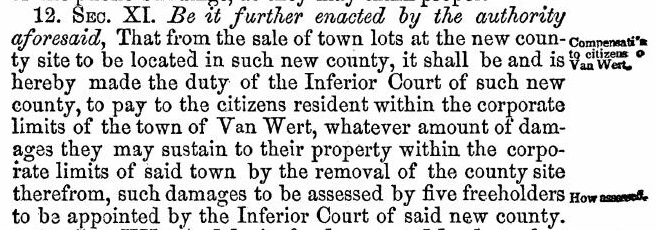
Near the bottom of page 55, the printed act turns from county boundaries to people’s property. Section XI covered citizens who lived inside Van Wert’s town limits and suffered damage to property there because the county seat moved. [1]
Polk’s Inferior Court was to appoint five freeholders, or landholders, to assess the damage. The court would pay the assessed losses from sales of town lots at Polk’s new county seat. The preceding section had dealt with Paulding, which makes this passage easy to misread. Here the lawmakers returned to the “new county,” the name they had given Polk earlier in the act. [1]
Did anyone receive a payment? We have yet to find a claimant’s name, an assessment by the five landholders or a receipt. Those county records could tell us what happened to individual families after the state made its promise.
Building Dallas
Across the new line, the paper trail leads to Garrett H. Spinks. Paulding County dates Dallas’s founding to May 14, 1852, on land Spinks deeded to the county. A later Dallas City Council exhibit identifies a deed from Spinks to the county justices dated May 14 and recorded August 18 in Deed Book I, page 154. We have the city’s reference. The original deed remains to be examined. [5] [6]
Dallas received its town charter on February 8, 1854. Building a courthouse left Paulding with a debt, and in 1856 the legislature authorized the county to levy an additional tax, on its grand jury’s recommendation, to pay what it owed. The historic courthouse you see in Dallas today dates to 1892. [3] [6] [7]
Dallas’s charter gave five commissioners authority for six hundred yards in every direction from its courthouse. Sixteen years later, Georgia appointed five commissioners for Van Wert and drew its town limits around the old courthouse. By then one community had gained the county’s business and the other had lost it. Both still had a town to govern. [3] [8]
Sources and research notes
- Georgia Acts, 1851–52, No. 26, pp. 52–55
Printed pages 52–55 checked in the scan supplied by UGA Libraries. Section XI is on page 55. - New Georgia Encyclopedia, “Paulding County”
- Georgia Acts, 1853–54, No. 184, pp. 232–235
- Newberry Library, Georgia Individual County Chronologies
- Paulding County, History
- Dallas City Council packet, May 5, 2025, Exhibit A, PDF p. 4
- Georgia Acts, 1855–56, No. 545, p. 545
- Georgia Acts, 1870, No. 150, sections 1–3, pp. 220–221
Read another local story
 Rockmart: The Town Built on SlatePublic-domain 1918 publication; Georgia Geological Survey / Digital Library of Georgia.
 The school Hiram helped pay forMoss & Sons · Original explanatory illustration; evidence and sources in the article.
What story should we tell next?
Is there a person, place or piece of local history you’d like to see on Moss & Sons? Perhaps your family has photographs, letters, an old business record—or a memory you’d like to share.
You don’t need to have the whole story. Tell us what you know, and we can start there. Daniel reviews contributions and confirms permission before anything is published.
Know someone who would enjoy this? Pass it along.