TALLADEGA, ALABAMA · PRINTING & EDUCATION
Who printed the governor’s copy?
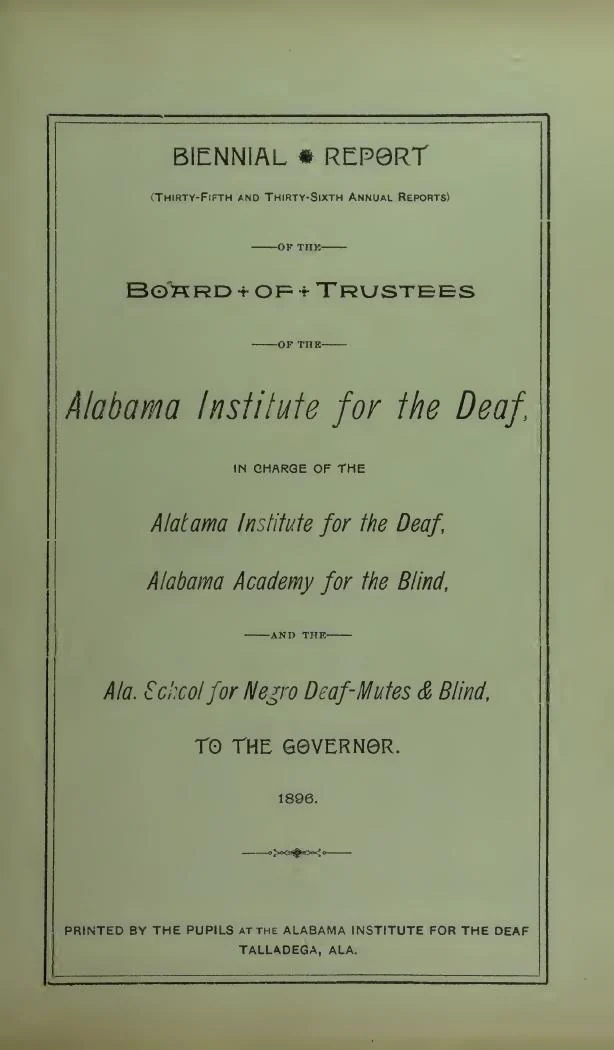
An 1896 school report addressed to Alabama’s governor carries the board of trustees’ name across the cover. Down at the foot of the page, two much smaller lines tell who made the document in Talladega. The pupils at the Alabama Institute for the Deaf printed it. Inside, the report names their shop foreman, Osce Roberts. [1]
In this story
A credit below the date
The school had begun with a family who crossed the state line from Georgia. Joseph Henry Johnson taught deaf children in Cave Spring. His younger brother William Seaborn Johnson was deaf. When Joseph moved his family to Talladega in 1858 to start a school in a rented building, Seaborn came too. He was among the twenty-one pupils enrolled by the end of the first year. [2]
A paper of their own
By 1880 the school had a weekly newspaper to produce. The principal’s report that year describes boys learning to set type, arranging the letters that would print the words on a page. Pupils printed The Messenger. Its editors and owners were deaf people educated at the school. [3]
An 1881 newspaper directory listed The Messenger as a four-page Saturday paper with a circulation of 450. By January 1895, when The Alabama Baptist reviewed an issue, it came in magazine form. Fifty cents bought a year’s subscription. The reviewer noticed a portrait of Principal Johnson on the first page and several pages from the department for blind students. [4] [5]
A week later the Baptist paper passed along a joke from The Messenger about a local pastor, Dr. French. Would a young woman in Talladega be going to the Baptist service? According to the joke, she answered, “I don’t understand French.” Someone at the Baptist paper liked the joke enough to print it again. A bit of Talladega humor had reached readers beyond the town. [6]
After the print shop
The 1896 report describes younger boys just starting to work in the printing office. It also acknowledges that the boys had more opportunities in the industrial department than the girls. The cover itself lists a separate school for Black deaf and blind children. Those details matter when we ask which children had access to a trade. [1]
What happened when a pupil left the shop? The report follows two members of the previous year’s class into paid newspaper work in Alabama. One worked on a weekly and the other on a daily. The school said both earned their own living and helped support their families. Their names are missing from that passage. Their work is still there, in a line about the living they earned inside a report their fellow pupils printed. [1]
Sources and research notes
- Trustees’ 1896 report. Cover, staff roster (scan p. 15), and industrial department (scan pp. 31–32).
- Alabama Institute for Deaf and Blind. The Johnson brothers and the opening of the Talladega school.
- Principal’s 1880 report, printed p. 7. The pupils who set type and the former students who owned and edited the paper.
- N. W. Ayer & Son’s Newspaper Annual, 1881. Talladega listing and reported circulation.
- The Alabama Baptist, January 24, 1895. A reader’s description of The Messenger.
- The Alabama Baptist, January 31, 1895. The joke the editors credited to The Messenger.
Read another local story
 The school downstairs in TempleMoss & Sons illustration. The slate and primer are imagined.
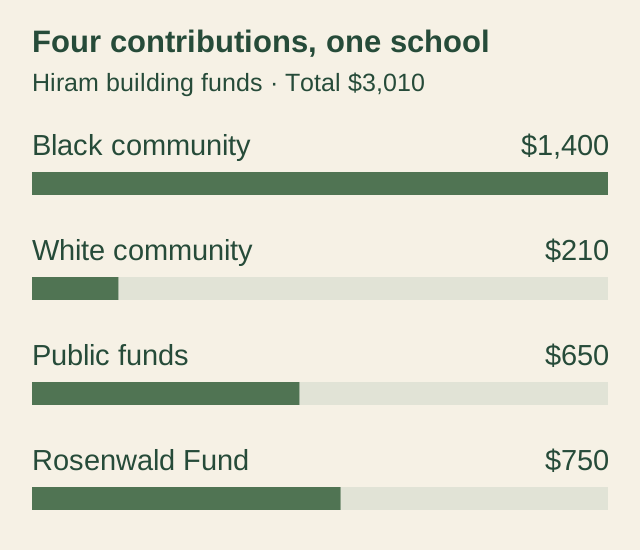 The school Hiram helped pay forMoss & Sons · Original explanatory illustration; evidence and sources in the article.
What story should we tell next?
Is there a person, place or piece of local history you’d like to see on Moss & Sons? Perhaps your family has photographs, letters, an old business record—or a memory you’d like to share.
You don’t need to have the whole story. Tell us what you know, and we can start there. Daniel reviews contributions and confirms permission before anything is published.
Know someone who would enjoy this? Pass it along.