TALLAPOOSA · INSIDE THE ARCHIVAL RECORD
Fourteen photographs—and a factory’s drawn-in smoke.
A small Smithsonian collection opens a window onto Tallapoosa’s businesses, streets and community life. One catalog note changes how we should read its industrial imagery.
The Smithsonian’s Archives Center holds fourteen mounted photographic prints attributed to H. H. French, under collection number NMAH.AC.0375. The finding aid dates the collection approximately to 1880 and describes views of Tallapoosa’s homes, businesses, river, hotel grounds and people. A deed of gift signed October 26, 1974 records their donation by Mrs. Franklin Chace. [1]
This article examines the catalog and finding aid, not the original photographs. We inspected the item inventory, including its scanned PDF page. We have not obtained the fourteen photographic images or inspected their backs. The distinction matters most for item 10.
The catalog’s most revealing detail
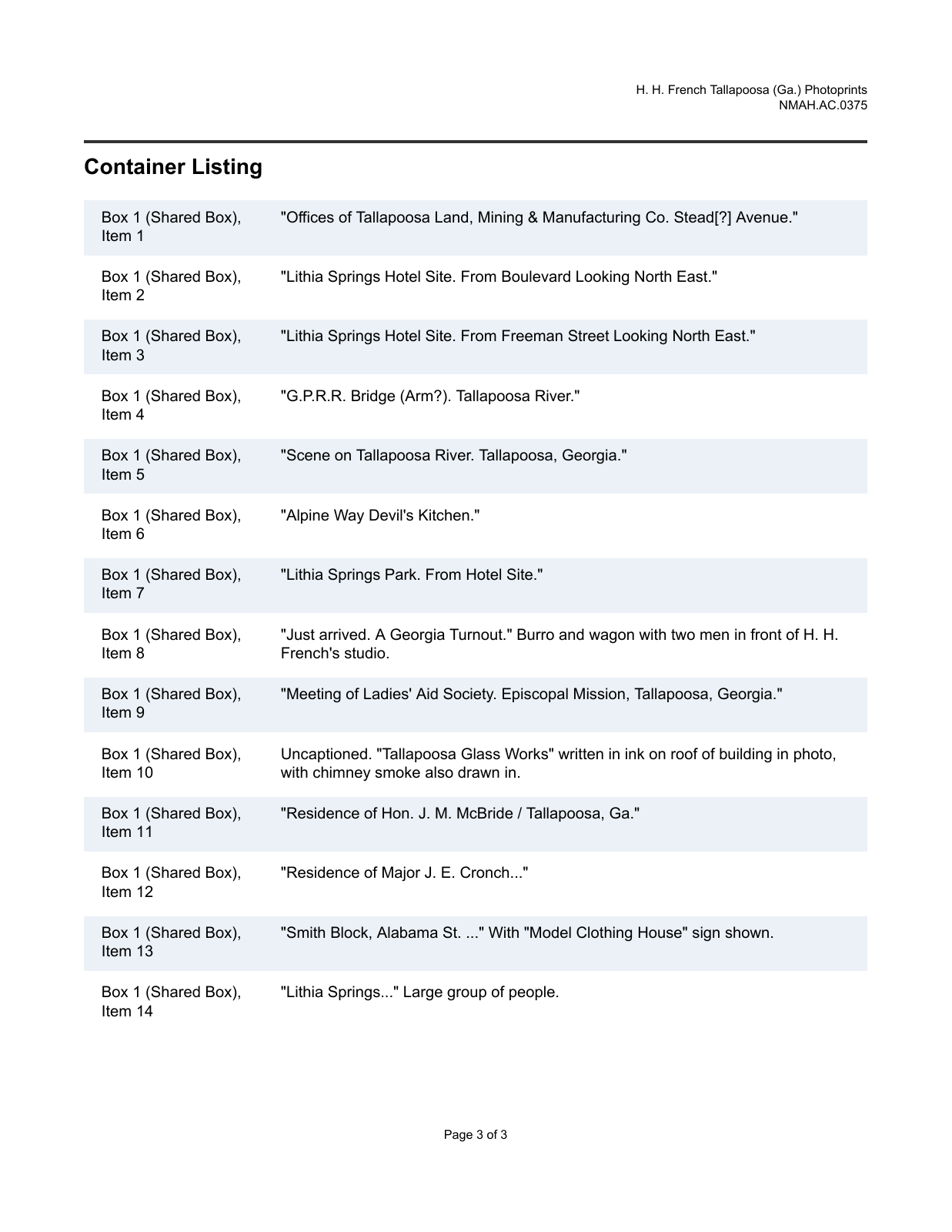
Item 10 is described as uncaptioned. The archivist records “Tallapoosa Glass Works” written in ink on the roof of the building in the photograph, with chimney smoke also drawn in. The name and smoke are therefore described as additions to the image—not simply details recorded by the camera. [1]
That does not tell us who added them, when, or why. It does not prove that the factory was idle, that French altered the print, or that anyone intended to mislead. It does mean that this drawn smoke cannot independently prove the factory was operating when the exposure was made. The added name is evidence to investigate, rather than a reason to skip identifying the building.
The next useful step is to inspect a high-resolution image and its mount, compare any other versions, and match the building against dated maps and business records. A small mark on a print can change a large historical claim.
Read the Smithsonian’s original inventory page
What else is in the box?
The inventory reaches beyond buildings. A studio scene could help identify French’s working location. A church society meeting could connect names in institutional records to faces. Three views involving the hotel site and park might eventually help reconstruct a landscape.
| Item | Subject | Detail or research limit |
|---|---|---|
| 1 | Tallapoosa Land, Mining & Manufacturing Co. offices | The avenue is transcribed as Stead[?]; its reading and modern location remain uncertain. |
| 2–3 | Lithia Springs Hotel site, two viewpoints | One caption looks northeast from Boulevard; the other northeast from Freeman Street. Both say site. |
| 4–5 | Railroad bridge and Tallapoosa River scene | The bridge entry reads G.P.R.R. and includes the uncertain parenthesis (Arm?). No present bridge has been matched. |
| 6 | Alpine Way Devil’s Kitchen | A named landscape feature; this catalog entry alone does not establish where to visit it. |
| 7 | Lithia Springs Park from the hotel site | A potential third viewpoint to compare with items 2 and 3. |
| 8 | A burro, wagon and two men at French’s studio | The catalog places the group in front of the photographer’s studio; the men are not identified. |
| 9 | Ladies’ Aid Society meeting at the Episcopal Mission | An institutional lead for membership, church and community records. |
| 10 | Factory photograph with ink additions | The catalog records a glass-works name written on the roof in the photograph and chimney smoke drawn in. |
| 11–12 | Two residences | J. M. McBride is named; the second entry gives Major J. E. Cronch… without a settled full reading. |
| 13 | Smith Block on Alabama Street | A Model Clothing House sign is recorded. A historic street name is not a verified present-day building match. |
| 14 | Lithia Springs group | The brief entry describes a large group; individual identities and occasion remain unestablished. |
A hotel site is not a finished hotel
Two entries specifically describe the Lithia Springs Hotel site, with views looking northeast. It would be easy to retell them as photographs of the completed hotel, but the catalog does not say that. Nor does the collection’s approximate date establish an exact exposure year for every print. [1]
A separate Georgia Archives record offers a useful future comparison: a Whitman Company postcard of the Lithia Springs Hotel, cataloged as approximately 1910. It is a different object, from a different source. Its rights statement includes contractual restrictions, so we link to it rather than reproduce it here. [2]
View the later hotel postcard and its archive record. Comparing it with French’s site views will require the actual photographs, dated development records and reliable street alignments.
A second record: industry on the 1895 map
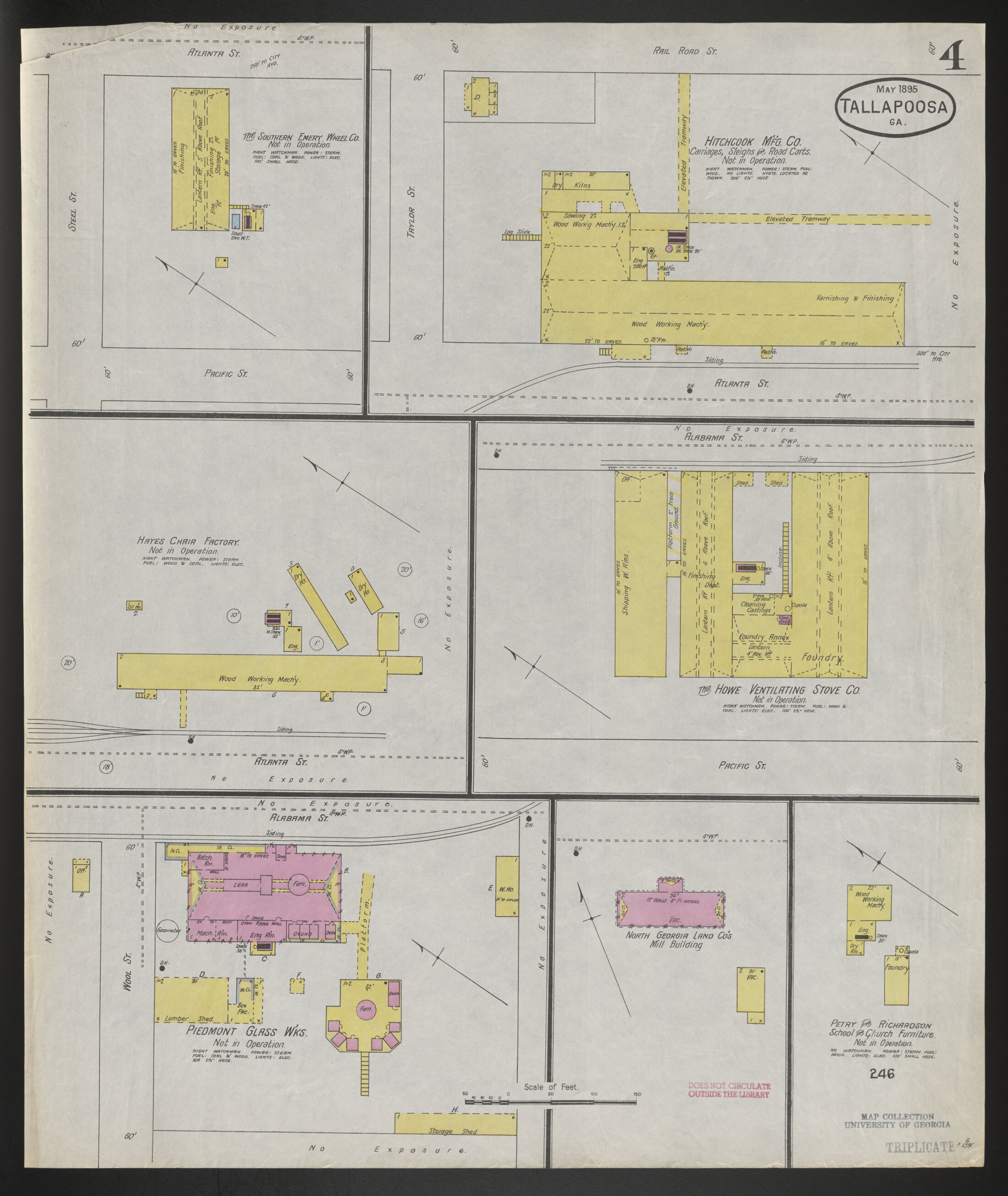
Sheet 4 labels Piedmont Glass Works, Southern Emery Wheel Co. and Hitchcock Manufacturing Co. as not in operation. That is a dated record of those mapped premises. It cannot establish why they stopped, when each last operated, or what happened to their workers. [3]
We have not established that the structure in French’s item 10 is the Piedmont Glass Works on this map. Similar industrial labels are a starting point for comparison, not proof of identity. The county’s working-history study places the map within a broader record of industrial change.
What would make a faithful then-and-now study?
- Obtain front-and-back images of the fourteen prints and mounts from the Archives Center, with reproduction terms established for the photographs themselves.
- Resolve dates and uncertain readings through inscriptions, directories, newspapers and company or church records. The finding aid supplies no biography of French. [1]
- Match buildings using more than a familiar name: roofline, openings, adjacent structures, street alignment and a dated map should agree.
- Photograph a current viewpoint only after the location and lawful access are established. Label demolished buildings, changed streets and uncertain matches plainly.
The Smithsonian’s CC0 policy for catalog text does not automatically clear the underlying photographs. Its collection notice makes no guarantee about copyright restrictions and says reproduction charges may apply. Those images and location checks remain the main unfinished work; no archive request has been sent on the publisher’s behalf. [1]
Sources and research limits
- Smithsonian Archives Center, H. H. French Tallapoosa (Ga.) Photoprints, NMAH.AC.0375. Full finding aid, printed pp. 1–3. Catalog and inventory inspected; photographs not inspected. Catalog descriptions are CC0; photographic reproduction conditions remain separate.
- Georgia Archives, Vanishing Georgia, hrl039-84. Whitman Company postcard of Lithia Springs Hotel, catalog date approximately 1910. Linked only; contractual restrictions recorded.
- Sanborn Fire Insurance Maps for Tallapoosa, May 1895, sheet 4. Original map image used in the existing county study; context for industry, not a proven photographic match.